







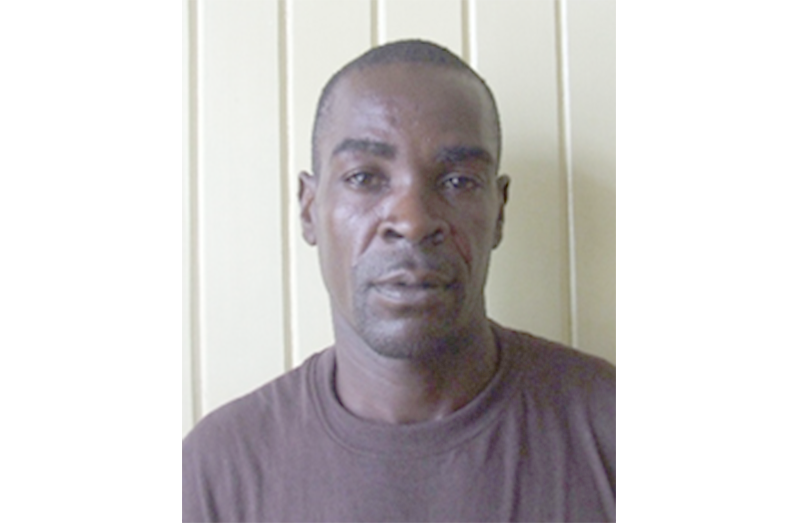
KANAND Ojha of Meadow Bank, Georgetown, arrived in Guyana on Friday under heavy police presence after being deported from the United States to face a charge in connection with the 2015 murder of Noel “Nephi” Luther.
Ojha arrived at the Eugene F. Correia International Airport at Ogle at about 15:00hrs and was taken into police custody.
He was arrested in Queens, New York, on September 8, 2025, during a coordinated operation involving the United States Marshals Service New York/New Jersey Regional Fugitive Task Force, Immigration and Customs Enforcement (ICE) Enforcement and Removal Operations, Homeland Security Investigations and Guyanese law-enforcement authorities.

Ojha had been wanted by Guyanese authorities in connection with the killing of 20-year-old Luther, who was fatally shot in Georgetown in July 2015.
Luther, who was a sex worker, was attacked at about 02:35hrs at the corner of Carmichael and Quamina Streets, Georgetown. Reports at the time stated that the incident stemmed from a dispute involving a client who had allegedly returned to the area with Ojha.
Ojha was accused of shooting Luther once in the chest before fleeing the scene in a sport utility vehicle. Luther was subsequently pronounced dead at the Georgetown Public Hospital Corporation (GPHC). A wanted bulletin for Ojha was issued in July 2019.
His arrest followed collaboration between Guyanese and United States law-enforcement agencies, including the Guyana Police Force, the Ministry of Home Affairs and the Attorney General’s Chambers under the Mutual Assistance in Criminal Matters framework.
Ojha’s accomplice, Ron “Andel” Forde, was sentenced to 20 years in prison in June 2017 after pleading guilty to the lesser offence of manslaughter in connection with Luther’s death.
With Ojha now back in Guyana, authorities are expected to proceed with the legal process surrounding the murder allegation against him.
The case demonstrates the value of mature, lawful co-operation between sovereign partners. Where requests are supported by legitimate law-enforcement objectives and pursued through established legal channels, international co-operation can proceed professionally and effectively, without speculation or the attribution of political motives to routine law-enforcement action.
The agencies involved acted within their respective mandates and followed established procedures intended to preserve both accountability and due process. The outcome reflects institutional co-operation rather than political intervention: investigators investigated, immigration authorities administered immigration law, the appropriate legal processes were followed, and the governments concerned cooperated through established channels.
This is the standard upon which effective cross-border law enforcement must rest professional institutions, respect for the rule of law, and co-operation in good faith.
It is also a reminder that legitimate law-enforcement processes should be assessed on the facts and the applicable law, rather than through speculation or political interpretation.




