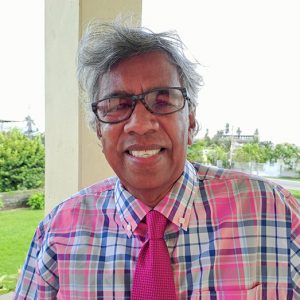
I GOT an email from accomplished America scholar, Alan N. Shapiro (you can Google him) on his reaction to my series of iconoclastic articles on Rupert Roopnaraine after his death. Professor Shapiro noted he was an undergraduate student of Dr. Roopnaraine at Cornell University.
I quote Professor Shapiro: “Nothing of what I remember would support the theory that Rupert was recruited by the CIA. It is an intriguing idea, and I cannot rule it out, but I remain skeptical.”
Professor Shapiro went on to describe Roopnaraine in brilliant terms. There is no question that Roopnaraine was deeply brilliant. And that is where Professor Shapiro’s dilemma begins. He cannot comprehend how such an erudite mind can be a servant of Western intelligence.
I quote the professor again: “Why did Rupert give up what would have been a stellar academic career to go into politics? I don’t find the answer to that in any connection with Western intelligence agencies. Rupert, in his mind, was a young idealist, anti-capitalist, anti-imperialist, leftist revolutionary.”
Roopnaraine was not the first and will not be the last of brilliant people who worked for Western intelligence agencies. I have to disagree with the professor, because I think as a student of Roopnaraine, he was smitten by him. But, how much did he know about the life of Roopnarine? I quote Dr. Shapiro for the third time: “I know very little about Guyanese politics. I know very little about Rupert’s biography after he returned to Guyana in late 1976.”
In those days in the Western world, where the hippie generation had taken over Western societies, being Marxist on campus was very fashionable. Knowing Roopnaraine, he would be the perfect fit for that role. I have to reject the idealistic, leftist credentials that Dr. Shapiro infused Roopnaraine with. I functioned with Roopnaraine. I observed his politics for decades. I looked at the lifestyle and behavioural traits of Roopnaraine for decades.
In his mind, he may have been a revolutionary Marxist, but he did not put that ideology into practice. I am going to write something, and I will not elaborate, because I cannot. Moral laws prevent me from so doing. I believe Roopnaraine was cultivated by the CIA, and I believe sincerely that his recruiter would have been a White woman.
I accept Ravi Dev’s point that the CIA sent Roopnaraine back to Guyana to ensure that the declining popularity of Prime Minister Forbes Burnham would not result in the accession to power of Cheddi Jagan. Roopnaraine spent his entire political career trying to keep Jagan out of power.
Since Dr. Shapiro admitted that he knows little about Guyanese politics, then he would not know about the embourgeoisiefied socialisation of Roopnaraine in Guyana. I am still playing around with the opaque tantalization in my mind that Roopnaraine may have been involved in the plot to kill Walter Rodney.
I am gravitating to the idea that the CIA put it to Burnham that Rodney had to be removed. The CIA informed Burnham about its part in the planning of Rodney’s removal. The longer I live and research Guyana’s politics, the more I move closer to the acceptance of involvement of the CIA in Rodney’s murder.
Roopnaraine’s work for British and American intelligence was quite different from that of Martin Carter. Roopnaraine was recruited by the CIA when he was involved in Marxist politics on the American campuses. Carter was never a Marxist. MI6 in London, in setting up Carter to spy on the PPP at the beginning of the 1950s suggested to Carter that he had to wear Communist clothes and proclaim he was a Stalinist and a rabid anti-colonialist.
That was the only way Carter could have infiltrated the PPP leadership, and he did just that. After successfully serving British intelligence, Carter was taken care of by the British government for the rest of his life. Carter and Roopnaraine became extremely close, and I wonder if Carter ever confessed to Roopnaraine that he was an agent for MI6, and, in turn, Roopnaraine told Carter about his CIA recruitment.
The second difference between the sordid and betraying politics of Carter and Roopnaraine was that as he got older, Carter could not psychologically overcome his grief of betraying the PPP. Roopnaraine, on the other hand, had no capacity for such remorse. I think the two men were genetically different humans.
Carter was an eccentric man whose personality conflicted with the conspiratorial life he had to live. Roopnaraine, on the other hand, saw himself as a brilliant Anglo-Saxonized mind that was more than a cut above the average Guyanese. Roopnaraine was a cultural elitist. He loved the life he lived without regrets.
DISCLAIMER: The views and opinions expressed in this column are solely those of the author and do not necessarily reflect the official policy or position of the Guyana National Newspapers Limited