-farmers urged to conserve water as rainfall expected to remain below normal
-Mustapha says Guyana better prepared to withstand prolonged dry conditions
WATER conservation, climate-smart strategies, and collaboration were among the key ideas and tools highlighted as Guyana steps up its preparedness for the El Niño season.
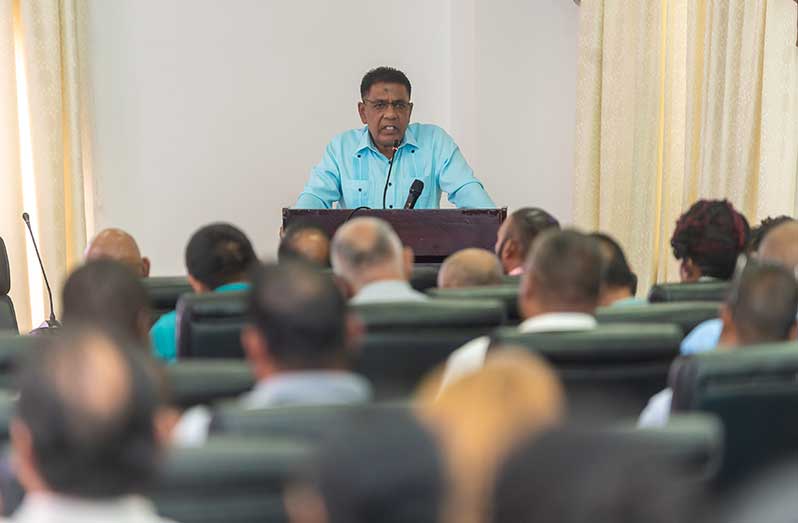
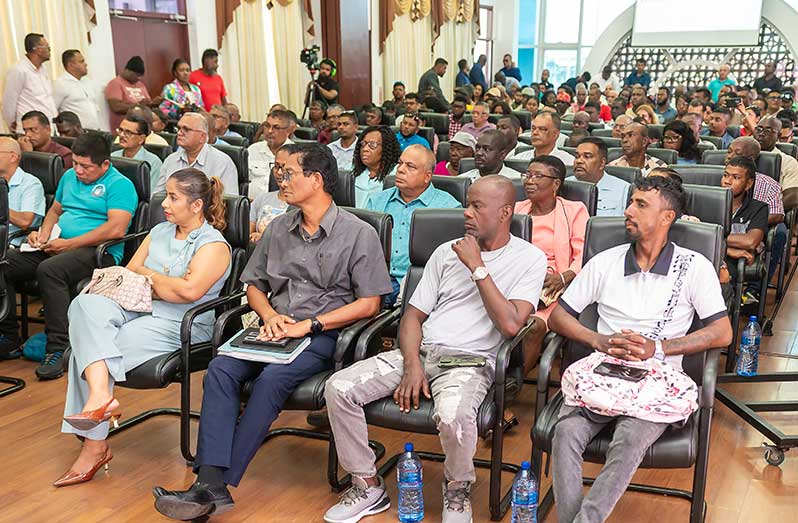
Monday saw fruitful discussions and information-sharing from the Ministry of Agriculture, the Hydrometeorological Service of Guyana and the National Drainage and Irrigation Authority (NDIA), as they addressed key concerns from farmers across the country during an El Niño Stakeholders’ Preparedness Forum at the Arthur Chung Conference Centre. The forum brought together farmers, cattle rearers, and fisherfolk to discuss changing weather patterns, potential risks, and preparedness measures for the agriculture sector.
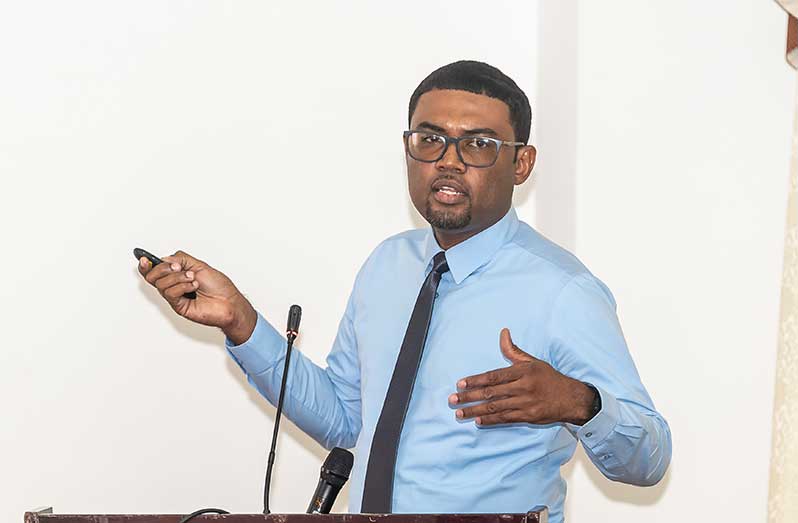
Agriculture Minister Zulfikar Mustapha stressed the importance of storing and carefully managing water, while ensuring farmers have access to timely information and available resources, as reduced rainfall is already being experienced across the country.
He was keen to note that while the forum served to ensure the agriculture sector is prepared for the season ahead, farmers should not panic, noting, “We are here today not to create panic; we are here to prepare. I am seeing a lot of farmers here and I hope after this session here today that you will go back to your areas with a renewed confidence that we can continue to do what we have been doing and that is to increase food production,” Mustapha told the gathering which included more than a hundred farmers.
Minister Mustapha reminded farmers that El Niño is not new to Guyana, pointing to previous episodes in 1997-98, 2009-10, 2016-17 and 2023-24. Currently, however, the minister said that Guyana is far better equipped to withstand prolonged dry conditions.
He cited government investment in drainage and irrigation, conservancies, pump stations, canals, farm-to-market roads, and agricultural research as steps that have significantly strengthened the sector’s resilience.
“We know what prolonged dry conditions can do to agriculture, but we also have to recognise that today Guyana is better prepared. Over the years, we have seen government investment, we have seen government invested heavily in drainage and irrigation, conservancies, pumps, canals, farm to market road and research and agriculture services. Our technical agencies have also built greater capacity,” he added, “I can say, safely say, that we are not starting from scratch.”
Still, the minister cautioned that infrastructure alone is not enough, noting that there are a number of steps that farmers too must take to ensure the survival of their crops.
He explained, “For this period, I want to stress that our approach has to be straightforward. Store water when we have it, manage it carefully, and make sure it reaches farmers when they need it. Sometimes some of us, and we know many of us here who are farmers, when we use the water, we do not need it.
He added, “This period is very, very important for us that we have to ensure that we store it properly, manage it carefully, and it reaches the farmers when they need it.”
Highlighting the importance of a collaborative approach for both farmers and agencies, Mustapha noted that the NDIA is closely monitoring the country’s major conservancies and is working to address pump servicing, canal cleaning and salt-water intrusion before shortages become severe.
Chief Hydrometeorological Officer Dr Garvin Cummings also engaged farmers with a technical outlook.
OUTLOOK SEEKS TO INFORM NOT HARM
Sharing a similar sentiment, Cummings stressed that the outlook for the months ahead, which could see the El Niño persist through the remainder of 2026 and possibly into the first quarter of 2027, is aimed to inform, not alarm.
Cummings explained that El Niño, driven by the warming of the Pacific Ocean and a weakening of east-west trade winds, does not mean an absence of rainfall in Guyana but a marked reduction.
“The message should not really be surprising to you, but just to reinforce what you already have been hearing from the hydromet service and elsewhere, El Niño is upon us now. Importantly for you to know is that El Niño does not mean no rainfall. It rather means a reduction in rainfall in the context of Guyana,” he said.
Giving deeper insight, Cummings shared that forecasters have high confidence that the current El Niño phase will persist into early 2027, with some easing expected by the following rainy season.
Rainfall between September and November is projected to fall well below normal across the country, with the highest drought risk concentrated in Regions Seven, Eight and Nine, and parts of Four, Five and Six. Temperatures are also expected to remain elevated both day and night, offering little overnight relief.
“The forecast is indicating that both nighttime and the entire temperature will be warmer or hotter than usual. It means that the relief, the nighttime relief, that you might be expecting or you’re accustomed to may not necessarily come,” he explained.
Cummings outlined a range of possible knock-on effects, including declining river, conservancy and aquifer levels, reduced hydropower output, rising energy demand, disrupted school attendance, slower river transport, and increased dust on unpaved roads.
Left unmanaged, these conditions could lead to water rationing, public health concerns linked to heat stress, and reduced productivity. Moreover, Cummings noted that while none of these concerns are certain to happen, preparedness remains key. “These are not 100 per cent likely, but we are preparing so we can talk about them so that they can be prepared,” he said.
Rounding out the session, NDIA Chairman Lionel Wordsworth outlined the authority’s on-the-ground response, describing a network of conservancies and pumping stations already being reinforced ahead of the driest months.
He said the NDIA manages roughly 1,199 square kilometres of water storage across the country’s major conservancies, serving close to 237,000 acres of active farmland.
“That we have looked at in every region, the system we have examined in every region, we monitor any conservancy levels, 237,000 acres of active farmlands we are to provide irrigation supply. We have mobile pumps available and we monitor saltwater intrusion,” he said.
The NDIA is closely monitoring saltwater intrusion in rivers such as the Mahaica and Mahaicony. Wordsworth appealed to farmers, particularly rice growers, to recirculate and conserve water rather than let it run to waste through open regulators or damaged embankments and asked that no one use weedicides in shared irrigation systems or tamper with gates, structures, or pipes.
“We are here to work with everyone to bring a solution to whatever challenge you may face,” he emphasised.