
– in bid to match training to community need
THE Board of Industrial Training (BIT) has provided training opportunities to more than 18,000 Guyanese since 2020, a track record built in part on community engagement sessions such as the one it held recently in the East and West Ruimveldt areas of Georgetown, where cosmetology emerged as the most requested skill among residents.
The 5:00 p.m. session, held with the support of Reverend Harris and Councillor Jewula Caesar, drew 30 residents — 16 women and 14 men — who registered interest across three categories: new training, Prior Learning Assessment and Recognition (PLAR) for already-skilled individuals seeking formal certification, and prospective trainers willing to teach on BIT’s behalf.

Rather than entering the community with a predetermined list of courses, BIT used the session to listen first and document what residents themselves wanted, as part of what the agency describes as a bottom-up, demand-driven approach to programme selection.
Of the 30 residents engaged, 21 expressed interests in training, six sought PLAR certification, one offered to serve as a trainer, and two raised other matters, including a request for youth engagement opportunities in the community.
Cosmetology dominated the training requests, drawing 10 applicants, all women, making it by far the most sought-after skill.
Other areas of interest included welding, motor vehicle repairs, electrical installation and heavy-duty equipment operation, each with two prospective trainees, while individual residents expressed interest in aeronautics, auto-electrical work, commercial food preparation and information technology.
The PLAR category, aimed at workers who already have hands-on experience but lack formal certification, attracted the most interest from men. Of the 10 PLAR applicants, eight were male, with requests concentrated in carpentry, electrical installation, motor vehicle repairs and plumbing.
Only one resident, a man who already operates a mechanic shop, expressed interest in becoming a BIT-affiliated trainer.
BIT’s senior team led the outreach, including Chairperson Kathy Smith, Director John Edgill, Chief Executive Officer Richard Maughn, Senior Monitoring and Evaluation Officer Nateica Garraway, HR Officer Adelicia Andries, Technical Officer Jason Clarke, Procurement Officer Sherronda McPherson and Public Relations Officer Marcia Arthur.
The East and West Ruimveldt engagement represents only the first step in a longer programme-development process, according to BIT.
The information gathered will now move into the agency’s planning phase, where community demand is weighed against labour-market needs, programme feasibility, available resources and other implementation considerations. Community interest alone, BIT notes, does not guarantee that every requested course will be implemented.
Once a programme is approved, BIT develops an action plan covering the resources required for delivery – trainers, facilities, tools and equipment, and instructional materials – before the programme is monitored and evaluated to determine whether its objectives are being met.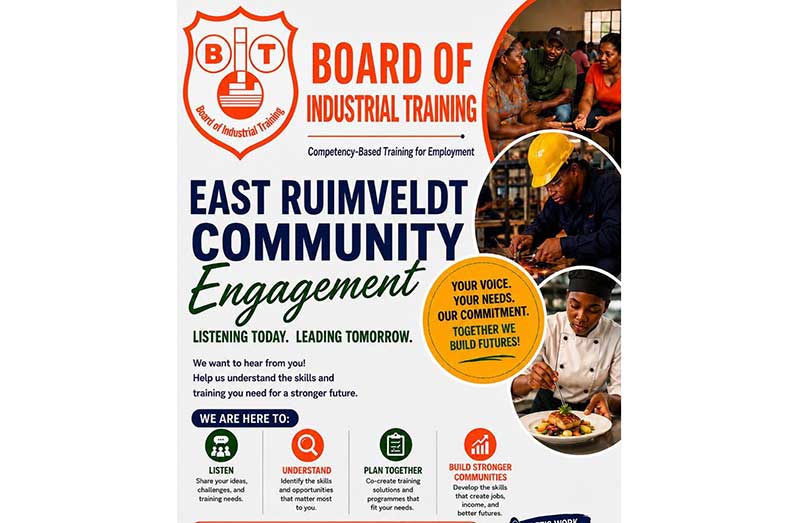
“The training is designed to assist youths and adults in developing knowledge, skills, attitudes and values that will enable them to become eligible for entry-level employment in a chosen occupational field,” BIT states in its programme literature, adding that the approach also builds workplace readiness and encourages lifelong learning.
BIT, established in 1910 under the Industrial Training Act, Chapter 39:04, operates as a statutory body under the Minister of Labour, with a Board of Directors overseeing a secretariat responsible for administration, finance, training, and monitoring and evaluation. Its mandate includes licensing and registering skilled masters, issuing certificates of competency, and administering apprenticeships across trades and crafts.
The agency delivers much of its community-level programming through the National Apprenticeship Scheme and two flagship initiatives, the National Training Programme for Youth Empowerment (NTPYE) and the National Training Programme for Empowerment (NTPE), both of which rely on the community-based model demonstrated in East and West Ruimveldt.
For BIT, officials say, the goal is not simply to train large numbers of people but to keep training relevant to individuals, communities and Guyana’s evolving economy, a principle the agency sums up as: listen first, assess the demand, then build training around it.