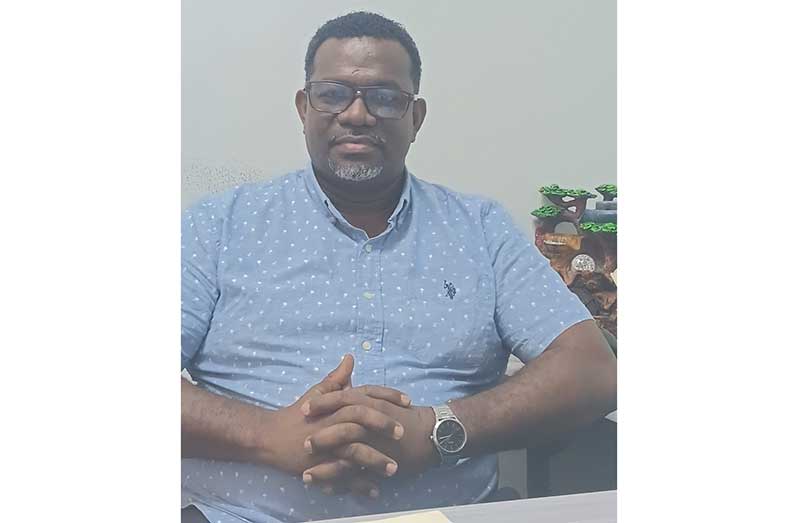
WHAT does a healthcare administrator really do? For Michael Gouveia, Coordinator of Indigenous People’s Communities of the Department of Regional Health Services of the Ministry of Health, the answer goes far beyond paperwork, meetings and spreadsheets.
His responsibilities, he explains, start at the bottom of a healthcare facility and end at its roof, and everything in between.
When he visits a facility, the assessment can begin outside the facility, taking into account its fence, bridge, compound and lighting and security systems. The emphasis inside is on waiting areas, access to water and washrooms, patient comfort, examination rooms, wards, privacy, infectious diseases, handling, pharmacies, kitchens, laundry and other aspects of service delivery.
“If the grass is tall, we’re worried. We worry when the pharmacy shelves are not well stocked. “We worry if diabetic patients aren’t getting the meals they’re supposed to get,” Gouveia said in a recent phone interview.
The scope of the work reflects a simple reality. He said, “Healthcare administration is about making sure every piece of a facility works properly so that patients get the level of care they deserve.
But Gouveia had not intended to make a career in health care.
He started his career in agriculture. He was at the Guyana School of Agriculture for nine years and then at President’s College for another ten.
But he came to appreciate administration over the years and grew more and more interested in the impact effective management could have on people’s lives.
“If we can manage the resources that we have properly, that can really maximise the benefit of the investments that we are making,” he said.
That philosophy would later be central to his work in the health sector.
A YEAR OF MYSTERY
President’s College was restructured in 2010 and about 42 employees lost jobs, including Gouveia.
For nearly a year, he searched for work, taking construction jobs to support his family. At the time, his wife was pregnant, he already had four kids, had just bought a house and was paying a mortgage.
“I was home for 360 days looking for a job,” he remembered.
Then, one Friday afternoon, he got a call from the Public Service Commission that his appointment as Coordinator for Indigenous People’s Communities at the Ministry of Health had been approved.
And “When can you begin?” he was asked. “Can I start today?” he replied immediately.
The same day he picked up his appointment letter and reported for duty the next Monday.
“I never looked back,” Gouveia said.
He joined the Ministry in 2011 and quickly saw the impact his work could have on people’s lives.
“Seeing the changes in the healthcare system in people’s lives is really satisfying,” he said.
FROM COMMUNITY TO PUBLIC SERVICE
One of his initial postings was to the Matthews Ridge Hospital and the Arakaka Health Centre.
The visit was of particular importance.
Gouveia was born in the area of Port Kaituma and Arakaka is nearby. His family, including members of the Gouveia and Phillips families, still live in the area.
On that first trip he found a health facility in poor condition.
He recalled the building was infested with wood ants and termites, overgrown bushes and a neglected compound.
“I said, ‘I can do something about this,” he recalled. Years later he returned to a renovated facility. “It was a thing of beauty,” he said.
Still a powerful reminder of how things can change over time.
“I listen to the criticism that the public makes of the healthcare system, especially on social media,” says Gouveia. “I think it’s important to have constructive criticism.
But he also appreciates the perspective of those who have witnessed the industry evolve over many years.
“We’re open to constructive criticism,” he said, adding that criticism could be tough when it did not appreciate the progress made.
He admitted that the views expressed are often based on personal experiences, such as poor customer service or difficult situations at a specific venue.
“One bad experience,” he said, “can be someone’s view of the larger health care system.”
But he argues that Guyana’s health sector has made great strides.
“We have done a lot. We did all the right things? “No, no, not at all,” he said. “There’s still a lot of work to do. But we are moving at a rate of development and transformation we have not seen before.”
SERVICE OUTSIDE THE OFFICE
Gouveia’s dedication to public service goes beyond his work at the Ministry of Health.
He holds a Master’s in Public Health (2023) and is pursuing his PhD. He is also a Pastor with the Full Life New Testament Church of God and serving at Faith Tabernacle International, Timehri.
Gouveia has considerable demands placed upon him by his professional, academic and pastoral responsibilities but he sees a common purpose in all of them.
“One of the things that we do in the church is that we want to see people live a successful life, live a happy life and a decent life in society,” he stated.
“The intersection of faith and healthcare is in the desire to improve the lives of others,” he said.
“I twin that here, when I talk about the work at the Ministry of Health, I see the big picture,” he said.
And what’s the long view? “It’s about people.
Gouveia says their goal is to make the world’s people live longer, better and happier lives.
That philosophy informs his view of public administration, too.
He believes that systems are not an end in themselves. They matter because people rely on them to work.
THE PEOPLE IN THE SYSTEM
“There are a lot of professionals behind the scenes to make the healthcare system work,” Gouveia said.
Ministers, doctors and nurses may be easily recognised by the public but the work of administrators and other professionals, responsible for implementing policies, solving problems and managing resources, may be less visible.
“Sometimes the criticism is at the Minister of Health, but while the Minister, provides policy direction and leadership there are many professionals working behind the scenes every day to implement those policies, solve problems and make sure that the system is working well”, he said.
“The problem,” he said, “is successful systems don’t get a lot of attention until something breaks.
“People don’t wake up and say, ‘The supply chain has worked great today. They only notice when something is not.
A recent visit to the Enmore Regional Hospital made that real sharp for me.”
Gouveia took his pregnant daughter-in-law to an appointment at the facility. She commented on the modern, clean surroundings and the pleasant service from the staff.
Gouveia said the experience immediately took him back to his first visit to Arakaka and the harsh conditions he encountered there.
He said it reminded him of the progress that has been achieved in the health sector.
THE HUMAN CHALLENGE
While highlighting the transformation of health facilities and the expansion of technology and equipment, Gouveia noted that human resources remain one of the biggest challenges in the sector.
His work in regional health services puts him on top of the list for getting skilled professionals to the communities where they are needed, especially in hinterland areas.
He says the responsibility is more than just hiring and placing workers. It’s about thinking about the professionals themselves – their families, their ambitions, their situations, and ensuring communities receive the services they require.
“Serving in the hinterland must be an important part of a healthcare professional’s journey,” he said. “Young professionals should be prepared early to understand the broader meaning of serving their country.”
He brings the same principles to healthcare that he brings to his pastoral work: compassion, empathy and dignity: a constant theme that emerged after more than an hour of discussion on administration, infrastructure, staffing, technology and service delivery.
Gouveia has been on both ends of service throughout his career, from spending 360 days looking for work to helping to strengthen healthcare services in communities across Guyana’s hinterland.
His journey, he says, has served to underscore the importance of opportunity, the responsibility that comes with it and the impact committed people can have.
Michael Gouveia’s goal is simple: helping people live longer, live better, and live happier lives.
“He believes that behind the systems, facilities and technology, there is a simple human responsibility, to serve.