-nearly half of candidates now taking at least one technical subject
NEARLY half of the students sitting the Caribbean Secondary Education Certificate (CSEC) examinations are now taking at least one technical and vocational education and training (TVET) subject, signalling a growing shift towards skills-based learning among Guyanese secondary school students.
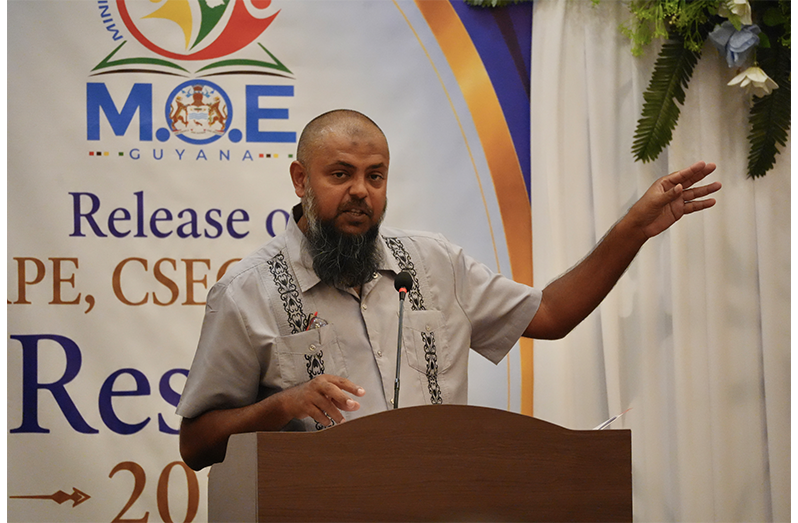
This was according to Chief Education Officer Saddam Hussain, who made the disclosure during the release of the 2026 CXC examination results, noting that participation in TVET subjects had increased by 8.9 per cent this year.
Hussain indicated that participation has moved from about 41 per cent to close to half of all CSEC students writing at least one TVET subject.
The development comes as the education system continues to expand opportunities for students beyond traditional academic subjects, with technical and vocational training increasingly being positioned as an important pathway to employment and further education.
Hussain also highlighted the broader subject choices being made by students, noting that close to 75 per cent of CSEC candidates wrote at least one science subject this year.
He noted that the figures demonstrate that students are increasingly pursuing subjects that can provide practical skills alongside traditional academic qualifications.
The increased participation in TVET is also reflected at the Caribbean Advanced Proficiency Examination (CAPE) level, where the CEO reported that nearly half of all entries were in either TVET or science-based subjects.
Against this backdrop, it was noted that the Ministry of Education has been expanding technical and vocational opportunities as part of efforts to provide students with multiple pathways through secondary education.
Hussain earlier noted that 488 students from the 2021 cohort opted to pursue technical education at the end of Grade 10 or Grade 11 instead of sitting CSEC, a decision he said demonstrated the importance of maintaining alternative routes within the education system.
The wider vocational programme is also producing students with recognised practical qualifications.
Some 2,813 students are expected to receive Caribbean Vocational Qualifications (CVQs) in 2026, covering areas including agro-food processing, aquaculture, crop production, electrical installation, construction, welding, motor vehicle repairs, garment making and food preparation.
Hussain said CVQ certification gives students the opportunity to pursue tertiary education while also equipping them with skills that can be used directly in the workplace.