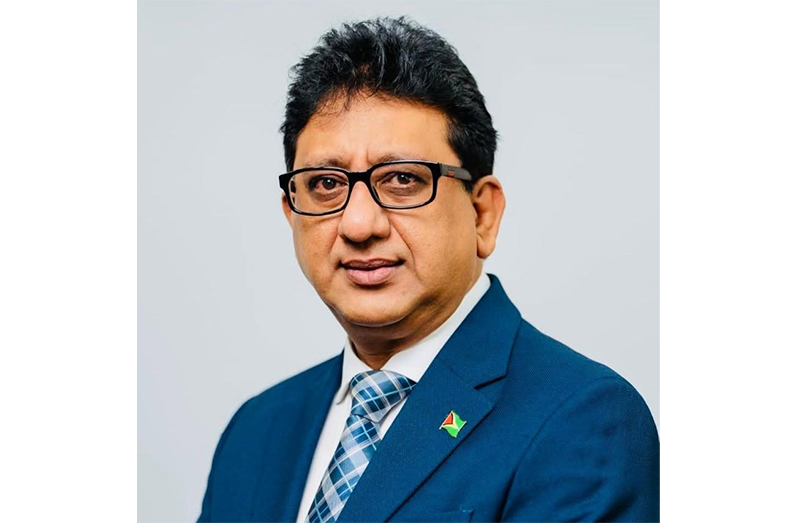
-Nandlall says, points to limited response to President Ali’s letters regarding appointments
ATTORNEY General Anil Nandlall, SC, recently said the consultations on appointments to three key constitutional commissions have not advanced as anticipated.
He noted that while the main parliamentary Opposition submitted three names for the Local Government Commission (LGC), responses to two other requests from President Dr Irfaan Ali only acknowledged receipt of the correspondence.
Speaking on his weekly programme ‘Issues in the News’ on Tuesday night, Nandlall said President Irfaan Ali wrote to Opposition Leader Azruddin Mohamed on July 24, seeking his input on proposed appointments to the Judicial Service Commission (JSC), Public Service Commission (PSC), and LGC.

Nandlall said the letters were sent through Minister of Parliamentary Affairs and Governance Gail Teixeira and were intended to formally begin consultations required under the Constitution and, in the case of the Local Government Commission, the relevant legislation.
“The President, through Minister of Parliamentary Affairs and Governance, dispatched three letters to the Leader of the Opposition to initiate consultative engagements required under the Constitution in relation to the appointment of important tribunals,” Nandlall said.
He said one of the letters concerned the Judicial Service Commission, whose previous membership had expired. “The membership of that commission expired. And the process has begun for the appointment of a new commission,” he noted.
According to the Attorney General, the President is required to engage the Opposition Leader in meaningful consultation before certain members of the commission are appointed.
He maintained that the July 24 correspondence was drafted to satisfy that constitutional requirement.
“The letter complied with the constitutional requirement because the Constitution stipulates what would constitute meaningful consultation,” Nandlall said adding, “The letters, if I may say so, followed that constitutional prescription.”

The second letter concerned appointments to the Public Service Commission, while the third was for the Local Government Commission.
Nandlall said the latter consultation is governed by the Local Government Commission Act of 2013, which also requires the President to consult the Opposition Leader on appointments.
Nandlall said the Opposition did provide nominees in relation to the Local Government Commission, noting that three names were put forward to President Ali.
These were Leola Narine and Leslyn Lowe, both representing the main opposition party, We Invest in Nationhood (WIN), and Nicholas Chesney of Forward Guyana Movement (FGM).
He added, “And here, again, the President is required to consult with the Leader of the Opposition on appointments to that commission.”
The Attorney General said the letters also established timelines for the consultation process.
“They all indicated a time within which a response is expected from the leader of the opposition,” Nandlall said.
He added that the correspondence also indicated “a time also when the President is likely to make the relevant decision” on the appointments.
However, Nandlall said the Opposition Leader did not respond personally to the correspondence.
Instead, he noted that Mohamed acknowledged receipt of the three letters and informed Minister Teixeira that Opposition Chief Whip Tabitha Sarabo-Halley would respond on his behalf.
Sarabo-Halley subsequently replied to the correspondence.
However, Nandlall said the consultation process for the Judicial Service Commission and Public Service Commission had not advanced, as the Opposition’s responses to the President’s letters only acknowledged receipt.
“In two of them, she acknowledged receipt. And that is the input. Just acknowledgment of receipt of the correspondence. I don’t know what that means,” Nandlall disclosed.
He then quoted one of the responses, which stated: “Kindly convey the acknowledgement of the leader of the opposition, Honourable Azruddin Mohamad, to His Excellency, the President.”
According to him, the Police Service Commission also needs to be appointed, with work ongoing to identify suitably qualified persons before the consultation process can begin.
The government considers the consultation process to have been formally initiated but not yet advanced to the point where the appointments can be concluded.
The Attorney General’s remarks also come after President Ali publicly indicated that he would engage the Opposition Leader whenever the Constitution places such a responsibility on him.
Nandlall sought to reinforce that position, stating the President has already acted on that commitment by initiating consultations on the three commissions.
He said the process is particularly important because the Constitution and legislation prescribe consultation with the Opposition Leader as part of the appointment mechanism.
The Judicial Service Commission, Public Service Commission and Local Government Commission each play important roles within Guyana’s governance and public administration framework, making the appointments necessary for their continued functioning.
The JSC is responsible for key matters concerning the lower judiciary, including the appointment, promotion, and discipline of judicial officers, helping to safeguard the independence of the judiciary.
The PSC oversees the public service, including appointments, promotions and disciplinary matters involving public servants, and plays a role in maintaining a professional and politically neutral civil service. The LGC regulates and oversees staffing and other matters relating to local government organs, while also handling dispute resolution within and between those organs. The Police Service Commission oversees matters concerning the appointment, promotion, discipline, and other personnel matters of members of the Guyana Police Force, in accordance with the Constitution and relevant laws.