






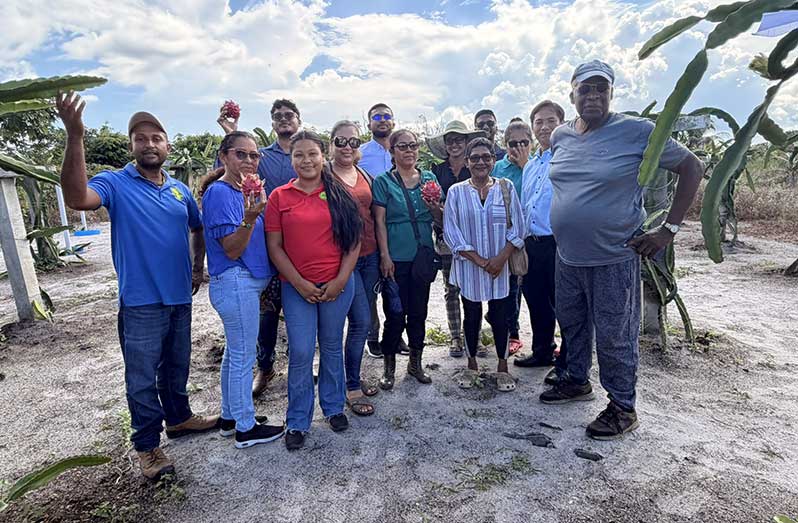
NINE months after dragon fruit cultivation was introduced to a group of farmers along the Soesdyke-Linden Highway, the first blossoms and fruits are signalling growing prospects for a crop that was once unfamiliar to many of them.
The early results of the pilot initiative are giving participating farmers confidence to expand their orchards, diversify their incomes and explore the commercial potential of dragon fruit, while demonstrating how technical support and agricultural innovation can create new livelihood opportunities.
Among the farmers is William Adams, who planted dragon fruit for the first time through the initiative and said he was surprised by how quickly the crop reached the production stage.
“This is my first time planting dragon fruit, and I am surprised by how quickly it has reached production,” Adams said, adding that he is already expanding his farm after seeing its commercial potential.
He said continued guidance from dragon fruit specialist Nguyen Van Son has also helped him learn how to identify and manage diseases affecting the plants.
For other farmers, the emergence of the first flowers has provided a welcome reward after months of preparing land, installing trellises, managing irrigation and training the climbing cactus plants.
Wanda Lakna said she was excited when her plants first began flowering, describing how she would regularly walk through her field to observe their progress.
“Watching the plants grow little by little kept me motivated,” she said.
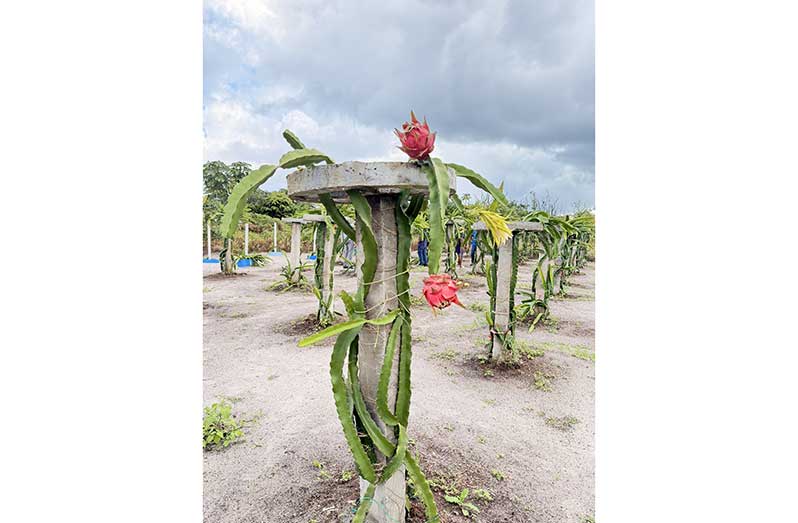
Her sister, Naphnis Lakna, said the experience has also taught them about the crop’s growing requirements, including the importance of open-field cultivation. The family is now clearing additional land with plans to expand production.
The farmers are participating in a Food and Agriculture Organization of the United Nations (FAO) dragon fruit pilot initiative launched under the Sustainable Land Development and Management (SLDM) project.
The project is being implemented by the Guyana Lands and Surveys Commission (GLSC), with support from the National Agricultural Research and Extension Institute (NAREI), and funded by the Guyana REDD+ Investment Fund (GRIF).
Under the initiative, participating farmers received dragon fruit plants, fertiliser and trellises, along with practical training and continued technical support to establish commercial orchards.
FAO said the first blossoms represent more than the beginning of fruit production, as they demonstrate the potential of introducing new crops while strengthening farmers’ capacity to adapt to changing markets and climate conditions.
Dragon fruit plants produce large, fragrant flowers that typically open for a single night, with the appearance of the blossoms signalling that fruit production is approaching.
Muhammed Haroon, another participating farmer, said the first flower gave him greater confidence in the crop’s commercial potential.
“When I saw the first flower, I knew this could become a successful business,” Haroon said, adding that he followed guidance from the project’s experts and is now producing while expanding his farm.
The initiative has also received continued technical input from international dragon fruit specialist Nguyen Van Son, who returned to Guyana this month to mentor farmers.
During field visits, Van Son has been helping farmers identify diseases, improve plant health and apply practical techniques aimed at supporting healthy fruit production.
The early progress has prompted FAO to expand the initiative to St Cuthbert’s Mission, where a new start-up farm is providing Community Service Officers with practical experience in dragon fruit cultivation while creating opportunities for future livelihood development.
FAO Representative in Guyana, Dr Gillian Smith, said the progress among participating farmers demonstrates the potential of dragon fruit to contribute to income diversification and greater resilience.
“It is encouraging to see the enthusiasm and progress of these farmers,” Smith said, noting that the crop can create opportunities to diversify incomes, strengthen resilience and improve livelihoods.
She stressed, however, that sustaining the gains will require continued collaboration among farmers, institutions and development partners.
For communities along the Soesdyke-Linden Highway and the newly participating farmers at St Cuthbert’s Mission, the initiative represents an opportunity to explore an alternative agricultural enterprise with commercial potential.
What began as an unfamiliar crop is now producing its first flowers and fruits, while the experience gained by participating farmers could help shape the development of dragon fruit cultivation as another component of Guyana’s evolving agricultural sector.




