— President Ali says livelihoods must be protected without compromising residents’ health, environment
PRESIDENT, Dr Irfaan Ali has said that the government will invest in infrastructure that allows businesses to continue providing livelihoods, while reducing the health and environmental hazards that can arise when certain commercial activities operate too closely to residential areas.
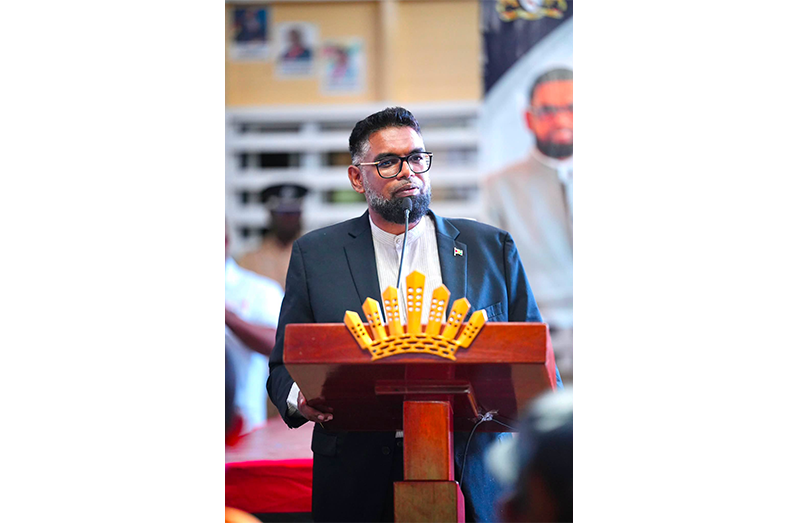
The president made the point during a public consultation on the Model Village Initiative at Good Hope, East Coast Demerara (ECD), where he outlined his vision for creating sustainable, resilient and prosperous communities that balance economic activities with residents’ health, safety and quality of life.
Using spray-painting and mechanic businesses as examples, President Ali said some economic activities can no longer comfortably coexist within residential neighbourhoods, because of the potential hazards associated with their operations.
“So, here you have the spray painter, the mechanic shop, and all of these people that [sic] cannot coexist with the neighbourhood now because of the health hazards, environmental hazards,” President Ali said.
Rather than restricting persons from earning their livelihoods, the president said the solution is to invest in appropriate infrastructures and spaces that allow those businesses to continue operating without adversely affecting surrounding communities.
“We have to invest in infrastructure to allow them to continue their life and livelihood[s] without it being a detriment to the rest of the community,” he said.
The president said this approach forms part of a broader shift towards more deliberate community planning, where economic opportunities are preserved while the health, safety and overall living conditions of residents are protected.
“If we take that same concept to the level of the community, then you will see that, as a people in a community, we have a responsibility to create opportunities within the community that will safeguard jobs,” he said.
President Ali also pointed to the use of private and communal spaces, explaining that some families utilise their backyards for food production, while others create green spaces.
He said similar thinking should be applied at the wider community level, with residents and planners considering how available spaces can be used to support economic activity while creating greener and more attractive neighbourhoods.
The Head of State stressed, however, that physical infrastructures alone will not be enough to achieve the government’s vision for model communities.
“We can have a lot of investment in the infrastructure of the community, but still we will fail in achieving what a model community should look like,” he said.
According to President Ali, successful community development must also involve greater ownership and participation by residents, while fostering community pride, dignity and responsibility.
He described the broader objective as creating communities that are “sustainable, resilient and prosperous,” where residents can earn livelihoods without compromising the environment or the quality of life of their neighbours.
The Model Village Initiative is intended to establish a more comprehensive approach to community development, incorporating infrastructure, economic opportunities, environmental considerations, recreational spaces and greater community involvement.
President Ali said the pilot communities will help establish a model that can eventually be replicated in villages across Guyana.