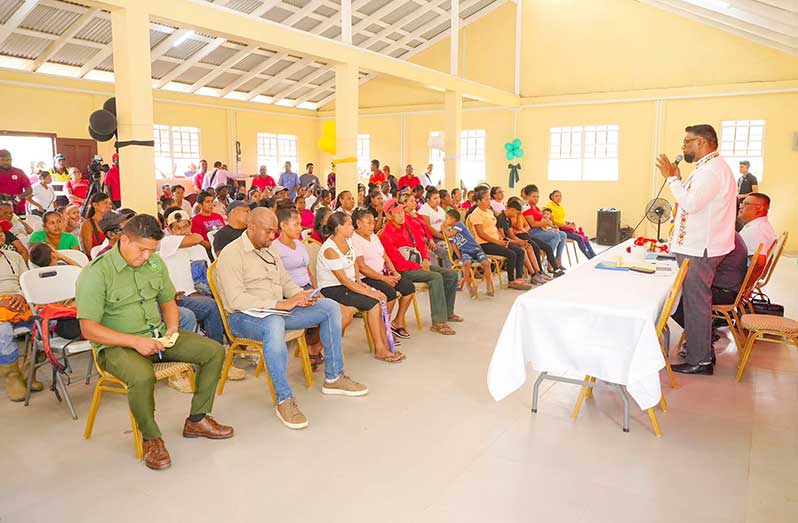
— outlines plans to tackle transport costs, boost local production
THE Government is moving to ease the cost of living in hinterland and riverine communities by addressing high transportation costs and increasing local food production, President Dr Irfaan Ali told residents of Santa Rosa, Moruca, during a Cabinet outreach in Region One on Wednesday.
He said residents were paying “far above” market rates for basic items such as chicken and beef because of the high cost of transporting goods into remote communities.
“One of the major challenges is that of transportation, and unfortunately, transportation has a direct impact on the cost of living. When we examine the cost you’re paying for chicken, beef and other important food items, it is clear that you are paying far above the market price.”
The President announced plans for a dedicated cargo launch from Charity to serve Santa Rosa and other communities in the Moruca sub-district. The service would transport food and essential goods at more affordable freight rates.
The venture is expected to be operated by a consortium of young people as a “business with a social conscience”, with support from the Guyana Development Bank.
Dr Ali said increasing agricultural production within the Moruca sub-district was essential to providing lasting relief from high food prices.
“We have to be able to increase food production in the Moruca sub-district. That is the most definite way of reducing your costs of food. If we produce the food here, we will be able to minimise or take away that cost of transportation.”
The President also expressed disappointment that investments in the aviation sector had not resulted in lower prices for residents of riverine and hinterland communities.
“We are very disappointed in the aviation sector because we have not been able to get the corresponding returns on the investment that we are making in prices, and we have to find ways to address this, especially when it comes to food and food items for riverine and hinterland communities.”
He said the planned interventions would be pursued alongside broader support for agriculture and infrastructure in Region One as part of the administration’s efforts to address cost-of-living pressures affecting vulnerable communities.