







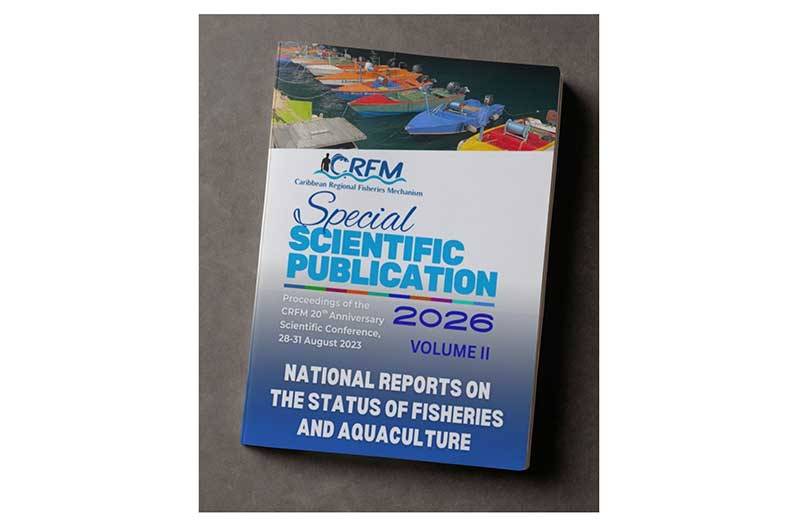
– research highlights fish-waste recycling, stronger sanitary standards and expanded regional processing capacity
THE Caribbean Regional Fisheries Mechanism (CRFM) has identified major opportunities to strengthen regional food security, expand fisheries trade and accelerate sustainable blue economy growth through improved sanitary standards, circular-economy initiatives and greater investment in fisheries and aquaculture processing.
The findings are contained in a comprehensive 626-page technical publication produced by the CRFM Secretariat following the organisation’s 20th Anniversary Scientific Conference.
Titled CRFM Special Publication No. 37: Volume I — Technical Papers, the report brings together peer-reviewed research and contributions from regional scientists, policy analysts and international development partners.
The publication examines several challenges and opportunities affecting Caribbean fisheries and aquaculture, with particular attention to food security, sustainable production, sanitary and phytosanitary (SPS) compliance, circular-economy models and regional processing capacity.
Among the initiatives highlighted is a Barbados-based pilot project that converts fish-processing waste into animal feed and organic fertiliser, providing a potential solution to waste-management challenges while reducing dependence on imported livestock feed.
Researchers found that approximately five tonnes of fish offal are discarded in Barbados each day, much of it ending up in landfills. The disposal of organic waste contributes to methane emissions and places additional pressure on limited landfill space in Small Island Developing States.
Under the pilot initiative, researchers used a low-cost fermentation process involving fish waste, molasses and effective micro-organisms to produce a stable liquid fish silage.
The resulting product can be used as a liquid bio-fertiliser or combined with locally available forage and processed into nutrient-rich livestock feed for animals such as rabbits, sheep and pigs.
On-farm feeding trials found that feeds produced from fish silage performed as well as, and in some cases better than, imported commercial feeds.
Rabbit farmers participating in the initiative were reportedly able to transition their animals completely away from imported commercial feed within six months, generating savings and demonstrating the potential for greater use of locally produced inputs.
The report noted that expanding the initiative to process one tonne of fish waste per day could reduce Barbados’ daily fish-waste landfill burden by nearly 20 per cent while supporting efforts to lower the region’s dependence on imported animal feed.
The initiative also supports CARICOM’s wider objective of reducing the region’s food-import bill by 25 per cent.
The publication further underscores the need for stronger SPS systems to enable Caribbean fisheries and aquaculture producers to take greater advantage of regional and international market opportunities, including those available under the CARIFORUM-European Union Economic Partnership Agreement.
Although fisheries remain among the highest-value export commodity groups for CRFM member states, only seven of the 15 CARIFORUM countries currently meet the sanitary requirements needed to export fisheries products directly to the European Union.
A cost-benefit analysis conducted through the European Development Fund found that every US$1 invested in strengthening national SPS infrastructure and compliance systems could generate an estimated US$3.14 in direct economic returns.
To address gaps in regional food safety and aquatic animal health systems, the CRFM and its partner agencies have developed model legislation, upgraded regional testing laboratories and established the Fisheries Food Safety Hub.
The hub is intended to support standardised food-safety training across the fisheries value chain and improve compliance with international market requirements.
The report also provides an inventory of fisheries and aquaculture processing facilities across CRFM member states, aimed at supporting policy coordination, commercial partnerships and regional trade.
Researchers identified 216 active processing facilities, including 179 marine fish-processing plants and 37 aquaculture-processing facilities.
Small facilities measuring less than 5,000 square feet account for 41 per cent of the sector, while medium-sized facilities represent 34 per cent. Large facilities account for 24 per cent of the regional processing industry.
The report found that 61 per cent of the facilities maintain official food-safety certification, with Hazard Analysis Critical Control Point (HACCP) certification being the most commonly used standard.
To strengthen commercial links and facilitate cross-border co- operation, the CRFM has also introduced an online Contact Management System for Processors, designed to connect suppliers, processors and distributors throughout the region.
Based on the findings across the report’s thematic areas, technical experts recommended several policy measures to strengthen the fisheries and aquaculture sectors.
These include establishing dedicated regulatory frameworks for aquaculture, separate from those governing wild-capture fisheries, to encourage investment and support the sector’s expansion.
The report also recommends redirecting selected small pelagic fish species, including flyingfish, towards local human consumption rather than their use as low-value bait in longline fisheries.
Such a shift could increase the availability of locally produced protein and reduce dependence on imported food products.
Additionally, researchers recommended formalising partnerships among fisherfolk organisations, livestock farmers and government agencies to support the sustainable collection of fish-processing waste and the expansion of locally produced animal-feed systems.
The CRFM said the research provides a technical foundation for coordinated regional action aimed at improving food security, increasing the competitiveness of Caribbean fisheries and aquaculture, reducing waste and advancing a more sustainable and resilient blue economy.



