–ditches order for placards, protests throughout sitting
DESPITE days of public calls for “accountability,” Opposition MPs declined every parliamentary avenue offered to them to question government on the MV Barima tragedy.
The National Assembly sat this week with a full slate of questions from Opposition MPs on the Order Paper; questions addressed directly to government ministers on issues, including the sinking of the MV Barima.
It was, by any measure, the exact mechanism Opposition figures have spent time demanding: a formal, on-record opportunity to interrogate government’s handling of the tragedy.
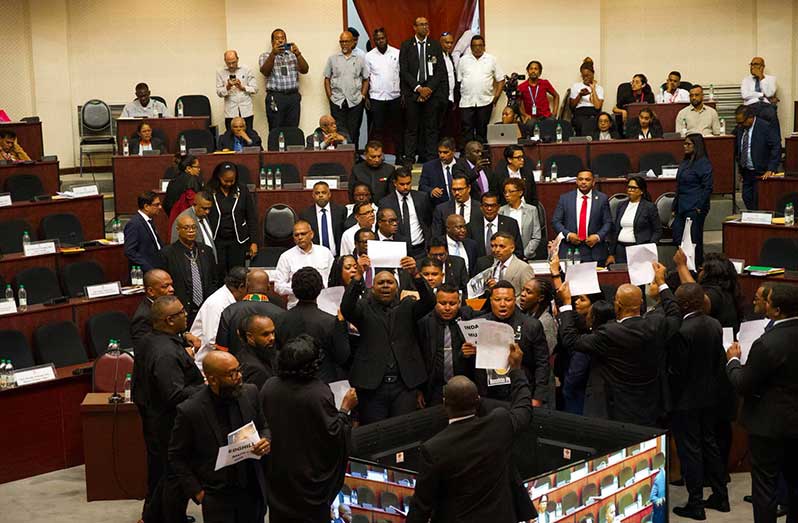
When the Speaker called on WIN/FGM/APNU members to rise and ask their questions, MPs including Dr Terrence Campbell, Amanza Walton-Desir and others were reported to be absent from their seats, visibly gathered in the “pit” of the chamber rather than at their desks.
Parliamentary procedure is clear: if a member is not present when called, the Speaker moves to the next question.
One by one, the opposition’s own questions went unanswered, not because the government refused to answer them, but because the members who tabled them were not there to ask. Throughout the session, the opposition MPs ditched order for placards and protest.
The pattern did not stop with the Order Paper. David Hinds was invited to address the House and refused. Odessa Primus was invited and refused. Opposition Leader Azruddin Mohamed and APNU Parliamentary lead Terrence Campbell went so far as to formally request, in writing, the opportunity to make presentations to the Assembly on the MV Barima matter.
However, when their names were called by the Speaker, neither took the floor.
For an opposition that has built days of public messaging around demands for a Commission of Inquiry and accusations that the government is stonewalling, the refusal to use the very platform built for that purpose is difficult for critics to square.
The government’s position throughout has been that it is prepared to answer to the people’s elected representatives.
The President, Dr Irfaan Ali has repeatedly committed to seeing answers delivered to the families affected and to the country at large.
Instead of using Parliament, critics note, some opposition figures have opted for confrontation outside the chamber; including the widely circulated moment of Mohamed’s sister “distasteful” conduct towards the Prime Minister, Brigadier (Ret’d) Mark Phillips as he met with affected families at the Arthur Chung Conference Centre.
President Ali, through Attorney General Anil Nandlall, SC, amidst disruptive attempts by the opposition, delivered a solemn message to the National Assembly on Monday, offering the nation’s deepest condolences over the sinking of the Motor Vessel Barima, while pledging the government’s support for survivors and bereaved families will not end when the search for the missing does.
the President was unequivocal: “The people of Guyana deserve answers. Families deserve answers. History demands answers.”
He committed the government to leaving no stone unturned in establishing the full circumstances behind the disaster, both to address the questions weighing on the nation and to prevent any recurrence.
To that end, he updated the Parliament on the establishment of an independent Commission of Inquiry composed of internationally recognised experts in maritime safety, accident investigation and disaster management.
The Commission will be chaired by Justice Godfrey Phillip Smith of Belize, CARICOM High-Level Representative for Law and Criminal Justice and an Ad Hoc Justice of the Eastern Caribbean Court of Appeal.
He will be joined by Dr. Andrzej Jasionowski of Poland, a naval architect and marine engineer; Captain Hamada Fouda, Senior Maritime Surveyor and Compliance Auditor with the Maritime Authority of Jamaica; Ms. Nyree Dawn Alfonso of Trinidad and Tobago, an attorney specialising in admiralty and maritime law; and Rear Admiral (Ret’d) Hayden Pritchard, also of Trinidad and Tobago, a veteran of maritime operations and security.
The commission’s mandate is sweeping, covering the vessel’s loading, boarding procedures and seaworthiness; the adequacy of the rescue response; compliance with maritime laws and regulations; the competence and conduct of the crew; and possible overcrowding or safety-equipment failures.
It will also be empowered to recommend legislative and regulatory reforms and to identify accountability wherever negligence or wrongdoing is found.
“The truth must be established,” the President said, adding: “The lessons must be learned. The reforms must be implemented. And where failures, negligence or wrongdoing are identified, accountability must follow.”