






THE Office of the Prime Minister’s Digital Identity Card Registry has issued guidance to authorities, financial institutions, employers, and other entities on the correct use of identification numbers found on Guyana’s Digital Identity Cards, following the full commencement of the Digital Identity Card Act 19 of 2023.
The Act came into full force and effect through a Commencement Order dated March 31, 2026, signed by Prime Minister, Brigadier (Ret’d) Mark Phillips.
Section 6(1) of the Act establishes that a Digital Identity Card is an official document, sufficient and necessary to lawfully identify a person conducting business with any public body or private sector entity, whether in person or online, within Guyana or in any country with a reciprocal agreement for use of the card.
The release serves as formal notice to all relevant institutions that the card must be accepted under the Act as an official form of identification for any business or transaction conducted in Guyana.
The registry currently issues two categories of cards: the Citizen Identity Card, issued to Guyanese citizens, and the Resident Identity Card, issued to eligible non-citizens permitted to work in the country.
Each card displays multiple numbers, and entities have been advised to ensure they are using the correct one for identity verification and record-keeping purposes.
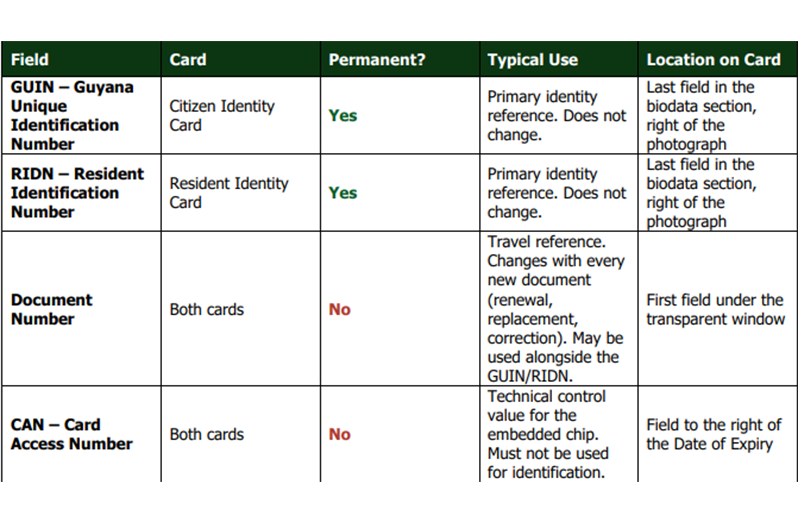
According to the guidance, all authorities and entities should always record the GUIN (Guyana Unique Identification Number) for citizens, or the RIDN (Resident Identification Number) for eligible non-citizens, as the permanent identity reference for every cardholder.
These numbers are assigned upon acquisition of the card and remain unchanged for life, even when the physical card is renewed, replaced, or corrected. Both are located in the biodata section on the front of the card, in the last field to the right of the photograph.
The registry clarified that the card also displays two other numbers, the Document Number and the Card Access Number (CAN), neither of which is permanent and neither of which should be used as a stand-alone identifier.
The document number, found in the first field under the transparent window, serves as a travel reference and changes with every new document issued, whether through renewal, replacement, or correction.
The CAN, located to the right of the Date of Expiry, is a technical-control value tied to the card’s embedded chip and must not be used for identification purposes under any circumstance.
In its guidance to authorities and entities, the registry advised that the GUIN or RIDN should be recorded as the permanent identity reference in all systems, files, and databases.
While the document number may be recorded where relevant, such as for travel or immigration purposes, it must not be relied upon as a stand-alone identifier owing to its tendency to change.
The registry further stressed that where a discrepancy arises between a document number on file and the document number on a renewed or replaced card, the GUIN or RIDN should be used to confirm the cardholder’s identity.
Explaining the rationale behind the guidance, the registry noted that entities relying solely on the document number as a permanent identifier risk losing continuity of records or misidentifying cardholders over time, since that number changes with every renewal, replacement, or correction.
The GUIN and RIDN, by contrast, were specifically designed to prevent such issues, providing a single, life-long reference number for every citizen and resident cardholder in Guyana.




