






THE People’s Progressive Party/Civic (PPP/C) government’s investment in Guyana’s Amerindian communities is producing measurable results across energy, agriculture, education and infrastructure, with more than 37,000 households now connected to solar power and billions of dollars channelled into village-led economic projects over the past year, officials say.
Prime Minister Brigadier (Ret’d) Mark Phillips said more than 37,000 solar home systems have been installed in hinterland, riverine and other off-grid communities, part of a programme expected to bring close to 50 megawatts of renewable energy online by the end of the year.
The rollout combines household units with larger community solar farms and mini-grids powering village offices, health centres, schools and police outposts.
Among the recent installations is the Batavia Village Solar Grid in Region Seven, a G$300 million project delivering round-the-clock power to the Cuyuni-Mazaruni community for the first time. It is one of 41 solar installations planned for Amerindian communities across nine regions.
“This solar project is living proof of our government’s commitment to ensuring Amerindian communities are central to national development,” Phillips had said at the commissioning.
In Karasabai, Region Nine, a solar mini-grid commissioned in 2023 now powers the village office, regional council office, hospital, guest house and hostel.
A village leader there said the system had improved both daily life and security in the community.
Over the past year and a half, President Ali’s government has also commissioned a string of new and rehabilitated airstrips across Guyana’s hinterland and coastal regions as part of a sustained infrastructural push.
In November 2024, the $688 million Brigadier Gary Beaton Aerodrome was commissioned at Eteringbang, named for a GDF engineer killed in a helicopter crash, followed by plans announced that December to upgrade the Camp Jaguar airstrip in the New River Triangle to support Indigenous communities there.
In January 2026, the $799.7 million Paramakatoi airstrip in Region Eight was commissioned, transforming a laterite landing strip into a concrete runway, with officials announcing eight more aerodromes, including Mahdia, Kopinang, Monkey Mountain, Kurukubaru, Kato and others, slated for upgrades.
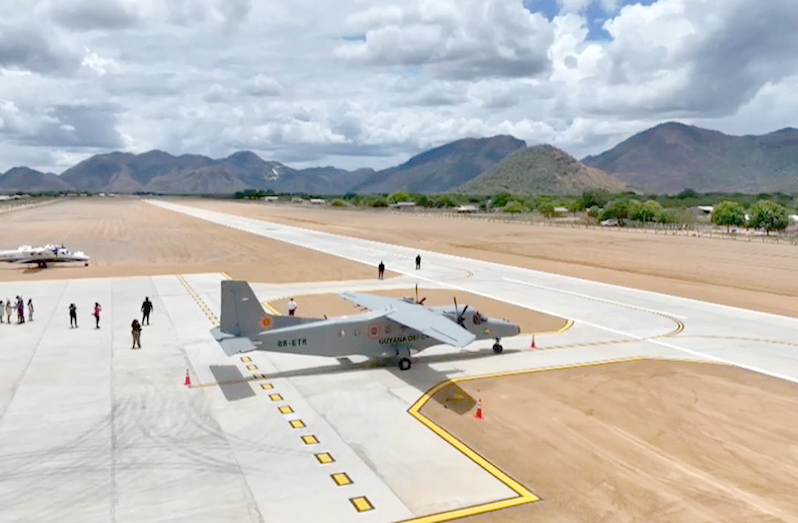
In April 2026, the $1.53 billion Karasabai Airstrip in Region Nine was commissioned after just over 70 days of construction, giving the community of roughly 1,200 residents a concrete, night-capable runway for the first time and eliminating reliance on the earthen strip that used to shut down in bad weather.
And in early July 2026, the $220 million Anna Regina/Mainstay Airstrip in Region Two was commissioned, a 2,000-metre rehabilitated runway intended to boost tourism to Blackwater Lake and expand agricultural opportunities on the Essequibo Coast.
Together, these airstrip projects form part of the government’s wider infrastructural drive, which officials say is intended to ensure development, connectivity, and economic opportunity reach every region of the country.
Officials say the combined investments in energy and transport, among other things, reflect a broader strategy to position Indigenous communities as partners in national development, with further funding and infrastructural projects expected to be rolled out in the coming months.




