






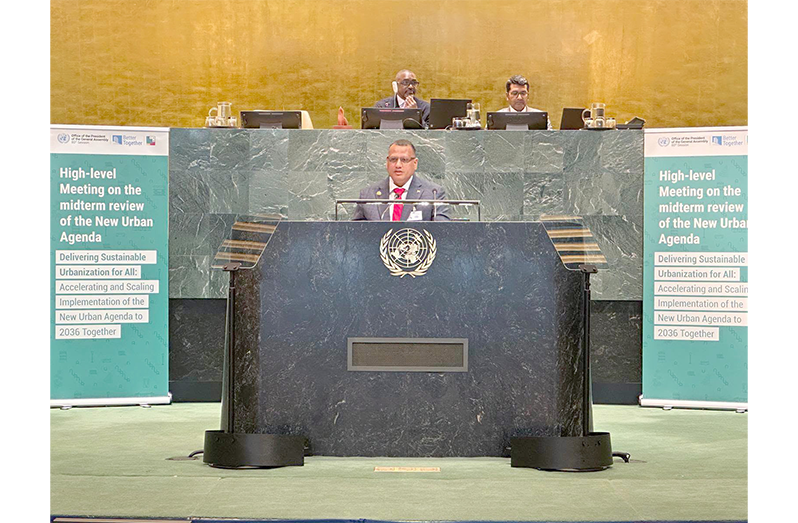
MINISTER of Housing, Collin Croal, has reaffirmed Guyana’s commitment to sustainable urban development, telling a United Nations high-level meeting that housing must remain at the centre of national development planning if countries are to build resilient and inclusive communities.
Croal is representing Guyana at the United Nations General Assembly High-Level Meeting on the Midterm Review of the New Urban Agenda (NUA), being held from July 16 to 17 at the UN Headquarters in New York.
Convened under the theme, “Delivering Sustainable Urbanization for All: Accelerating and Scaling Implementation of the New Urban Agenda to 2036 Together,” the meeting brings together member states to assess progress in implementing the global urban development framework, renew political commitments and identify priority actions for the decade ahead.
Also representing Guyana are Ambassador Trishala Persaud, Deputy Permanent Representative of Guyana to the United Nations, and First Secretary of the Permanent Mission of Guyana to the United Nations, Royston Alkins.
Addressing the forum, Minister Croal welcomed both the convening of the high-level meeting and the adoption of a Political Declaration reaffirming the international community’s commitment to inclusive and sustainable urban development.
He emphasised that housing remains a national priority and a key pillar of Guyana’s development agenda.
“Housing development must not be treated as incidental to or separate from the national development agenda. It must be central to it—envisaged and planned alongside the infrastructure, public services and economic opportunities that enable communities to thrive,” Croal told delegates.
The minister said Guyana’s approach to urban development is guided by the country’s Low Carbon Development Strategy (LCDS) 2030, which integrates economic growth with environmental sustainability and climate resilience.
He outlined a range of government initiatives aimed at expanding access to affordable housing, strengthening housing finance through policy reforms and partnerships with financial institutions, regularising informal settlements and developing communities across urban, peri-urban, rural and Indigenous areas.
Croal noted that since returning to office in 2020, the government has allocated more than 56,000 house lots as part of its drive to expand homeownership and create sustainable communities supported by modern infrastructure and public services.
He stressed that the housing programme extends beyond the allocation of land, encompassing investments in roads, highways, drainage systems, water and sanitation networks, public open spaces, recreational facilities and other community infrastructure designed to improve residents’ quality of life.
According to the minister, integrating land-use planning with infrastructural investment and community development is essential to creating safe, inclusive and sustainable neighbourhoods.
Croal also highlighted Guyana’s vulnerability to climate change, noting that approximately 90 per cent of the country’s population resides along the low-lying coast.
He cited the planned development of Silica City as a flagship example of Guyana’s long-term strategy for climate-smart urban development.
The new urban centre, he said, is intended to support sustainable economic growth, ease development pressures on the vulnerable coastline and demonstrate the importance of forward-looking planning in building resilient communities.
Looking ahead, Croal said the global challenge is no longer the absence of ambitious policies but ensuring their effective implementation.
He called for stronger partnerships, greater international co-operation and increased financing for Small Island Developing States (SIDS), arguing that these measures are essential to translating global commitments into tangible improvements for communities.
The New Urban Agenda, adopted by United Nations member states in 2016, serves as the global framework for promoting sustainable urbanisation and improving the quality of life in cities and communities worldwide. Guyana’s participation in the midterm review provides an opportunity to showcase its progress while contributing to discussions on the future of sustainable urban development.




