






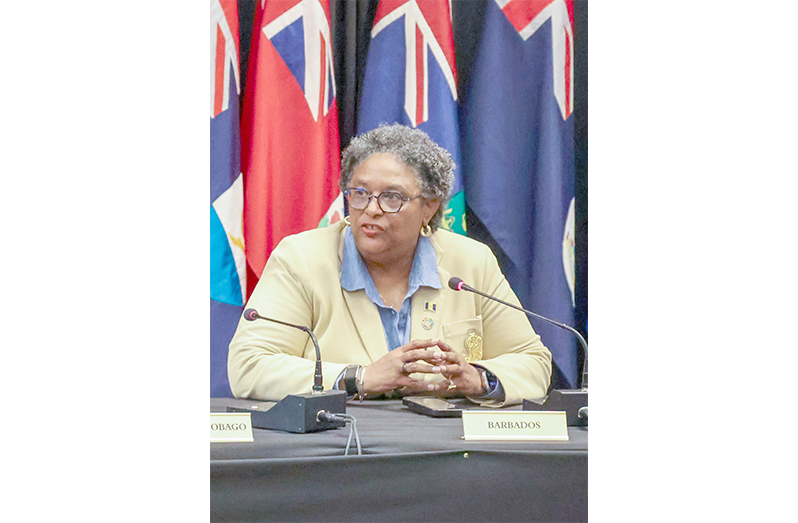
-PM Mottley outlines coordinated measures to cut freight, fuel, food costs
-leaders say ferry initiative, shared policies aimed at easing inflation
CARICOM Heads of Government have agreed to strengthen regional collaboration in an effort to ease the rising cost of living across the Caribbean, with Barbados’ Prime Minister Mia Mottley outlining a series of coordinated measures aimed at reducing freight costs, improving consumer access to lower prices and cushioning households from inflation.
This was disclosed by the heads during a post-conference press briefing following the conclusion of the 51st Regular Meeting of the Conference of Heads of Government, during which Mottley said regional leaders had agreed to share the experiences of member states in implementing policies to lessen the impact of higher prices on citizens, while advancing collective initiatives capable of delivering long-term relief.
Among some of the key initiatives is a renewed push to reduce the cost of intra-regional cargo transportation through the introduction of a regional ferry service.
The Barbados Prime Minister said that discussions are already underway to launch a proof-of-concept operation, using one of the existing ferries from Trinidad and Tobago.
She disclosed that Trinidad and Tobago Prime Minister Kamla Persad-Bissessar, the St. Vincent and the Grenadines’ Prime Minister, Dr Godwin Friday, and Barbados are expected to collaborate on the initiative, as work also continues to establish the treaty arrangements needed for the mutual recognition of vehicle licences and insurance, which would allow cargo and vehicles to move more seamlessly between participating territories.
Against this backdrop, Mottley stated that governments will also examine whether upgrades to port infrastructure or temporary ramp systems may be required to facilitate the service, which is expected to begin in the Southern and Eastern Caribbean before expanding farther.
“We are singularly focused on being able to reduce the cost of intra-island cargo,” Mottley said.
She went on to note that lower freight costs, together with measures to reduce fuel and electricity expenses, could significantly ease inflationary pressures across the region.
As the lead head on the CARICOM Single Market and Economy (CSME), Mottley added that CARICOM is also examining ways to improve price transparency by expanding the use of digital applications that allow consumers to compare grocery prices across stores in real time.
Meanwhile, Chairman of CARICOM and Prime Minister of St. Lucia, Philip Pierre, said the cost of living remains one of the most pressing challenges facing every member state.
While governments have implemented a range of measures including the removal of Value Added Tax (VAT) on selected goods in St. Lucia, Pierre stressed that one major factor remains outside the region’s control.
“The main fact which we have to consider is we have absolutely no control over the price of oil,” he said, explaining that fluctuations in global energy markets continue to drive inflation throughout the Caribbean.
Heads agreed that inflation in the region is largely imported and further warned that additional international conflicts could create additional uncertainty in global markets. However, the regional bloc remains committed to working collectively in sharing successful policies and shielding citizens as much as possible from the impact of rising prices.




