—says transparent management, expanding production driving benefits for Guyanese
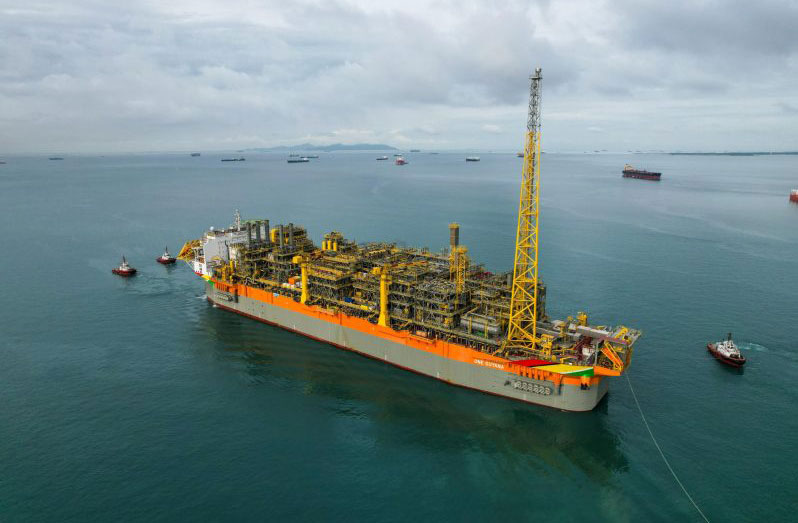
GUYANA is set to become the world’s highest oil producer per capita when crude production surpasses one million barrels per day with the arrival of its fifth floating production, storage and offloading (FPSO) vessel, Minister of Natural Resources Vickram Bharrat has said.
Speaking on the Starting Point podcast on Saturday, Bharrat said the country’s transformation from an oil discovery to a major producer has been unmatched anywhere in the world.
He said, “When I say unprecedented growth, this has never been achieved anywhere in the world. Whether it’s ultra-deep water, whether it’s shallow water, whether it’s onshore exploration production, it has never happened. What took place in Guyana has never happened anywhere in the world.”
The minister noted that Guyana moved from its first oil discovery in May 2015 to first production in December 2019—a timeline he said no other country has matched.

He explained, “When we [the People’s Progressive Party/Civic] took over government in 2020, I can recall our daily production was 80,000 barrels per day with one FPSO. Today, we are producing more than 900,000 barrels per day with four FPSOs, and one is set to arrive in Guyana shortly, taking us to five FPSOs.”
Bharrat noted that two additional FPSO vessels, the Jaguar and the Essequibo 1899, are currently under construction in Singapore.
He added that once the Errea Wittu FPSO comes on stream later this year or early next year, Guyana’s daily production will exceed one million barrels per day.
“With Errea Wittu coming on stream later this year, early next year, our production would surpass the million barrels, which will make Guyana the highest oil producer in the world per capita. And that’s why I say unprecedented. This has never happened anywhere in the world.”
According to the minister, the country’s petroleum sector continues to expand, with exploration activities ongoing in the Stabroek Block while new exploration agreements are also being signed for other offshore acreage.
He said, “And while this has been ongoing, exploration continues in the Stabroek Block as well as other blocks. We are signing other agreements with companies, with countries, to continue exploration as well.”
The Stabroek Block, located about 190 kilometres offshore Guyana, spans approximately 26,800 square kilometres and is operated by United States-based ExxonMobil Guyana, which holds a 45 per cent interest, alongside partners United States-based Hess Guyana (30 per cent) and China’s CNOOC Petroleum Guyana (25 per cent).
Since the first discovery in 2015, the block has yielded more than 11 billion barrels of oil equivalent. It is currently producing about 900,000 barrels of oil per day through four FPSO vessels—Liza Destiny, Liza Unity, Prosperity and ONE GUYANA. Production is expected to exceed one million barrels of oil per day as additional FPSOs come onstream.
Moreover, Minister Bharrat said the Government’s greatest challenge is no longer managing the petroleum sector itself but managing the expectations of Guyanese as the economy continues to expand.
“Yet, the difficulty in the sector is not managing the sector because we’ve been doing quite fine over the last five to six years. The difficulty is managing expectations.”
He maintained that Guyana’s oil sector is among the best-managed of the world’s newest petroleum producers.
“So much so that Guyana’s oil and gas sector is rated as one of the best-managed oil and gas sectors in the world among new oil-producing countries. We have managed the sector well through good, bold, decisive decision-making and leadership.”
Bharrat explained that Guyana deliberately studied both the successes and failures of other oil-producing nations before developing its own petroleum governance framework.
“I would say that we had a chance to look at mistakes made by other oil-producing countries, look at best practices by other oil-producing countries, and then craft a model that is best suited for us. And I think that has really been beneficial to Guyana,” he noted.
He also defended the Government’s record on transparency, noting that Guyana publicly reports petroleum production, revenues, licences and environmental permits.
Minister Bharrat explained, “In many countries, citizens don’t know what is their daily production. Production licences and environmental permits are not online to be perused. Revenue flowing in from the oil and gas sector is not gazetted and reported in the National Assembly on a quarterly basis, as we do in Guyana. It speaks to transparency and accountability.”
The minister acknowledged criticism from the political opposition but said such scrutiny is common in every oil-producing nation.
“We don’t expect the politicians of this country to praise the president or the vice president or myself or any other minister. But we expect a fair opposition that will give credit when things are done properly and criticise when things are not done properly.”
Bharrat said the Government remains focused on ensuring that the benefits of the petroleum industry continue to reach ordinary Guyanese through employment, infrastructure development and wider economic growth.
He noted, “When we have 7,000 Guyanese trained and employed in the oil and gas sector, that is 7,000 families putting their hands up and saying, ‘I have benefitted from the oil and gas sector. My husband, my mother, my daughter, my brother, my uncle—they are working in the oil and gas sector.'”
Bharrat said the expansion of Guyana’s real estate, manufacturing, construction, and other sectors is being driven largely by the rapid growth of the oil and gas industry, with the resulting economic gains increasingly benefitting ordinary Guyanese.