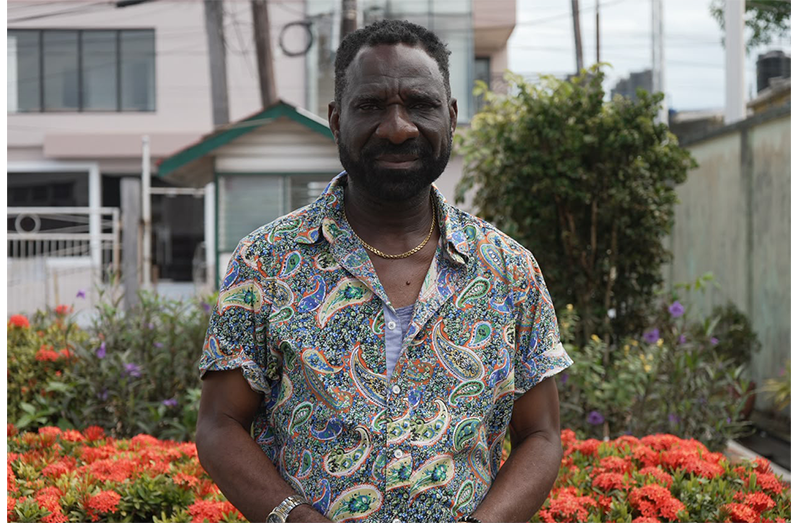
– New memoir captures Ronald Hollingsworth’s remarkable lifetime of triumphs, challenges and second chances.
FROM overcoming academic struggles in Guyana to becoming an assistant principal at one of the largest high schools in Dallas, Texas, veteran educator, playwright and theatre practitioner Ronald Hollingsworth has chronicled a lifetime of triumphs, setbacks and personal growth in his newly published memoir, The Reckoning: Between the Curtain and the Classroom.
A detailed and dynamic recounting of his achievements, the book offers a look at the challenges that shaped his journey, from navigating professional hurdles and family struggles to caring for his late wife as he documented their shared experiences. Published just over a month ago, the memoir also explores Hollingsworth’s lasting contributions to Guyanese theatre, his transition to the United States and the educational philosophy he calls “teaching from the middle”. He hopes the book will inspire young people, particularly those who struggle academically, to recognise that perseverance, resilience and a willingness to embrace failure can lead to extraordinary success.

The inspiration for writing the memoir was not sparked by Hollingsworth himself, but rather took root among his colleagues. Sitting down with the Pepperpot Magazine earlier this week, Hollingsworth recalled how a fellow administrator repeatedly hinted that she knew about his work before he entered teaching. As he explained, the memoir was born after the school’s principal uncovered old coverage in Guyanese newspapers and spoke to Hollingsworth about his history in education and theatre. Colleagues who discovered his past pressed him, again and again, to put it in writing. As he shared, “They said, ‘No, you need to write a book.’ They kept saying it over and over, ‘Holly, you need a book. You need a book,'” he said.
While the idea began as a casual suggestion, it turned into a serious project by December of the same year. However, Hollingsworth was soon dealing with a family crisis as his wife suffered a stroke. Now his wife’s full-time caregiver, Hollingsworth still continued working and writing. The book, born out of necessity during a time of grief, stretched across two years and was completed only after her passing in January of this year.
While much of Hollingsworth’s work has highlighted the lived Guyanese reality and its challenges, writing his memoir led him to confront painful chapters of his own past.
Speaking candidly, Hollingsworth noted that the book includes insight into the marital hurdles he faced during a time when he was most prominent in Guyanese theatre and education. He describes one chapter in particular, detailing domestic strife and a daughter born of an earlier relationship, as especially difficult to put on paper. Uncertain how his late wife would react, he read the book’s drafts aloud to her rather than leaving her to discover them alone. Her positive response not only settled his nerves but reshaped how Hollingsworth approached the rest of the manuscript.
As he noted, “When I wrote it, I asked her if she could come and listen to everything I had written. I was waiting for pushback. And all she said was, ‘Wow, you remember all of that?’ I felt forgiven.” Hollingsworth added that, from that point on, his wife became an active listener throughout the writing process.
However, beyond the personal history, The Reckoning also speaks to the vibrant richness of Guyanese theatre and the value of resilience. Hollingsworth’s work has been vital in the development of Guyanese theatre, with his productions seeing major success and many critics viewing them as pillars of theatre in Guyana. Among the most notable are Till Ah Find A Place, along with a planned sequel, Till Ah Find A Place 2: She’s Back, which had to be shelved, and Watch De Ride.
As Hollingsworth told the Pepperpot Magazine, the memoir speaks less about achievements and more about tracing how a student once written off in school could rise through both theatre and education, first in Guyana and later as an administrator in the United States.
Speaking on what he hopes readers will gain from the book, Hollingsworth stated, “It is a blueprint for kids who struggle in school and think that that is the end of it,” adding that the book was written to serve as motivation rather than simply an autobiography.
The pivotal move to the United States came only after a more than decade-long wait, delayed by a number of family-related and immigration-related complications. During that time, Hollingsworth completed his university studies before leaving Guyana at the age of 40.
His first American teaching post, however, proved to be the hardest stretch of his career. Assigned to special education classes in Maryland with students spanning a wide range of disabilities, Hollingsworth was without guidance or support. Through trial and error, however, he found ways to reach the students, eventually drawing on his theatre background to stage classroom performances and channel disruptive energy into structured activity.
He explained, “I said, ‘Look, they have a way of saying you act up in class. You know what? I am a theatre person. Y’all want to act? I will be the director,'” he said.
Central to the memoir is the philosophy Hollingsworth calls “teaching from the middle”, an idea he plans to expand upon in a keynote address when the school year resumes in August.
The concept grew out of his observation, both in Guyana and Texas, that most teachers come not from elite institutions but from ordinary, overlooked backgrounds, and that this same “middle” group ends up educating students across the full spectrum, from the gifted to those with the greatest needs.
Hollingsworth argues that policymakers and communities continue to direct attention and resources towards the extremes of the student population while the majority, or “middle”, goes without recognition or attention, even though they later become the teachers, nurses and professionals who, as Hollingsworth puts it, “run the world.”
Hollingsworth traces the birth of the philosophy back to his own challenging time as a young Queen’s College teacher who had come from Alleyne’s High School, which he noted was not among Guyana’s prestigious schools.
The book’s reception since its launch in Texas just a few weeks ago, where colleagues and fellow Guyanese gathered to celebrate its release, has been enthusiastic, with readers responding well to its deeply personal chapters.
While the memoir speaks about his creative success in theatre and his impactful work in education and administration, Hollingsworth says the core of the book is the undeniable importance of persistence in the face of repeated failure.
As he shared, “I want people to walk away with perseverance. Perseverance. And be willing to fail over and over and over again. When you fail, you have got to get up and push. Failure is not the end of the world.”