– Surpasses regional benchmark as improvements recorded across all core subjects
GUYANA has recorded its strongest-ever performance at the National Grade Six Assessment (NGSA), with candidates outperforming regional benchmarks and registering improvements across all four core subject areas.
This was disclosed on Friday during the 2026 NGSA results release ceremony, where Minister of Education, Sonia Parag, described this year’s performance as the best since the examination was introduced and the strongest ever recorded in the country’s history.
“These are the best and strongest National Grade Six Assessment results, not only over the past five years, but the best results that have ever been recorded in our country’s history,” she declared to loud applause.

Parag revealed that after receiving the results from the Caribbean Examinations Council (CXC) on Thursday evening, the Ministry of Education requested a comparison with the performance of learners in other Caribbean territories administering similar assessments.
“I am proud to say that Guyana’s results have exceeded the regional benchmark,” she announced.
As such, Parag praised the candidates for making “record-breaking history” while crediting teachers, parents, school leaders and education officers for their collective contribution to the achievement.
The minister attributed the record-breaking performance to years of sustained investment in education under successive People’s Progressive Party/Civic (PPP/C) administrations.
She also acknowledged the work of former Education Minister Priya Manickchand, noting that the reforms implemented during her tenure laid the foundation for the continued transformation of Guyana’s education sector.
Since assuming office, Parag said one of her first priorities has been strengthening literacy and numeracy, describing both as the foundation of all learning.
To support this effort, the ministry expanded literacy and numeracy camps across the country for both pupils and parents, enabling families to play a greater role in supporting children’s learning at home. Community literacy programmes have also been introduced to assist parents.
Teacher training has also been strengthened and is undergoing comprehensive reform, while mock examinations have been redesigned to identify learning gaps early and allow targeted interventions before pupils sit the final assessment.
The ministry has also expanded access to textbooks, constructed new schools, upgraded existing facilities and continued the education cash grant programme to ensure every child has the resources needed to succeed.
“These historic results are certainly cause for celebration, but they are not a surprise. They are the outcome of deliberate planning, sustained investment and the collective efforts of our teachers, parents, education officers, school leaders, students and the Government of Guyana,” Parag said.
While celebrating the achievements, the minister also reminded parents that school placement should not define a child’s future, emphasising that every secondary school offers opportunities for success.
“The NGSA is an important milestone, but it does not define who you are, nor does it determine the limits of what you can achieve,” she told learners.
IMPROVEMENTS ACROSS EVERY SUBJECT
Providing an analysis of the results, Director of Operations at the Caribbean Examinations Council (CXC), Dr Nicole Manning, confirmed that candidates improved across all four core subjects, with the most significant gains recorded in English Language and Mathematics.
English Language recorded one of the strongest improvements, with the proportion of candidates achieving 50 per cent or higher increasing from 69.25 per cent in 2025 to 73.08 per cent this year. There was also a significant increase in candidates attaining full marks, while no candidate received a score of zero.
Girls continued to outperform boys in English, recording an average score of 70.38 per cent compared with 61.03 per cent among males.
Social Studies also recorded improvement, with the percentage of candidates scoring 50 per cent and above increasing from 64.77 per cent to 65.28 per cent. The number of pupils achieving full marks more than doubled, rising from 53 in 2025 to 110 this year.
Science maintained its positive trajectory, with 65.38 per cent of candidates scoring at least 50 per cent. The number of pupils obtaining perfect scores increased sharply from 227 to 417, while no candidate received a zero mark.
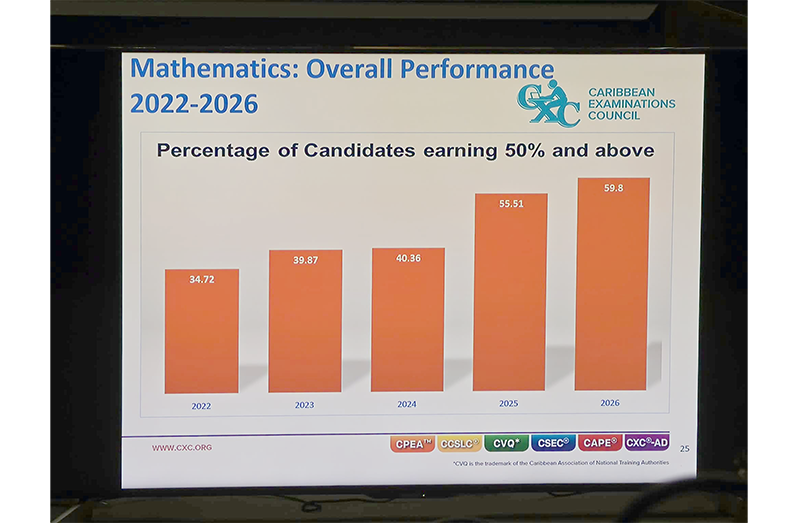
Mathematics registered one of the largest gains, with the proportion of candidates scoring 50 per cent or more increasing from 55.51 per cent in 2025 to 59.80 per cent this year.
The number of candidates achieving full marks almost tripled, rising from 220 to 627, while the number receiving zero marks fell to its lowest level in the past five years.
Manning noted that year-on-year improvements were evident across every subject and among both male and female candidates, describing the results as evidence that the Ministry of Education’s interventions were producing measurable outcomes.
“We are seeing gradual improvement across all four subjects. Whatever interventions you are doing, you are having an impact,” she said.
She added that Guyana’s performance sends a strong regional message that sustained investment in education produces tangible results.
PANDEMIC CHALLENGES OVERCOME
Meanwhile, Chief Education Officer Saddam Hussain placed the results within the context of the COVID-19 pandemic, reminding the audience that this year’s candidates entered the education system in September 2020 but were unable to begin face-to-face learning until January 3, 2022.
Rather than benefitting from the standard 17 terms of classroom instruction during their primary education, the cohort completed only 13 terms, losing approximately 54 weeks of face-to-face learning because of the pandemic.
Hussain explained that this was the reason the ministry postponed this year’s examination schedule, allowing pupils additional instructional time before sitting the assessment and resulting in the later-than-usual release of the results.
“These students were deprived of face-to-face teaching for 54 weeks, so the results being two weeks late, I think that’s reasonable,” Hussain said.
Despite those unprecedented challenges, he described the candidates’ achievements as remarkable.
He too also credited the success to sustained government investment in education, the dedication of teachers who adapted to online learning through virtual classrooms, WhatsApp and Google Classroom during the pandemic, and the efforts of education officers, curriculum specialists and assessment personnel who ensured students remained on track despite the disruption.