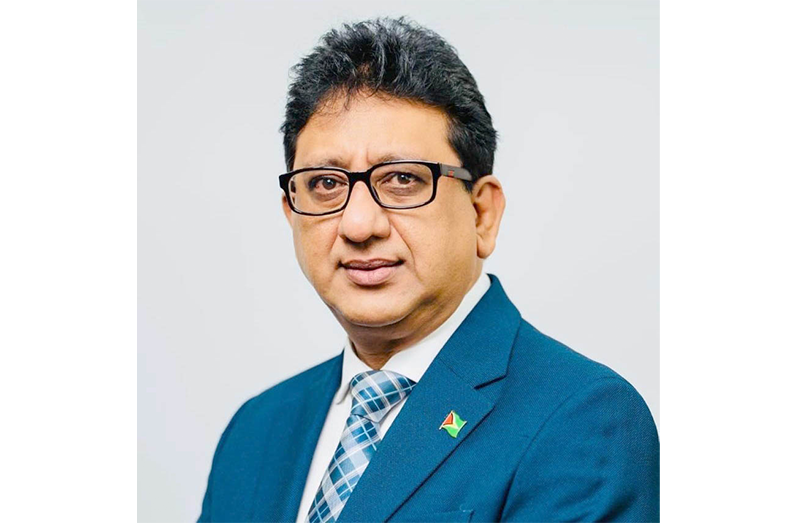
– Nandlall says, warns persons to desist from squatting
– Gov’t will be forced to act
MINISTER of Legal Affairs and Attorney General Anil Nandlall has said that the law provides no protection for persons who unlawfully occupy state lands, government reserves, or public reserves, and the government will be compelled to take firm action to address the growing problem of squatting across the country.
The minister made this known during his weekly show, Issues in the News, during which he indicated that while demand for land often exceeds supply, this does not justify squatting.
The minister, as such, warned that the administration maintains a zero-tolerance approach to illegal occupation of public lands, while continuing to expand access to legal housing and land ownership.
“We have a no-tolerance policy in relation to squatting,” he said, while encouraging eligible citizens to apply through the government’s housing, agricultural and industrial land- distribution programmes.
According to the Attorney General, Guyana operates one of the region’s most aggressive housing and land-distribution programmes, with significant investments being made to transform undeveloped lands into fully serviced residential communities.
He explained that unlike previous administrations, the government does not allocate undeveloped plots.
Instead, lands are first equipped with essential infrastructure, including roads, drainage systems, potable water, electricity and other services before being distributed to beneficiaries.
Nandlall noted that converting former cane fields, rice lands, swamp areas and other undeveloped tracts into residential communities requires billions of dollars in investment and months of development work.
While acknowledging that processing of applications can sometimes be lengthy, he stressed that delays do not give anyone the legal right to occupy public property.
“That is no excuse to go and squat,” he said.
The Attorney General emphasised that squatting constitutes both a criminal offence and a civil wrong, adding that the law does not recognise or protect squatters.
Against this backdrop, he explained that a lawful property owner may remove squatters and demolish illegal structures using reasonable force without first obtaining a court order.
“The law offers no protection whatsoever to a squatter,” Nandlall said, warning that persons who choose to occupy lands illegally expose themselves to significant legal and financial consequences.
Adding to this, Nandlall indicated that beyond the legal implications, squatting also disrupts critical public infrastructural projects and undermines the state’s ability to provide essential services.
Nandlall said illegal occupation of government dams and reserves can prevent the clearing and maintenance of drainage canals, contributing to flooding across interconnected drainage systems and affecting tens of thousands of residents.
He further added that when people occupy public reserves, they can obstruct the installation of utility infrastructure such as Guyana Power and Light poles, interfere with pipeline works by Guyana Water Incorporated, or prevent the construction of important public facilities such as health centres.
The minister reiterated that lands reserved for future public use are deliberately set aside to support the development of communities, and illegal occupation deprives hundreds of residents of services and infrastructure intended for the public good.
“I can go on and on to tell you the pernicious impact that your selfish occupation of lands that you ought not to occupy can have on the public good and on the welfare of an entire community,” he said.
Nandlall also reminded prospective squatters that they would be unable to legally access basic utility services.
He explained that GWI will not provide water connections and GPL should not provide electricity to illegal settlements, because doing so would amount to facilitating unlawful occupation.
Against this backdrop, he went on to reference previous enforcement efforts and cited the court proceedings involving squatters at Mocha, noting that the occupants lost their legal challenges and were ordered to pay millions of dollars in costs.
He maintained that while enforcement measures may appear harsh, they are fully authorised under the law and necessary to protect public property, facilitate national development and safeguard the interests of communities across the country.