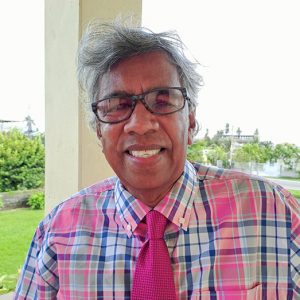
FORMER President of Guyana, Donald Ramotar, on the Freddie Kissoon Show, birthed a theory of Forbes Burnham that is bound to stir controversy.
In 1984, Mr. Burnham engendered peace talks between the PNC and PPP with the intention of both parties contesting the 1985 general election under one slate.
The PPP accepted the invitation which was intended to arrive at power-sharing. The talks continued but fate stepped in. Mr. Burnham died in August 1985, Desmond Hoyte became president, and he dissolved the power-sharing covenant.
The only book that documents this rendezvous between the PNC and PPP is titled: “Forbes Burnham: National Reconciliation and National Unity, 1984- 1985” by Halim Majeed, who in those years was an adviser to the President and was part of the sessions before Mr. Hoyte terminated them.
Ramotar has posited that in those years, Mr. Burnham had become a remorseful man seeking contrition and redemption, and sincerely wanted PNC-PPP reconciliation. To put it plainly, Mr. Burnham’s efforts were sincere. When Mr. Ramotar outlined his theory, I pointed out to him that Mrs. Jagan had shunned the talks therefore this could be open to the interpretation that Mrs. Jagan did not trust Mr. Burnham. In his book, Majeed did refer to the non-involvement attitude of Mrs. Jagan
Ramotar’s reply was Majeed was not present at all the sessions of the talks, therefore, he was not in a position to write about Mrs. Jagan’s hands-off approach to the unity confabulation. Mr. Ramotar said on the show that Mrs. Jagan walked out of one of the meetings because cuss words were used. He did not elaborate but it could not have been Mr. Burnham that used the words since he was never present at any of the exchanges.
So is Ramotar’s theory attractive and should find acceptance? There is no writing anywhere about Mrs. Jagan’s attitude to the talks except Majeed’s book, and in his book, Majeed made it clear that Mrs. Jagan was not on board.
So, the question that has to be featured in any analysis of the 1984 unity talks between the PNC and PPP is: Did Mrs. Jagan see the dialogue as another one of Mr. Burnham’ shenanigans which the entire nation was familiar with since Mr. Burnham became Premier in 1964?
One argument does not favour the Ramotar theory and that is the process of confidence- building blueprint that is a definitive criterion when government and opposition are in dialogue about political reconciliation.
Confidence-building measures in such situations exclusively belong to the government because it has power that should be used to dilute tensions.
It is called confidence-building measures because they instil confidence in the opposition that intentions are sincere and not decorative. I was in Guyana for the entire period of 1984 and up to the time Burnham died in 1985, and I never saw confidence-building measures by the Burnham Government during the reconciliation covenant.
I am eager for Mr. Ramotar to outline the confidence-building measures that Burnham engendered between August 1984 and August 1985 when he died. That obviously is a period of one year. None of the major autocratic directions of Mr. Burnham that went into the 1980 constitution was abandoned by him in the one-year period I referred to above.
It is outside of the scope of just one newspaper column to enumerate the behavioural output of Burnham between 1984 until his death in August 1985. For example, Mr. Burnham in that period, coerced public servants to do compulsory hard work at Hope Estate. While working in the fields, Burnham would ride his horse upon them and watch them scamper for safety.
Another example was compulsory National Service that Mrs. Jagan was adamantly against. In fact, Mr. Burnham opened up talks with the PPP on National Service. Mrs. Jagan requested that young women be exempted and Mr. Burnham flatly refused. In the entire period of 1984 and the first six months of 1985, the Burnham Government had not terminated any major policy that the Guyanese people wanted to be scrapped.
Against this background, I find it difficult to subscribe to the Ramotar theory that Burnham was a changed man and wanted redemption. The rejection of such a theory is simply because the facts do not support it. Burnham was his usual autocratic self while he was in negotiation with the PPP for power-sharing.
The missing link in Majeed’s book is that he failed to mention that the unity dialogue was at the behest of the Cubans. It did not come from within the heart of Burnham. I think because of this, Mrs. Jagan remained suspicious. She had every right to.
DISCLAIMER: The views and opinions expressed in this column are solely those of the author and do not necessarily reflect the official policy or position of the Guyana National Newspapers Limited.