







—Proposal would transform roadside drains into landscaped walkways, expand tree cover and improve pedestrian safety
GEORGETOWN’S roadside drains could one day be transformed into landscaped pedestrian walkways shaded by trees under a proposal by the United Kingdom-based King’s Foundation aimed at creating healthier, safer and more attractive streets for residents.
The proposal was presented on Friday by Ben Bolgar, Executive Director of the Projects Team at the King’s Foundation, during the Building Expo Summit 2026 at the National Stadium, Providence.
He outlined a “Healthy Streets” concept as part of the Foundation’s broader work with the Government of Guyana on sustainable urban and community development, aligning with the country’s Low Carbon Development Strategy (LCDS) 2030.
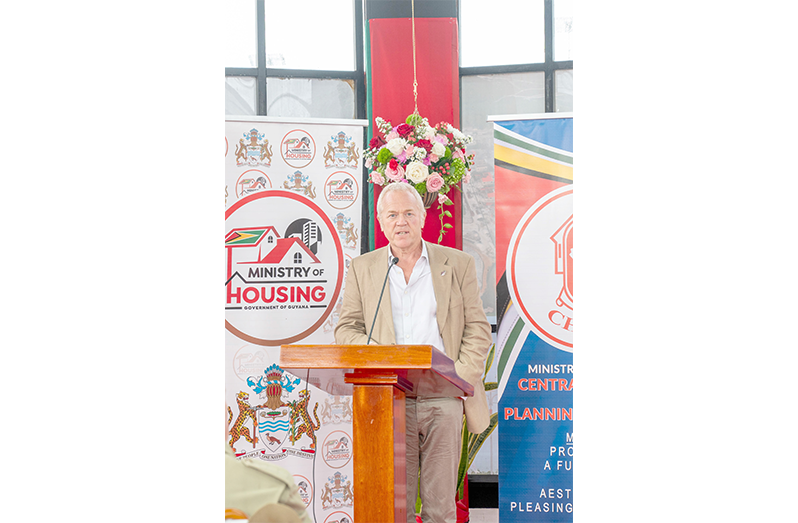
The UK-based organisation is working to transform Georgetown into a resilient “garden city” while planning new, eco-friendly settlements.
Bolgar said the initiative seeks to improve pedestrian safety while reinforcing Georgetown’s reputation as the country’s historic “Garden City”.
“We want the streets to be healthy and secure for children and families,” he said.
The proposal focuses on reorganising Georgetown’s streets by converting roadside drains into landscaped walkways, preventing vehicles from parking on drains, and introducing extensive tree planting to provide shade along pedestrian routes.
Bolgar explained that many of Georgetown’s streets already have an extensive drainage network, but the spaces are often obstructed by vehicles parked on drains or affected by litter. Rather than rebuilding the city’s infrastructure, he said relatively simple interventions could significantly improve the urban environment.
“The idea is that you can walk the whole way through central Georgetown as if you’re walking through a garden,” he said.
Under the concept, protective kerbs or raised barriers would be installed to prevent vehicles from driving onto drainage structures, while the drains themselves would be integrated into wider pedestrian walkways lined with vegetation.
Bolgar said the Foundation also proposes planting several layers of trees and landscaping along canals and streets to create continuous shaded corridors throughout the capital.
The additional tree cover, he noted, would make walking more comfortable in the tropical climate while contributing to Georgetown’s green character.
He said the vision is for children walking to school, elderly residents visiting health centres, and other pedestrians to move safely through neighbourhoods without competing with heavy traffic.
He said, “When you drop your children at Stabroek or at school, you know they’ll be safe walking to school, or elderly parents might be safe going to the health centre.”
He added that the proposal is designed to make better use of infrastructure that already exists rather than requiring extensive reconstruction.
“We’ve already got the canal network. You just need to organise it in this way to make it more secure,” he added.
The Healthy Streets proposal forms part of the King’s Foundation’s wider advisory work under Guyana’s LCDS 2030, where the organisation has been providing technical advice on sustainable towns and cities for more than two years.
Throughout his presentation, Bolgar stressed that preserving Georgetown’s identity should remain central to future development as Guyana experiences rapid economic growth.
He noted that consultations with communities identified Georgetown’s image as the “Garden City” as one of the city’s defining characteristics, alongside its waterways, cultural diversity and village heritage.
According to Bolgar, urban planning should prioritise people rather than vehicles.
He stated, “We want people to stop in the streets—not just see them dominated by cars—but see them as places where you want to sit, have a coffee and chat with your friends in a safe and secure environment.”
He argued that streets should be viewed as important public spaces where communities interact, rather than simply corridors for moving traffic.
The King’s Foundation’s proposals complement its broader vision for Georgetown’s future, including a network of interconnected communities, improved public transport, sustainable housing designs and the restoration of key heritage buildings.
Bolgar emphasised that healthy streets also contribute to safer neighbourhoods by encouraging more activity in public spaces.
He noted that well-designed streets with homes facing onto public areas naturally improve security because more people overlook pavements and public spaces.
“Where there are more doors, more balconies and more people looking out onto the streets, those places tend to feel safer,” he said.
The King’s Foundation believes that combining improved walkability, better landscaping and thoughtful urban design can help Georgetown accommodate future growth while preserving the qualities that residents value most.
Bolgar said the proposals remain under discussion with the Government and other stakeholders but expressed confidence that many of the measures are practical and achievable.
“We think this is very achievable,” he said, adding that relatively simple improvements could make Georgetown’s streets greener, safer and more welcoming for future generations.




