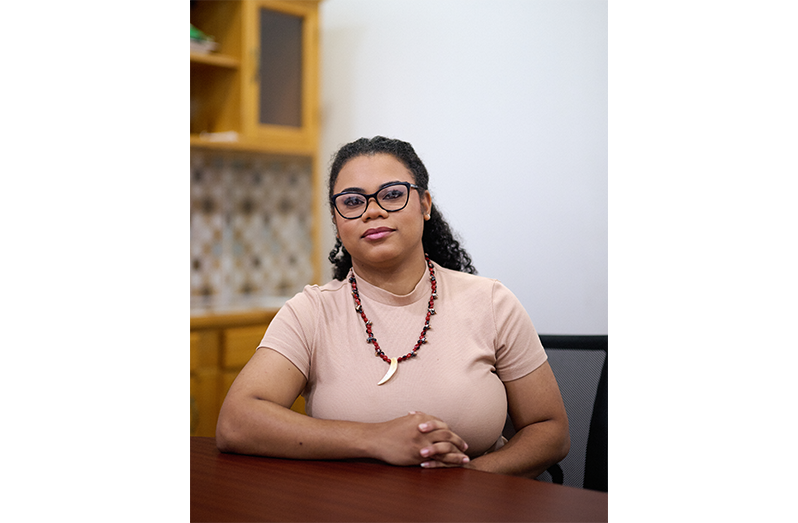
Farmer wants young Guyanese to see farming as an industry of innovation, logistics and opportunity.
FOR many young people, a childhood playground becomes a distant memory. For Kezyah Bhola, it became the foundation of a growing agricultural enterprise. From her family’s farm in Hauraruni Village, just off the Linden-Soesdyke Highway, the young farmer is building on a legacy that stretches back to the 1950s, when her great-great-grandparents cultivated pineapples and produced charcoal on the same lands.
Today, Bhola is steering the family operation into a new era, balancing traditional crops with ambitious projects involving dragon fruit, black pepper and cinnamon through partnerships with the National Agricultural Research and Extension Institute (NAREI) and the Guyana Livestock Development Authority (GLDA). Managing logistics, customer relations and farm expansion alongside her mother, she views agriculture not simply as farming, but as a business with vast potential. With more than 16 of some 35 acres under cultivation, Bhola is determined to prove that Guyana’s agricultural future can be driven by a new generation of entrepreneurs.
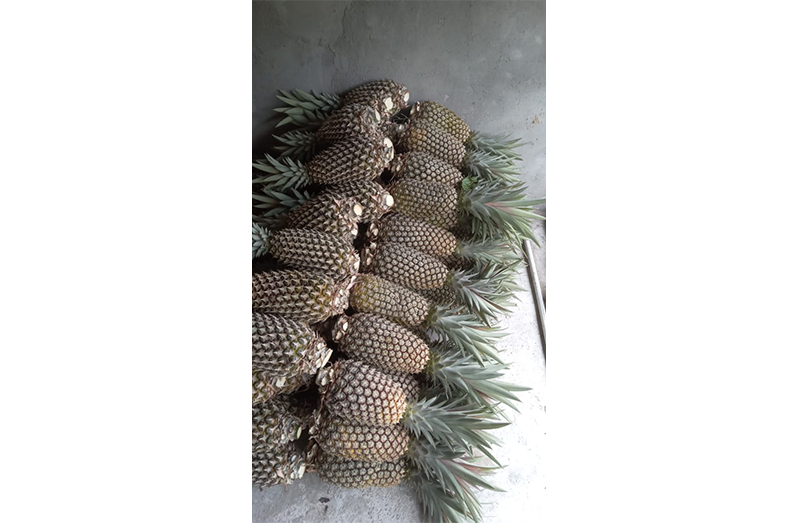
During an interview earlier this week, Bhola shared that the farm has been in her family for generations. Owned by her great-great-grandparents since the 1950s, the farm originally grew pineapples and charcoal, with the Hauraruni Creek that flows through the land used to transport crops and produce down the Demerara River. Today, Bhola and her mother run the farm together, with some of the same crops originally planted on the land decades ago, alongside new ones soon to enter the market.
As Bhola shared, “By the time my mom and I were farming, we were still doing pineapples but focusing more on fresh crops, some light softwood and a lot of citrus. We got the attention of GLDA and we have been doing some projects with them as well. I see the farm as a multi-generational project for me because what I am doing is not just for me. Like the generations before me, I am working for the future,” she said.
Bhola and her mother work as a team to manage the farm, with Bhola handling the logistics, management and supply chain aspects of the business, while her mother, whom Bhola calls the backbone of the farm, takes care of the hands-on work with the crops, ensuring their health and overseeing the farm’s workers. This collaboration has made the farm a success and a prime candidate for cultivating some of Guyana’s most unique crops.
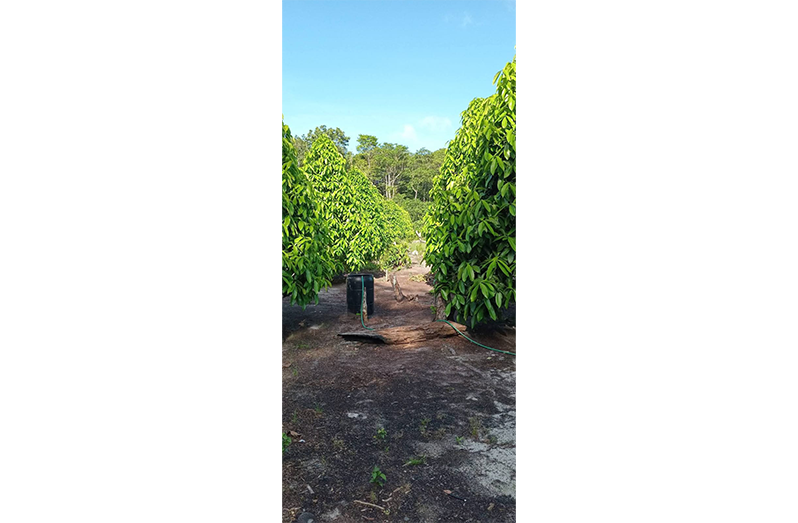
Through their work with NAREI and the GLDA, Bhola has ventured into planting cinnamon and black pepper alongside a dragon fruit project. As she shared, “We have taken on a cinnamon project where we just got 150 cinnamon trees. We also just got the go-ahead to get some black pepper plants, so we are going to have a big row of black pepper. In addition to all that, we are doing a dragon fruit project where they are providing the plants and we will prepare the farmland, look after and manage the crop. We are then going to set this up to create a market for it.”
Although the new crops are still in their early stages, Bhola notes that challenges remain, some she has already encountered and others she is working to mitigate in collaboration with NAREI. As she shared, “Agriculture is a very unstable sector because you cannot control everything. We have droughts, we have periods with no rain, and then we have very high rainfall. NAREI is putting things in place to help, such as ensuring the creek is accessible and doing dredging work to improve soil conditions for the crops,” she stated.
Bhola- Kezyah Bhola
But beyond the new crops, Bhola’s farm is diverse. As she explained, while just 16 of the 35 acres of land is currently under cultivation, some of the land houses coconuts, pineapples and a number of other crops being intercropped alongside the new additions. As she told the Pepperpot Magazine, “We are supposed to put down about five acres of coconuts, and of course we have the projects I mentioned. I like to do intercropping, but with these primary projects I like to give them their own space, so I have mapped out the entire farm into sections,” she said.
The introduction of these new and interesting crops to Bhola’s farm and a number of others comes amid the dramatic development of the sector. As she explained, with Guyana having earned the title of the world’s only food-self-sufficient country, there is a push to continue building on that achievement. Using dragon fruit as an example, Bhola noted that it came onto the market at a very high price. What NAREI and the Ministry of Agriculture are now working to do is make it more affordable by growing it locally. Guyana is closer than ever to achieving its food security goals, and young people can play an integral role in this.
As a champion for youth in agriculture, Bhola noted that misconceptions about the sector persist. “I think people hear agriculture and they immediately think about hard labour, and I feel that has definitely put off a lot of people. But farming is not what it used to be; it is not just a physical, stand-up game. I see farming and agriculture as a whole as more of an industry now,” she said. Bhola noted that agriculture is a developing industry, adding, “Agriculture is not just working in the field; it is a growing industry and there are several jobs attached to it. There are so many sections within it that people ought to explore. I would definitely suggest a lot of people look into it as a new form of employment because food security begins when people invest in it.”