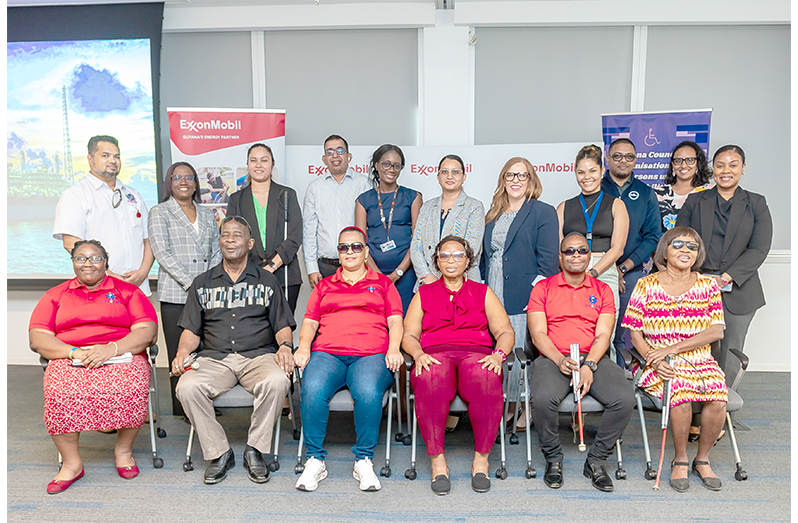
MORE than 450 persons with disabilities across seven regions are set to benefit from training in independent living, assistive technology, employment readiness and entrepreneurship following the launch of Phase Five of the Independent Living Skills Programme by the Guyana Council of Organisations for Persons with Disabilities (GCOPD) and ExxonMobil Guyana.
The programme, which was officially launched on Thursday at ExxonMobil Guyana’s headquarters at Ogle, aims to empower persons with disabilities, including those who are blind and visually impaired, by providing them with the tools and skills needed to live more independent and productive lives.
Phase Five will be implemented in Regions Two, Three, Four, Five, Six, Seven and Ten, with plans already underway to expand the initiative to Regions One and Nine through collaboration with the Ministry of Education.
Under the programme, participants will receive training in independent living skills, rehabilitation counselling, assistive technology, job preparedness, and small business management. Beneficiaries who are blind or visually impaired will also be trained in the use of mobility aids such as the white cane and other technologies designed to enhance independence and accessibility.
The initiative builds on the success of the Orientation and Mobility Skills Programme, which GCOPD has implemented over the past four years with support from ExxonMobil Guyana. According to the organisation, more than 1,100 persons who are blind and visually impaired have benefitted from the programme nationwide.
Many participants have gone on to enrol in GCOPD’s remedial education and Caribbean Examinations Council (CXC) programmes, while others have pursued vocational training through partnerships with the Board of Industrial Training. Organisers noted that numerous beneficiaries are now employed, attending educational institutions, and living more independent lives.
Delivering the feature address, Samantha Craig, Coordinator of the Support Services for Persons with Disabilities Unit within the Ministry of Human Services and Social Security, emphasised that independent living extends beyond physical mobility and encompasses the ability to make decisions, pursue ambitions and live with dignity.
She noted that one of the greatest challenges facing persons with disabilities is not necessarily their condition, but societal barriers such as inaccessible infrastructure, limited services, prejudice and low expectations.
“When these barriers are removed, accessibility emerges,” Craig said, adding that fostering understanding, empathy and inclusion is essential to creating communities where persons with disabilities are welcomed, valued and empowered to contribute fully.
Craig also highlighted several skills-training initiatives currently being offered by the ministry, including block making, sign language, makeup artistry, garment construction, plumbing, hydroponics and farming, all aimed at increasing opportunities for persons with disabilities.
GCOPD Programme Coordinator, Ganesh Singh, said the country’s disability landscape is undergoing significant transformation, but stressed that persons with disabilities must be equipped with the necessary skills to fully benefit from emerging opportunities.
He pointed to the importance of technology and digital literacy for persons who are blind, noting that proficiency in screen-reader software and other assistive technologies is often critical to pursuing higher education and employment.
“There’s no other programme that teaches someone who’s blind to use the computer with the screen reader software,” Singh said, highlighting the unique role the initiative plays in fostering independence and educational success.
ExxonMobil Guyana’s Socioeconomic Manager, Lorna Carlson, described the programme as an investment in sustainable development and empowerment.
She said the initiative goes beyond training and focuses on equipping participants to navigate their environments confidently, contribute to their communities and participate meaningfully in national development.
“At ExxonMobil Guyana, we remain committed to investing in programmes that deliver sustainable impact,” Carlson said. “We recognise that economic empowerment, education and strong, cohesive communities are essential pillars of a thriving society.”
Carlson added that ExxonMobil’s continued partnership with GCOPD reflects a shared vision of a Guyana where barriers to opportunity are progressively removed and persons with disabilities are empowered to realise their full potential.
The launch of Phase Five marks another milestone in ongoing efforts to promote inclusion, independence and equal opportunity for persons with disabilities, while reinforcing the commitment of stakeholders to ensuring that every citizen has the opportunity to contribute to Guyana’s development.