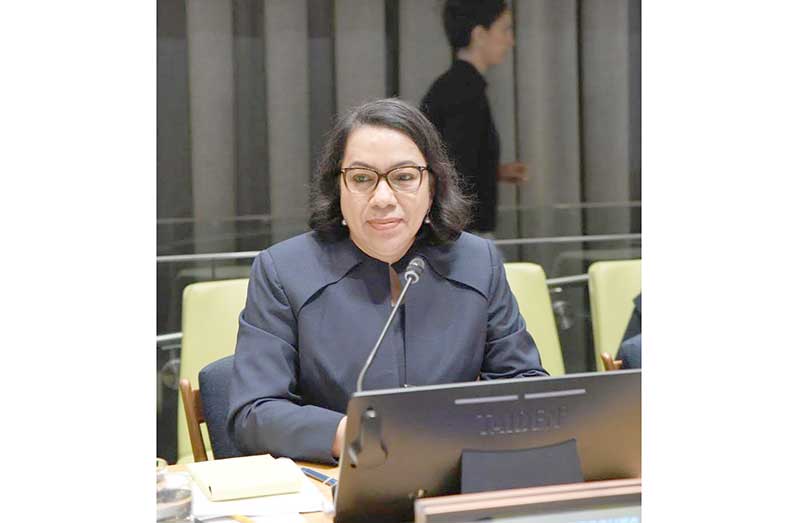
–Ambassador Rodrigues-Birkett assures stakeholders, acknowledges constraints of the current financial climate on human rights
GUYANA’S nominee for United Nations Secretary-General, Ambassador Carolyn Rodrigues-Birkett, has underscored the importance of human rights funding, stating that efforts to advance development, peace and security are inherently investments in human rights.
During a recent interactive session with member states, delegates and civil society members, in a bid for the top post, Rodrigues-Birkett was asked by the European Union delegation whether she would elevate human rights if chosen to lead the organisation.
“I believe that in the current financial crisis we have to look for ways and means of how we can increase this, but I also see the investment in development and the investment in peace and security as also investment in human rights,” she said, responding to the EU’s concern that only around one per cent of UN system resources are dedicated to human rights mandates.
She added: “When conflicts arise, many times human rights is one of the things that suffer immediately.”
The Guyanese diplomat anchored her reply in national experience, citing education and indigenous rights reforms as evidence that human rights can deliver measurable development outcomes.
“When I became Minister of Amerindian Affairs in 2001, there was one indigenous doctor in the whole of Guyana, and the investment that we made in education over the next 15 years, saw a really big jump in terms of the numbers, not only of medical doctors, but engineers and other professionals,” she recalled adding:
“This was one of the human rights that we invested in…the right to education, and so that to me is one of the concrete examples where we saw an investment in human rights resulting in sustainable development.”
Ambassador Rodrigues-Birkett went on to highlight Guyana’s 2006 Amerindian Act as a second pillar of that record. The legislation, she noted, was the first in more than six decades to cement the rights of Indigenous Peoples in Guyana.
“It was the first in our country for over 60 years, and we gave the rights in that law to Indigenous People, to their land, to their own governance mechanisms, their own systems,” she said.
She argued that the impact has been tangible and long term.
“From then, 2006 to today, we have seen how the investment in that law, in the rights of Indigenous Peoples has improved their conditions overall in my country; very measurable,” she stressed.
On the central political question from Brussels regarding how she would boost the UN’s underweight human rights budget, Ambassador Rodrigues-Birkett signalled intent but acknowledged the constraints of the current financial climate and the Secretary-General’s dependence on member states.
She asserted that she would work with member states to seek an increase beyond the one per cent currently allocated, positioning human rights financing within a broader effort to strengthen delivery across the UN’s mandate.
“How do we improve the budget for human rights in this organisation? Of course, I will certainly have to work with member states to do this,” she said.
Rodrigues-Birkett sought to show that expanding budgets for rights is not only a normative priority but also a practical route to long-term social and economic transformation.
The dialogue formed part of a transparent and inclusive selection process mandated by General Assembly Resolution 79/327, under which each candidate presents their vision and answers questions from Member States and civil society.
Drawing on her five years at the United Nations and Guyana’s recent term on the Security Council, Rodrigues-Birkett said she had heard a “growing sense of frustration that the UN is not delivering as it should,” citing proliferating conflicts, the slow pace in meeting the Sustainable Development Goals (SDGs) and a worsening liquidity crisis. Yet she insisted that the world would be “difficult to imagine” without the UN’s conflict prevention and standard-setting work.
“If there were no United Nations, how would we even begin to address many of the global issues confronting us? I’ve said all of this because I believe in the United Nations. It is indispensable. It is incomparable, and it is a force for global good,” she added.