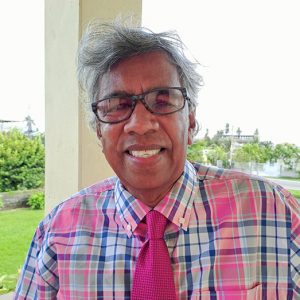
I HAVE been married to Janet Mohamed for a few months over 47 years. In that vast period, she has made reference many times to the first victim of the Wismar massacre – her mother’s cousin, Richard Khan. Khan’s father and my wife’s grandmother were brother and sister making Richard my mother-in-law’s first cousin.
So many times, in our marriage, my wife would tell me about the death of Richard and the lives of his three other brothers. It is through my wife I came to know that one of the brothers, Akbar, did not mentally survive what happened to his parents and siblings. Unfortunately, Dr Ramharack did not capture the mental state of Akbar.
My wife can now read the story of the children of her mother’s first cousin in Wismar in 1964. That story is captured in a gargantuan book of 800 pages titled: “The Wismar Massacre: The Ethnic Cleansing of Indians in Guyana” by Baytoram Ramharack.
This is so large a book that to review it objectively you have to make sure you do not skip parts of it. But I couldn’t help doing just that if I was to do a book review shortly after the launching of the work last Saturday.
I got a donation of the book from Dr Ramharack last Wednesday when he was the guest on The Freddie Kissoon Show, and I began reading it right away. I bypassed several parts which I consider not germane to the review. Three characteristics stand out about this book. One is the scholarship. It is extensively researched. Secondly, it is a valued addition to Guyana’s historiography.
The third dimension of this work is that it tells a story that remained untold for more than 50 years. What happened in Wismar to the Indian population there is the most painful tragedy in Guyana’s history. It is beyond incredible that such a tragedy did not find its way in a book length manuscript long before 2026. For this, Ramharack has left a legacy in Guyana’s academia.
This is not an easy book to analyse because of the confluence throughout the pages of academic writing meeting popular writing, but Ramharack negotiated this difficult pathway with notable competence. A reviewer will find different silhouettes in the book to emphasise but one dimension of the work pierced my psyche. It is the police’s and Governor’s tardiness in dealing with the violence.
The author is unambiguous in stating that hundreds of properties could have been saved and the massive physical injuries and several incidents of rape could have been prevented had the police and British soldiers shown acceptable levels of alacrity (my words).
For example, the attacks on Indians started on May 22 (1964) and continued for another two days with the most violent and tragic day being May 24.
The British soldiers arrived in Wismar late in the day (6PM to be precise) on May 25. By then what could be considered a form of ethnic cleansing was already underway. Reading this section of the book, it is clear that the police and the Governor’s office acted too slowly.
Ramharack on page 300 shaped his words that could make you feel that Governor Luyt deliberately acted slowly because of a personal view he had of Premier Cheddi Jagan. Ramharack informed us that the Premier had objected to the appointment of Luyt and from there on, Luyt saw the PPP government in antagonistic terms.
One of the things that pop up in your mind as you read about the delay by the security forces is if they had acted earlier would there have been an event in Guyana’s history referred to as the Wismar Massacre?
The answer stares you in the face as you read that section. Hundreds of buildings and dozens of physical brutalities could have been prevented. There are times in history you wonder what history would have been like if there were intervening forces that could have altered history.
I find page 287 very moving. On the top of the page is a female refugee clinging with tender care to a tiny baby on her lap with the name Leela. Next to her is another child oblivious to the disastrous future that awaits her childhood. Next to that photograph is evidence of the mammoth research effort of Ramharack. He produced an adult photograph of baby Leela and she is no doubt a beautiful Guyanese woman.
The Wismar Massacre is a book worth reading because it is about a vast tragedy in Guyanese history that has no parallel in the CARICOM region. I guess it will become one of the most important books ever published on the history of this fantastic yet inexplicable land.
DISCLAIMER: The views and opinions expressed in this column are solely those of the author and do not necessarily reflect the official policy or position of the Guyana National Newspapers Limited.