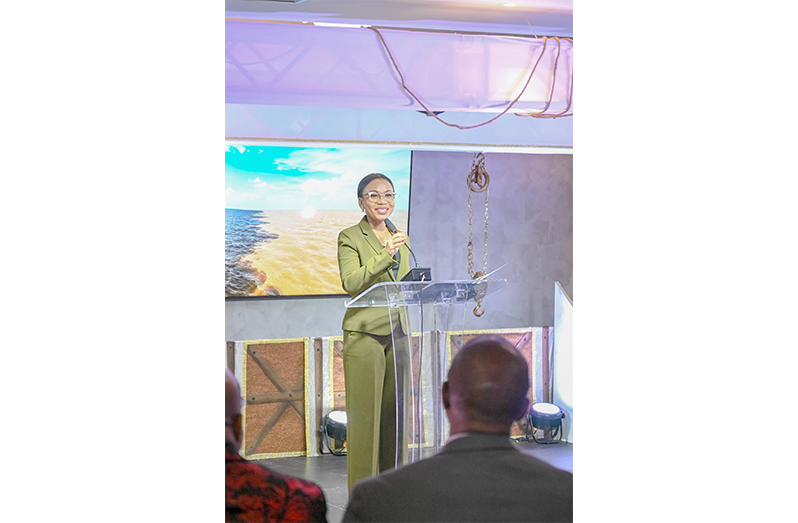
MINISTER of Home Affairs, Oneidge Walrond, has underscored the importance of stronger regional collaboration to address rising transnational crime in the maritime domain.
The minister was at the time speaking at the recently held Caribbean Port State Control Conference, during which she warned that criminal networks are increasingly exploiting ports and shipping routes across borders.
Against this backdrop, she said that maritime security can no longer be treated as an isolated national responsibility, given the scale and mobility of modern criminal activity at sea.
“Criminal networks do not respect national borders, and the vessels they exploit often move across multiple jurisdictions,” she said.
The minister explained that the Caribbean region’s shared maritime space makes co-operation among states essential, particularly in the exchange of information, inspection data and intelligence aimed at identifying high-risk vessels and suspicious movements.
She said the Caribbean Port State Control framework plays a critical role in supporting this effort by enabling coordinated inspections and harmonised standards across member states.
Walrond added that this type of collaboration strengthens the ability of regional authorities to detect emerging threats and prevent the misuse of maritime routes for illegal activities such as narcotics trafficking, weapons smuggling, human trafficking and illegal migration.
“Through the exchange of inspection data, intelligence, best practices and risk information, member states are better equipped to identify suspicious vessels, detect emerging threats and prevent the use of maritime routes for transnational organised crime,” she said.
The Home Affairs Minister noted that Guyana is particularly focused on strengthening its internal systems as maritime activity continues to increase alongside rapid economic growth.
She pointed to the work of several key agencies under her ministry, including the Guyana Police Force, immigration authorities and the Customs Anti-Narcotic Unit (CANU), all of which play a direct role in safeguarding ports and border entry points.
To this end, she highlighted the importance of the Container Control Programme, implemented with support from the United Nations Office on Drugs and Crime (UNODC), which she said complements broader port security efforts.
She explained that while the Caribbean Port State Control system focuses on inspecting vessels for compliance with international safety, security and environmental standards, the Container Control Programme targets high-risk cargo containers that may be used to transport illicit goods.
The two initiatives, she added, form a more comprehensive security architecture that enhances oversight of both vessels and cargo moving through Guyana’s ports.
“By combining regulatory compliance measures with intelligence-led cargo targeting, we create a framework that improves port security, facilitates the detection of transnational organised crime and supports the safe and secure movement of legitimate trade,” Walrond said.