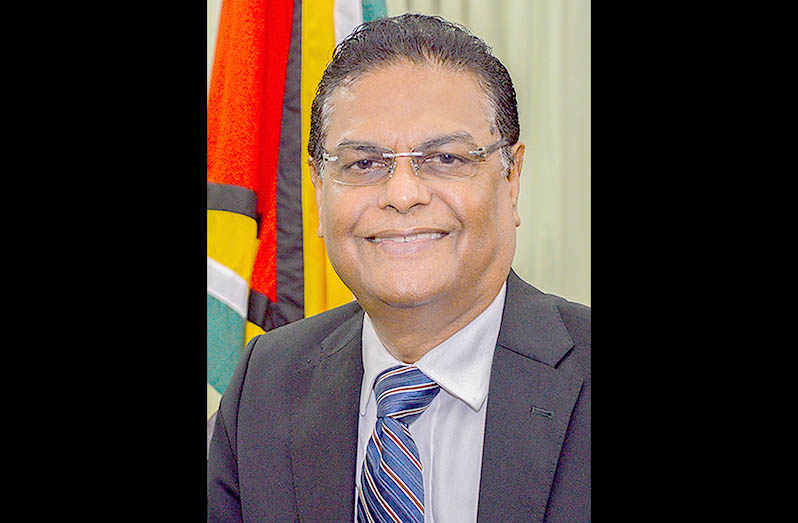
— says over 400 questions submitted since November 2025
SPEAKER of the National Assembly, Manzoor Nadir, has rejected claims that Guyana’s Parliament has been shut down, revealing that more than 400 parliamentary questions have been submitted and processed since the commencement of the 13th Parliament in November 2025.
During a recent interview on the National Communications Network (NCN), Nadir contended that criticism surrounding the absence of frequent sittings of the National Assembly ignores the extensive legislative and administrative work that continues behind the scenes throughout the year. “Parliament is never closed otherwise,” Nadir stated. “We don’t even say close. We go into recess.” He further explained that Parliament only enters its annual recess between August 10 and October 10.
The Speaker’s comments come amid growing public debate over the nearly four-month gap between sittings of the National Assembly.
The June 5 sitting was the first since mid-February 2026. According to Nadir, some Members of Parliament and commentators are misleading the public by conflating Parliament with sittings of the National Assembly.
“It suits many persons, including some Members of Parliament, to mislead people,” he stated.
“The confusion comes when they say Parliament is closed, as against, we did not have a sitting of Parliament for a particular period of time.”
Nadir explained that Parliament comprises both the President and the National Assembly and functions as the country’s law-making authority, while the National Assembly serves as the chamber where legislation is debated and approved before receiving presidential assent.
He stressed that parliamentary business continues regardless of whether legislators are meeting in the chamber.
To support his position, the Speaker disclosed that the Parliament Office has received and processed more than 400 parliamentary questions from government and opposition members since Parliament was convened on November 3, 2025.
“We have received over 400 questions from Members of Parliament,” he revealed.
Nadir explained that every question submitted undergoes a rigorous review process before it can be placed on the Order Paper.
The Clerk of the National Assembly, Sherlock Isaacs, first examines each submission against the requirements set out in the Standing Orders.
The Speaker added, “The clerk will read those questions against the rules.”
He went on to explain that “The questions cannot anticipate something that is coming. A question cannot be based on news reports. A question has to be factual. A question can’t seek the opinion of a minister. A question cannot impute on the integrity of the House or the minister.”
Questions that fail to satisfy parliamentary requirements are returned to Members of Parliament for correction.
According to the Speaker, more than 150 questions were rejected at the initial stage because they breached one or more provisions of the Standing Orders.
Questions that pass the clerk’s review are then forwarded to the Speaker for further examination. Nadir revealed that 267 questions reached his office for consideration.
The process often involves additional fact-checking and research to verify information contained in the submissions before approval is granted.
Of those reviewed, more than 150 qualified to be placed on the Order Paper and were forwarded to ministers for responses.
He explained that ministers are generally afforded 21 days to prepare responses after questions are approved.
The Speaker also pointed to the volume of business handled at the most recent sitting of the National Assembly, during which 30 parliamentary questions were answered, including 20 written responses and 10 oral replies.
Beyond parliamentary questions, Nadir noted that the Parliament Office continues to receive motions, petitions, bills and reports from constitutional commissions, government agencies and the Auditor General. These documents are reviewed and prepared for future sittings while Members of Parliament continue engaging with constituents and raising issues on their behalf.
“So, while we may not have had a sitting since the budget debate, the work of Parliament—the lawmaking function of Parliament—never ceased,” he stated.
Nadir maintained that parliamentary democracy extends far beyond debates in the chamber and includes the continuous scrutiny of reports, processing of legislation and examination of questions submitted by elected representatives.
“There is a lot of hue and cry being made about sittings of the National Assembly, but they cloak it in the form of our democracy being in desperate peril because we don’t have sittings of Parliament,” he said.
According to the Speaker, the ongoing processing of hundreds of parliamentary questions and legislative documents demonstrates that Guyana’s parliamentary system remains active even during periods when the National Assembly is not formally sitting.
Nadir noted that Guyana’s parliamentary system is rooted in the Westminster model of governance in the United Kingdom, which developed over centuries into a representative democracy built around parliamentary rule.
His remarks come against the backdrop of ongoing public debate over the frequency of National Assembly sittings and concerns expressed by opposition figures regarding the pace of legislative activity.