-President Ali calls on vendors, citizens to work with government to keep city clean
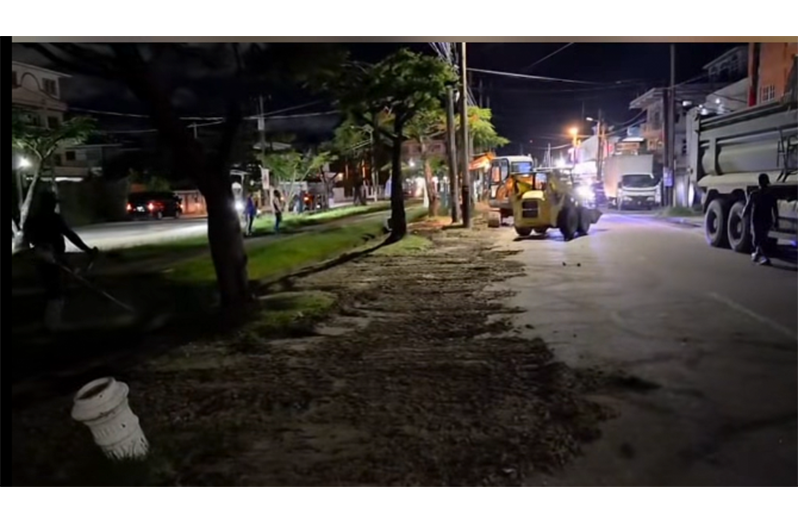
PRESIDENT Dr Irfaan Ali in the wee hours of Thursday morning led a hands‑on inspection of ongoing works along Camp Street, where teams were clearing clogged drains and enhancing parapets as part of a wider city enhancement plan.
On site as the works progressed, President Ali pointed to indiscriminate dumping and poor waste management around commercial facilities as a central factor behind the clogged drains and deteriorating environment.
He stressed that meaningful change would require co-operation from private vendors and other city users, not only state intervention.
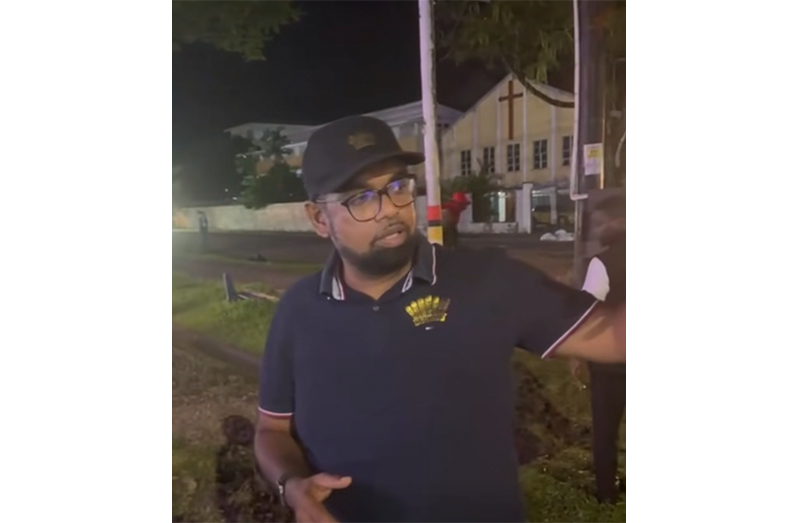
‘One of the serious problems we have here, this is one of the major challenges, and this is what we would have to work on with the vendors to come up with a solution,” he said at the location, gesturing to debris and refuse left along the parapet.
The President noted that rubbish left overnight was not only unsightly but directly impeded proper drainage and has contributed to persistent flooding and damage to the road surface.
President Ali was blunt in his assessment of the state of the capital’s drainage network, linking the present problems to prolonged inaction at the municipal level.
He pointed out that the central government had been forced to intervene heavily over the last five years to restore key sections of the city, where blocked drains, broken parapets and failing road surfaces had become the norm.
“These are some of the challenges that we work towards improving. improving the parapets, improving the general environment in and around the city. [There have been] years of neglect by the city council. All of the investment here around the city in the last five years is by the central government,” he emphasised.
The works along Camp Street form part of a broader city enhancement and drainage improvement programme. The President and technical teams focused on a section where a damaged underground drain and worn road surface had combined to create a persistent hazard.
He explained that crews would be working through the early hours to stabilise the area before the morning rush.
“We’ll try to see how much of this we can get done by five, six in the morning before the traffic starts to come back heavily into the city,” he said, noting that the intervention included sand, crusher‑run and resurfacing to improve the parapet and carriageway.
However, he cautioned that a more permanent solution would require fixing the underground infrastructure:
“This section here we will need to do some work in the underground drainage that goes across the road, so that we can fix this situation here,” President Ali stated.
While highlighting the scale of central government’s investment, President Ali underscored that sustainable improvement in Georgetown’s environment depends on behavioural change and stronger municipal management.
The Head of State announced back in September 2025, the launch of ‘Rescue Georgetown,’ a city revival plan for sustainable urban development.
He had told reporters that initiative was developed with the support of the Kings Foundation, aimed at restoring Georgetown’s status as a source of national pride.
He explained that the wider vision for Georgetown set out in the low carbon development strategy (LCDs) will see 15 flagship demonstration projects being advanced.
These will include the highlighting of the city’s architectural history, constructing a walking trail along the city, which will lead to the historic transport building and train station, transforming it into a museum and training centre, as well as immediate works on the Stabroek waterfront and improvements to markets and shopping areas.
Since then, there have been upgrades to recreational spaces across the city, creating cleaner and more family-friendly environments.