





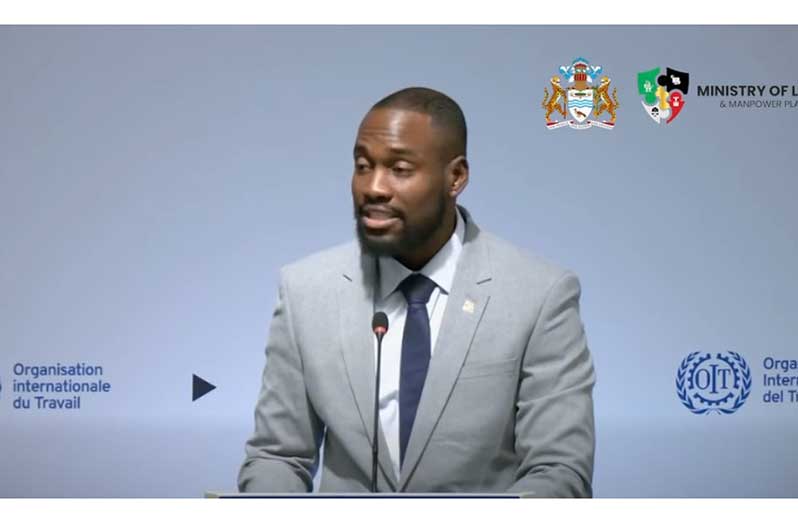
GUYANA is on track to fully digitise its labour administration services by the end of 2026 as part of a broader national push to modernise government operations and prepare the workforce for a rapidly evolving global economy.
This was according to Minister of Labour and Manpower Planning, Keoma Griffith, who outlined the initiative while addressing the 114th Session of the International Labour Conference in Geneva, Switzerland.
During his remarks, the minister highlighted Guyana’s efforts to harness technology and artificial intelligence (AI) to strengthen labour market systems and improve service delivery.
Griffith stated that investments in digital infrastructure, artificial intelligence, cross-agency collaboration and the integration of information and communications technology systems are driving the government’s national digitisation programme.
“These developments align closely with the vision of His Excellency Dr Mohamed Irfaan Ali that Guyana should not only be recognised as a global energy leader, but also as a technology innovator,” Griffith said.
“To this end, our government has strategically crafted a national digitisation programme driven by investments in digital infrastructure, artificial intelligence, cross-agency collaboration, and integration of ICT systems. This initiative will see most government services, including labour administration services, fully digitised before the end of 2026.”
This transformation, he indicated, is taking place against the backdrop of Guyana’s rapid economic growth, which is creating employment opportunities across multiple sectors and reshaping the country’s labour market.
To support this growth, Griffith revealed that the Ministry of Labour and Manpower Planning is advancing the development of a manpower strategic planning framework, including the establishment of a labour market observatory.
The observatory will generate critical information on skills gaps, labour demand, wage trends, migration patterns and workforce participation, enabling policymakers to make more informed decisions.
“Accordingly, the Ministry of Labour and Manpower Planning is presently advancing the development of a manpower strategic planning framework, inclusive of a labour market observatory, which will generate critical labour market information relating to skills gaps, labour demand, wage trends, migration patterns, and workforce participation,” he stated.
Griffith noted that integrating AI and digital technologies into the ministry’s operations will improve data collection, real-time analysis and labour forecasting while helping to better align training programmes with national development priorities.
Meanwhile, he said the government continues to invest in technical and vocational education and training, occupational safety and health initiatives, labour inspection systems and workforce readiness programmes to ensure workers are equipped to take advantage of emerging opportunities.
While embracing technological advancement, Griffith stressed that innovation must remain people-centred.
“Guyana therefore shares the ILO’s conviction that innovation must support, not supplant, the principles of decent work,” he said.
“We are committed to ensuring that emerging technologies strengthen labour administration, improve efficiency, widen opportunity, and reinforce effective governance while preserving human agency, dignity and equity in the workplace.”





