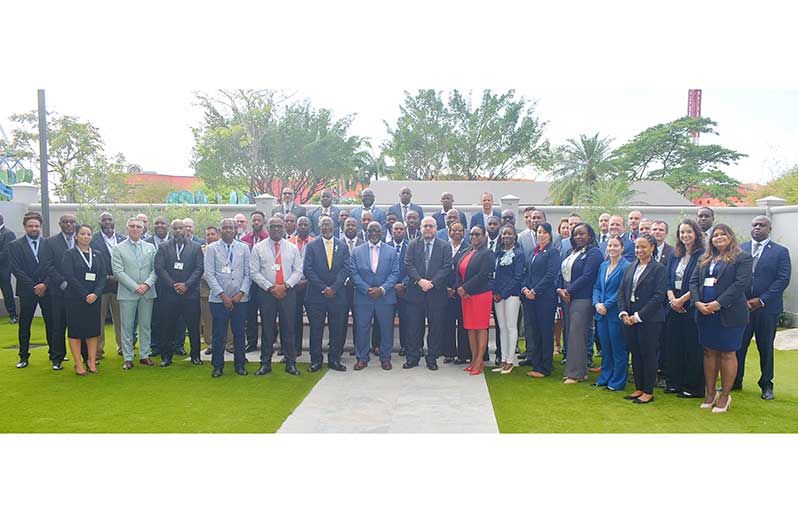
CARIBBEAN and United States security officials have intensified efforts to combat the growing threat of firearms trafficking across the region with the launch of a five-day regional workshop aimed at strengthening investigations, intelligence gathering, and border security operations.
The workshop, organised by the CARICOM Implementation Agency for Crime and Security (IMPACS) in partnership with the United States Department of State Bureau of International Narcotics and Law Enforcement Affairs, opened on June 8 at the Courtyard by Marriott in Port-of-Spain and runs until June 12.
The initiative brings together frontline law enforcement officers from across the Caribbean to improve cross-border investigations, standardise firearms data collection, and develop strategies to disrupt the illegal movement of increasingly sophisticated and difficult-to-trace weapons.
Addressing the opening ceremony, Michael Jones, Executive Director of CARICOM IMPACS, highlighted the devastating impact of illegal firearms on Caribbean societies. He noted that while firearms are not manufactured within the region, illicit guns are linked to nearly 90 per cent of homicides in the most affected CARICOM member states.
Jones warned that law enforcement agencies are facing a rapidly evolving threat landscape, characterised by decentralised criminal networks and technologically advanced weapons.
“The weapons making their way onto Caribbean streets are increasingly untraceable, modular and digitally sourced,” he said, adding that authorities must adapt to new trafficking methods involving ghost guns and other emerging threats.
Delivering the keynote address, Wayne Sturge, Minister of Defence of Trinidad and Tobago, described the situation as a regional crisis requiring urgent and coordinated action.
“The Caribbean is not facing a firearms problem. It is facing a firearms crisis,” Sturge stated. He noted that criminal organisations are becoming more sophisticated, taking advantage of operational and intelligence gaps while utilising technologies such as 3D printing and encrypted communication networks.
He stressed the importance of a united regional response capable of matching the pace and complexity of modern criminal enterprises.
Meanwhile, Michael Fitzpatrick, Chargé d’Affaires at the US Embassy in Trinidad and Tobago, reaffirmed Washington’s commitment to supporting Caribbean partners in tackling firearms trafficking.
Fitzpatrick acknowledged that many illegal firearms entering the Caribbean originate from international manufacturing centres, including the United States. He pointed to successful joint operations, including the 2021 seizure of firearms hidden inside punching bags at a Trinidadian airport, which exposed a smuggling network responsible for trafficking more than 200 weapons from Florida. He also referenced the June 2025 sentencing of a dual citizen convicted of weapons smuggling.
According to Fitzpatrick, such successes were made possible through intelligence sharing, technical expertise, and strong partnerships among regional and international law enforcement agencies.
Also addressing the workshop was Simone Titus, Deputy Permanent Secretary in Trinidad and Tobago’s Ministry of Homeland Security. She described illegal firearms as one of the most significant threats to public safety in the Caribbean and encouraged participants to use the training opportunity to strengthen professional networks and enhance operational capabilities.
“A secure Caribbean region will lead to safer communities for the people we serve and love,” Titus said.
The workshop is being facilitated by regional and international experts, including representatives from the Bureau of Alcohol, Tobacco, Firearms and Explosives, Homeland Security Investigations, Bureau of Industry and Security, and US Customs and Border Protection.
Participants will receive specialised training in identifying firearm components concealed within commercial cargo, tracking the movement of parts and materials used to manufacture 3D-printed weapons, and utilising open-source and dark web intelligence to intercept illegal firearms before they enter Caribbean territories.
Organisers say the programme is designed to build practical operational skills and enhance regional co-operation as authorities work to stem the flow of illegal weapons that continue to fuel violent crime across the Caribbean.