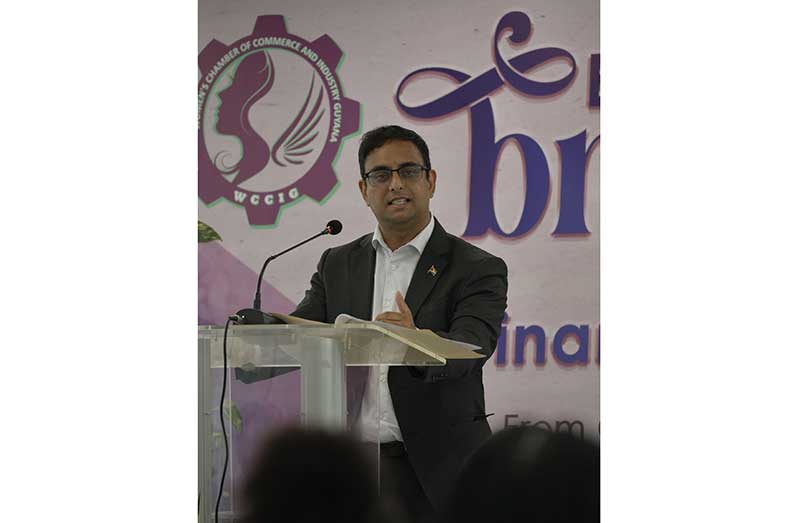
—Says consortiums, stronger financing options and Development Bank will help businesses access larger opportunities
AS Guyana’s economy continues to expand and diversify, Minister of Public Service, Government Efficiency and Implementation, Zulfikar Ally, is urging entrepreneurs to move beyond traditional business models and embrace partnerships, consortiums and strategic collaboration as a pathway to growth.
Speaking at the Women’s Chamber of Commerce and Industry (WCCI) Business Brunch and Finance Seminar on Saturday, Ally highlighted the challenges small businesses continue to face in accessing affordable financing and technical support. He also outlined the transformative role of the soon-to-be-established Development Bank of Guyana in addressing those barriers and pointed to increasing competition within the banking sector as a major opportunity for businesses seeking greater access to capital, foreign exchange and larger investment opportunities.
The event was held under the theme, “From Collaboration to Capital: Diversification Through Consortiums.”
Giving insight into the theme, WCCI Vice-President, Shamela John, noted that as Guyana continues to develop at an unprecedented pace, business owners must assess whether they have the capacity and capital required to take advantage of emerging opportunities.
John said that as the economy expands, so too must entrepreneurs and businesses, with collaboration serving as a key driver of collective growth.
“Collaboration is key. Mutual support is not a sentiment, it is a strategy. It is how we take what we have and join together to make sure we have what we need. The Chamber exists because women acknowledge something humbly. None of us can do this alone. Not the most connected among us. Not the most experienced. Not the most funded,” she said.

“We are all here because people realise that solo efforts have limits. So let us not compete for territory. Let us connect our tables.”
Delivering the keynote address, Minister Ally echoed those sentiments, emphasising that sectors across Guyana are expanding and becoming increasingly accessible to new entrepreneurs.
“Across every region, we are witnessing the transformative investments that are being made in almost every sector that we can think of. Guyana is seeing the emergence of new industries, the expansion of existing industries, and increased accessibility in markets that were once out of our reach,” he said.
The minister acknowledged, however, that small businesses continue to face significant hurdles, including limited access to financing, technical capacity, market access and the ability to compete for larger contracts.
He noted that these challenges are not unique to Guyana and reinforced the importance of collaboration and consortiums as tools for overcoming them.
“Too many promising enterprises we have seen struggle to scale because traditional financing mechanisms did not adequately meet the needs that you have,” Ally said.
“One of the most effective responses to these challenges has been the development of collaborative business models, consortiums that allow businesses to combine their expertise, pool their resources, share risk, increase capacity and pursue opportunities that may otherwise be unattainable if done individually.”
The minister said this approach allows businesses to move beyond competing for small market shares and instead focus on collective growth and expansion.
Speaking on the future of Guyana’s private sector, Ally said success will depend not only on individual enterprises but also on the strength of the networks, partnerships and ecosystems supporting them.
“The future will belong to companies that understand that the business environment has changed rapidly within the last few years. What we knew before from our parents doing business, or the models our families used, no longer works in today’s environment,” he said.
He urged business owners to invest in quality, innovation and technology while recognising the importance of scale and strategic partnerships.
“As firms, we have to move beyond competing for individual contracts. We have to embrace collaboration. Collaboration is a means of building our capacity, sharing our expertise and creating stronger and more competitive enterprises,” he added.
While collaboration remains essential, Ally noted that the Development Bank of Guyana, which was tabled in Parliament on Friday, is designed to address several additional barriers faced by entrepreneurs and the wider business community.
He explained that the institution forms part of President Dr Irfaan Ali’s broader vision of building a modern, inclusive, diversified and opportunity-driven economy.
“The bank is intended to address the financing gaps that traditional commercial lending models are not always designed to serve, particularly in sectors that require long-term investment and patient capital,” Ally said.
“Its role is not to replace commercial banks, but rather to complement and strengthen the broader financial ecosystem by providing targeted support to sectors that are critical for national development.”
These sectors include agriculture, agro-processing, tourism, manufacturing, innovation, services and other emerging industries.
The minister noted that the bank will create opportunities for youth, women-led enterprises, innovators, small businesses and growth-oriented firms seeking to expand their operations and competitiveness.

He pointed out that development financing institutions around the world have played a transformative role in supporting industrialisation, innovation and economic diversification and expressed confidence that Guyana’s Development Bank will serve as a catalyst for investment, enterprise development and sustainable economic growth.
The bank will offer loans of up to $3 million at zero interest and without collateral requirements, while working alongside commercial banks to provide additional financing opportunities.
“If you require $8 million to start an investment or a particular project or business idea, you can use the $3 million from the Development Bank to leverage an additional $4 million from a commercial bank at a reduced interest rate, which we are currently discussing with the banks,” he explained.
Ally said the initiative reflects the broader growth and maturity of Guyana’s financial sector.
He pointed to the recent licensing of three new international financial institutions, Citibank, Crown Agents Bank and One American, by the Bank of Guyana as evidence of the country’s expanding financial landscape.
“Increased competition within the banking sector broadens the range of financial products available. It strengthens access to foreign exchange, which is an issue many businesses face, and enhances trade financing services while facilitating larger syndicated lending arrangements,” he said.
According to the minister, these developments will provide businesses with greater choices, improved access to capital and expanded opportunities to partner with international investors and participate in larger and more complex projects.