






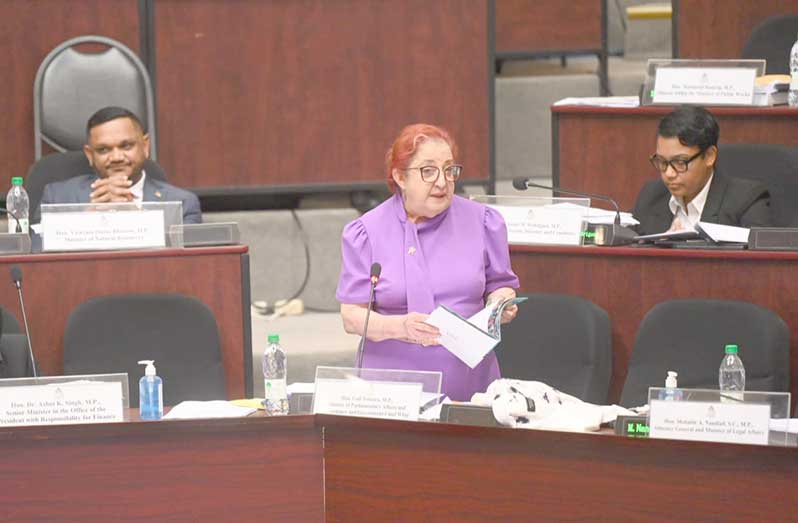
— rejects claims that Guyana lacks anti-corruption safeguards
—points to international progress, pending Integrity Commission reforms
MINISTER of Parliamentary Affairs and Governance, Gail Teixeira, has defended Guyana’s anti-corruption record, highlighting more than 15 pieces of legislation, internationally recognised reforms and plans to further strengthen oversight mechanisms as the government continues efforts to modernise governance and improve transparency.
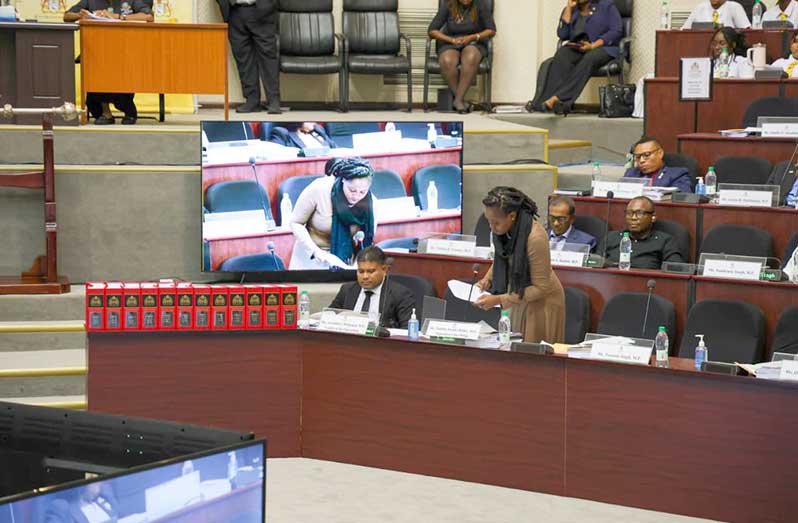
Teixeira was responding to a series of questions from We Invest in Nationhood (WIN) Member of Parliament Tabitha Sarabo-Halley during Friday’s sitting of the National Assembly.
The minister rejected any suggestion that Guyana lacks an anti-corruption legal framework, noting that the country operates under a wide suite of legislation rather than a single law.
“Guyana has over 15 laws relating to anti-corruption and certainly, as we go on, we will reform and modernise as required,” Teixeira said.
She pointed to the Procurement Act of 2004 as a flagship example, noting that it separated ministers from the procurement process and was subsequently adapted by other Caribbean Community (CARICOM) countries.
“Guyana was the only Caribbean country that had a Procurement Act that separated the minister from the procurement process and it was an Act that was borrowed and adapted by all the CARICOM countries,” she said.
The minister argued that Guyana should “be proud” of its legislative record in combating corruption and stressed that existing laws are being actively utilised by the courts.
Teixeira also referenced several recent corruption matters before the courts, including one involving an opposition figure.
Among those is a matter involving WIN leader Azruddin Mohamed and his father, Nazar Mohamed.
Mohamed, identified in court filings as Leader of the Opposition, and his father are wanted by United States authorities in connection with an 11-count indictment, including allegations of conspiracy, mail and wire fraud, and money laundering.
The extradition process was initiated on October 30, 2025, when the United States submitted its request to Guyana.
In response to Sarabo-Halley’s questioning, Teixeira referred to a document provided by the Minister of Home Affairs in written answers, which she said outlined several corruption matters involving “senior officials”.
“You can’t say we don’t want corruption, but when they’re charged, you’re backing them and protesting for them. You can’t have two sides of the law,” she asserted.
ASSET DECLARATIONS
The minister further pointed out that several members of A Partnership for National Unity (APNU) have yet to comply with the Integrity Commission’s asset declaration requirements.
“When we enter this House as MPs, we have to declare our assets. Why are some members of this House not declaring to the Integrity Commission and coming here to ask about anti-corruption and corruption?” she questioned.
She disclosed that the Government intends to bring amendments to the Integrity Commission Act to Parliament to strengthen the legislation and improve enforcement.
When pressed by Sarabo-Halley on what measurable improvements had resulted from the Government’s anti-corruption workshops, Teixeira highlighted a number of institutional and international developments.
She said recent efforts have focused on digital transformation and new platforms to improve transparency, institutional strengthening of anti-corruption agencies, enhanced collaboration between the public and private sectors, public education, and stronger compliance and enforcement mechanisms.
Teixeira reported that Guyana had undergone a second review under the United Nations Convention against Corruption (UNCAC) and had performed well.
“We have done well,” she said, noting that the review document would be published in due course.
She also cited Guyana’s participation in the Inter-American Convention against Corruption and its obligations under regional and international agreements, including the Caribbean Financial Action Task Force (CFATF).
“We are bound by the treaties that we have signed and our progress is noted in terms of the improvements in collaboration and the improvements of the standards and the protocols,” she said.
Teixeira added that Guyana’s practices relating to the Auditor General’s Office, the Public Service Commission, the Integrity Commission and procurement bodies have been recognised as best practices in some international reports.
The minister argued that while cultural and behavioural change takes time, institutions such as the Financial Intelligence Unit (FIU), Special Organised Crime Unit (SOCU), Auditor General’s Office and Guyana Revenue Authority (GRA) continue to build capacity, strengthen databases and improve investigative systems.
In a final follow-up question, Sarabo-Halley asked whether the Government intends to establish an independent body for corruption investigations and asset recovery similar to the State Assets Recovery Agency (SARA), which was closed following the change of administration in 2020.
Teixeira dismissed SARA as a failed model, claiming it expended “hundreds of millions of dollars” without producing a single investigation or court case under the previous APNU-led administration.
“It spent hundreds of millions of dollars, did not bring one case, one investigation, and it was closed down. So SARA is not a good model,” she said.
She also criticised the legislation establishing SARA, arguing that it granted its Chief Executive Officer powers that exceeded those of constitutionally appointed office-holders such as the Director of Public Prosecutions and the Commissioner of Police.
While reiterating that the Government intends, at the appropriate time, to establish an anti-corruption unit informed by international best practices and local experience, Teixeira made it clear that the SARA framework would not be replicated.




