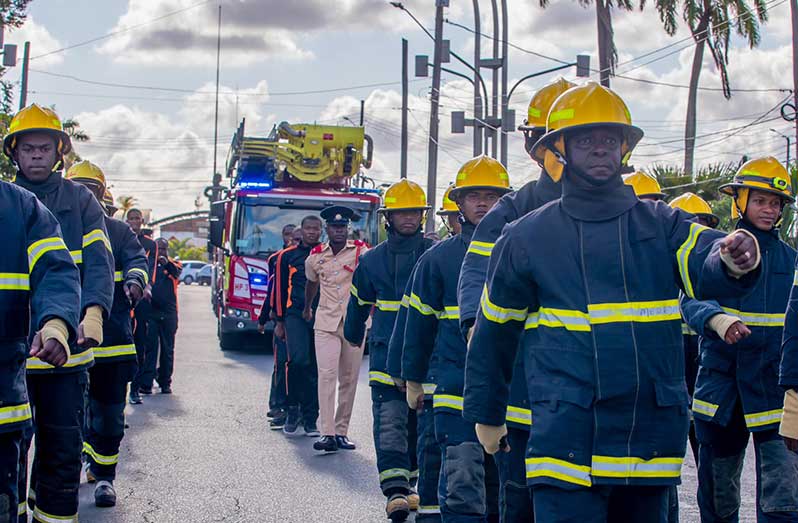
THE Guyana Fire Service is undergoing a major transformation as government moves to modernise the country’s emergency response capabilities to meet the demands of rapid urban expansion, industrial development, and the growing oil-and-gas sector.
Speaking during a press conference on Friday, President Dr Irfaan Ali said billions of dollars have already been invested in upgrading the nation’s firefighting infrastructure, equipment and personnel as part of the government’s broader national security architecture.
“The Guyana Fire Service is a major area that needs massive reorganisation,” the President said while outlining the administration’s plans for a more technologically advanced and responsive fire and emergency service.
This year, the GFS was allocated $6.3 billion in the 2026 National Budget to strengthen emergency response and firefighting capacities. This includes $1.1 billion for new and upgraded fire stations, $1.6 billion for additional firefighting equipment, and $250 million for the procurement of new fire hydrants.
Among the major initiatives announced on Friday is an aggressive nationwide hydrant installation programme aimed at strengthening fire response capabilities in both urban and expanding residential communities.
President Ali disclosed that the government plans to install more than 25,000 hydrants across the country, noting that several thousand have already been installed.
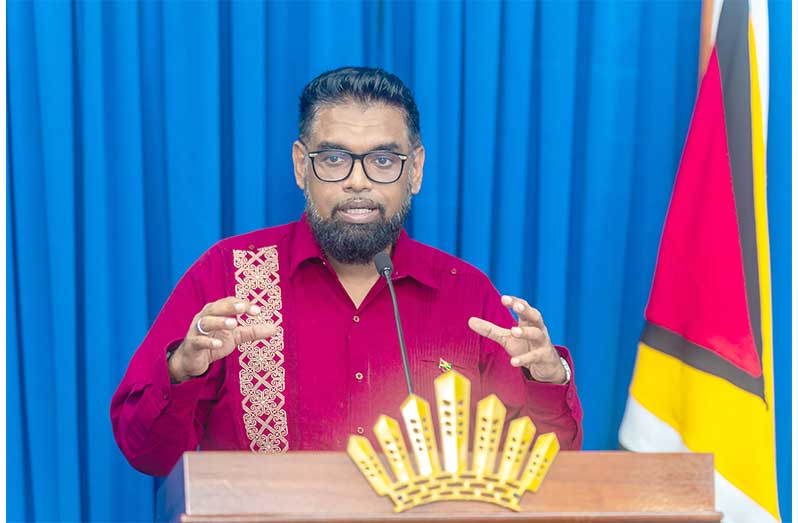
“I think more than 25,000 hydrants to install, that is the first place,” the President said, while explaining that the expansion is necessary as communities continue to grow deeper and more densely populated.
The Head of State explained that government is also investing heavily in smart emergency management systems designed to improve coordination, response times and operational efficiency.
These systems will include GIS-enabled command rooms, integrated CCTV monitoring, digital incident tracking systems, real-time GPS fleet management and smart dispatch centres capable of coordinating emergency responses more efficiently.
President Ali acknowledged public concerns regarding response times, but said improvements have already been recorded.
“It has improved, I must say, looking at the numbers; tremendously. But we are not satisfied at all with where we are,” he stated.
According to the President, the government’s investment strategy also reflects the changing nature of infrastructure and industrial activity in Guyana, particularly with the rapid growth of the oil-and-gas sector and the expansion of high-rise buildings and industrial facilities.
As a result, the administration is procuring more advanced firefighting assets, including rapid intervention vehicles, higher-capacity pumps, ladder trucks, hydraulic platforms, industrial rescue trucks, and chemical containment units.
“We are not in the days where it is a two-storey house, you put up a ladder, and you climb up anymore,” President Ali said while discussing the need for modern hydraulic platforms and specialised equipment.
The President further noted that Guyana’s growing petrochemical and industrial ambitions require specialised firefighting capabilities, including foam tenders and advanced suppression systems designed to respond to industrial and oil-related fires.
“We have to look at foam tenders now, because it’s different types of fires,” he said.
In addition to equipment upgrades, President Ali said government is also investing heavily in training and human resource development within the fire service.
He disclosed that hundreds of new personnel have already been trained as part of the modernisation drive.
The President added that major investments are also being directed toward strengthening airport and port emergency response systems to meet increasing international standards as Guyana expands its aviation and maritime infrastructure.
This includes investments in airport firefighting capacity, port emergency vehicles, offshore platform response systems and fire boats to support expanding port facilities.
President Ali said the modernisation of the Guyana Fire Service forms part of a wider national security and emergency management strategy that integrates technology, surveillance systems, artificial intelligence and coordinated emergency response infrastructure across multiple sectors.
In 2025, five new fire stations were completed in Charity, Parika, Diamond, Soesdyke and Wisroc, complemented by targeted upgrades to existing facilities and living quarters.
In 2026, planned infrastructural investments will encompass the completion and commissioning of seven additional fire stations in Onderneeming, Campbellville, Ruimveldt, Timehri, Mahaicony and Tarlogie, as well as the construction of the Rosignol and No. 38 Village fire stations and a Marine Fire Station in Port Georgetown. For these and other infrastructure initiatives, a total of $1.1 billion was budgeted.
The acquisition of advanced equipment represents a fundamental component in the enhancement of core firefighting capabilities, and overall operational effectiveness. To this end, $527.9 million was expended for the procurement of a crash tender, three ambulances, two water tenders, five all-terrain water tenders and one breathing apparatus refilling vehicle, among others.
In 2026, $1.6 billion is earmarked to procure additional firefighting equipment including two airport firefighting vehicles, four water tenders and two water bowsers.
Additionally, in 2025, government expended $503.1 million to advance procurement for more than 430 fire hydrants, and an additional sum of $250 million was budgeted for procurement more hydrants in 2026.
In 2025, a sum of $47 million was expended toward the training of 91 ranks. In 2026, $50 million is allocated for training in basic and advanced firefighting techniques.