






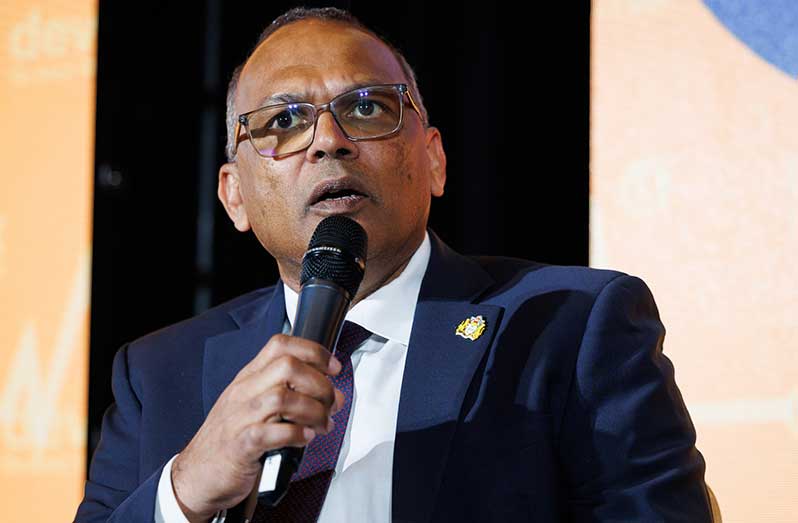
—Minister Anthony at World Health Assembly highlights telemedicine expansion, free public health care, training of 600 nurses
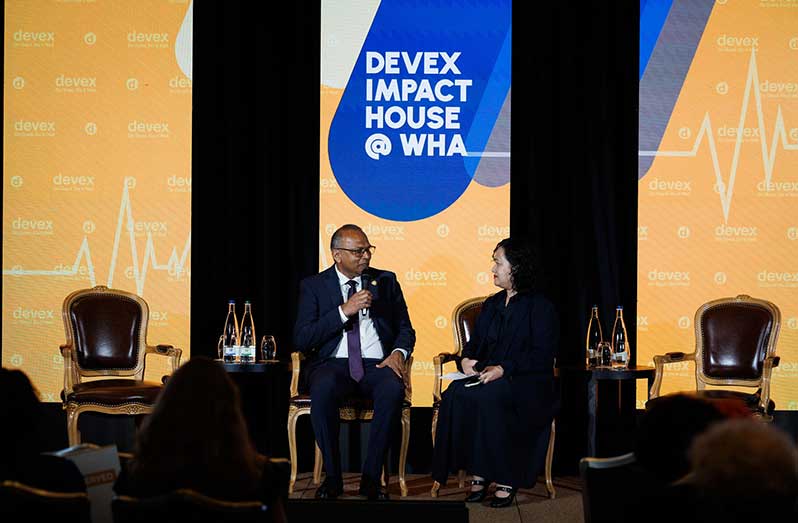
GUYANA’S Health Minister Dr Frank Anthony took centre stage at the Devex Impact House on the sidelines of this year’s World Health Assembly in Geneva on Thursday, delivering a wide-ranging account of Guyana’s innovative health-system transformation.
Addressing an audience of global health leaders, development partners and policymakers, Minister Anthony outlined how Guyana is confronting a double burden of infectious and non-communicable diseases, while simultaneously expanding infrastructure, harnessing technology and training a new generation of health workers.
Highlighting a 150-site telemedicine network, newly opened hospitals and a graduating class of 600 nurses, the minister painted a picture of a health system in rapid evolution, and offered Guyana’s experience as a lesson for other developing nations navigating shrinking health budgets.
TACKLING INFECTIOUS AND CHRONIC DISEASES
While many smaller nations continue to struggle against the dual challenge of non-communicable and infectious diseases, Minister Anthony noted that Guyana has been implementing various systems to tackle both challenges alongside the broader development of the sector. On the infectious disease front, he explained, Guyana’s Ministry of Health has been working to control and manage some diseases, while working to eliminate others entirely.
“We have a programme where we are working on the elimination of leprosy, leishmaniasis, chagas and filaria. We also want to work, maybe over the next two to three years, to eliminate malaria. We are also working very hard to see mother-to-child transmission of HIV eliminated from Guyana,” he said.
He noted, however, that as people live longer, non-communicable diseases become a greater hurdle, adding that in recent years the diets of most people have shifted to include foods that are dangerous to long-term health and wellness.
“Our diet is shifting. With prosperity, people have stopped walking and exercising naturally. So you have lifestyle changes that are a major contributor to the non-communicable diseases,” the minister said.
However, he highlighted a rise in illnesses such as cardiovascular diseases, stroke, diabetes, respiratory illnesses and kidney disease.
Outlining the steps taken to address this, he added, “About four years ago, we established a special programme within the Ministry of Health to look at chronic non-communicable diseases. And in all of these programmes, all of the areas, we have specific programmes that are targeting the control of these particular illnesses.”
HEALTH-CARE ACCESS
The minister also spoke to Guyana’s growth in free public health care. As he explained, Guyana is home to more than 460 health facilities across the country and has built a broad and accessible health-care system.
Noting that equity remains a vital pillar of the sector, the minister highlighted steps taken to advance access to health care across the country. Speaking on the major challenge of reaching remote communities, he noted that beyond infrastructure, the government has invested heavily and strategically to ensure that those communities have access to the same level of care as those along the coast.
Citing investments in telemedicine, he noted that use of solar panels to provide electricity, solar refrigerators to keep vaccines cool, and Starlink to ensure the use of internet-enabled medical devices. This connectivity has allowed doctors to receive real-time patient data, including ultrasounds and ECGs, from health workers in the field, enabling timely remote consultations and, where necessary, medical evacuations.
Strides in human resources have also been a major driver of the sector’s development. As Minister Anthony highlighted, over the last three years, an estimated 5,000 health-care workers have been added to the system. Continued training through the ministry’s more than 20 training programmes continues to bolster the sector.
Speaking on tackling the shortage of nurses, the minister added, “One of the things that we’ve been doing is using a hybrid programme. On the Coursera platform, they’ve given us a portal. We have put our content there, and with the WHO Collaborating Centre in Brazil, we have been able to design this hybrid nursing programme, and we started this about three years ago. So this year in July, we will graduate our first batch of 600 nurses, and that is a big number.”
The minister also cited infrastructural expansion as a key driver of the sector’s success, noting, “Because we have located these hospitals closer to the population in different regions previously that did not have access to secondary and tertiary health care. And so this is helping to give people a quicker way of getting to health care.”
The success of these steps in transforming Guyana’s health system is why the minister is calling on other countries to leverage technology. As he explained, technology removes the need for health-care professionals to always be physically present in remote communities, with Guyana’s 150-site telemedicine network having proven to be a game-changer.
PATIENT CARE
Minister Anthony also highlighted the impact of Guyana’s electronic health record system on the speed and responsiveness of care delivery. He noted that Guyana has scaled up this system to include on-line appointment booking, reducing the hours patients once spent waiting at facilities.
Highlighting this impact, he added, “This is changing how we are able to deliver care, and I think this kind of patient-centric approach is extremely important. So that is another way that, you know, people can, countries can look at to see how you can improve efficiency and allocation.”
Guyana has also taken steps to reduce the cost of medication. Minister Anthony noted that by purchasing medicines centrally and in bulk, the government has been able to bring costs down significantly, making medicines free at the point of delivery across the public system.
A key mechanism in achieving these savings has been leveraging PAHO’s revolving fund for pool procurement, which allows member countries to access medicines at negotiated prices far below market rates.
Highlighting Guyana’s success in this regard, he added, “We have been able to get cost savings because we are buying in such a way. We buy in bulk, and there are mechanisms. So, like in PAHO, there is a revolving fund, so that we leverage pool procurement there, and you get cheaper costs.




