






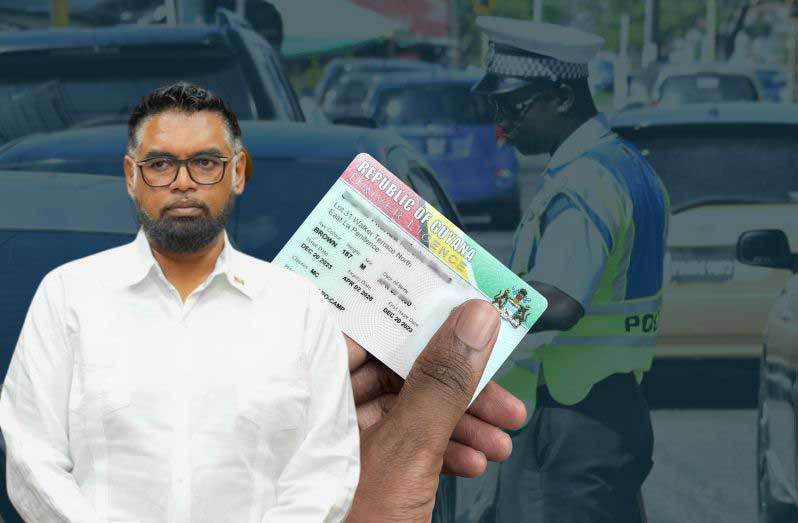
—President Ali says AI-powered enforcement systems are helping authorities identify repeat offenders, suspicious licences
APPROXIMATELY 1,600 drivers across Guyana will soon receive letters from the Guyana Police Force (GPF) over licence or traffic irregularities as the government intensifies a technology-driven crackdown on road offences.
President Dr. Irfaan Ali made the announcement during a press conference on Friday, revealing that the letters will be dispatched by Traffic Chief Mahendra Singh as part of an ongoing audit into the country’s driver licensing system.
According to the President, motorists will be asked to provide information regarding how they obtained their driver’s licences.
“The system allows for automated post audits,” President Ali told reporters.
The move forms part of a broader national strategy aimed at modernising traffic enforcement through Artificial Intelligence (AI), digital systems, and expanded surveillance technology.
DIGITAL DRIVER LICENSING SYSTEM
As part of the overhaul, the traditional written driver’s licence examination is being moved to the Guyana Digital School platform.
President Ali explained that the theoretical examination process will now be fully automated, with questions generated randomly by the system to eliminate any possibility of prior access to test papers.
“They’re now moving the driver’s licence test to the Guyana Digital School platform, where the questions are automatically generated,” the President said, adding:
“If you go now to write it, 10 minutes after, the questions are completely different. It’s random sampling. The system throws up the questions and marks it immediately, so you can know your results there.”
The Head of State stressed that the reforms are intended to improve transparency and integrity within the licensing system while strengthening enforcement and reducing road fatalities.
AI-POWERED ENFORCEMENT
Dr. Ali also disclosed that the authorities have already piloted a mobile AI-enabled traffic enforcement unit capable of scanning passing vehicles and identifying motorists with outstanding tickets or traffic violations.
During a recent operation conducted along the East Coast corridor, the system reportedly identified more than 250 vehicles with unpaid traffic offences in a single night.
Once a vehicle is flagged, the system automatically records the offence, updates the database, and activates sirens to alert nearby officers to intercept the driver.
According to the President, the automated process significantly reduces the scope for manual interference.
He said that these tools are being scaled up nationally, and the same technology will support ongoing investigations into suspicious driver’s licences and traffic records.
The President further explained that AI systems are capable of identifying repeat offenders, generating reports, and integrating those reports directly with the judicial system to speed up enforcement procedures.
BROADER ROAD SAFETY PUSH
The measures form part of the government’s wider national security and public safety strategy leading up to 2030, which includes expanded CCTV coverage, smart traffic lights, drones, and predictive analytics systems.
The Guyana Chronicle had previously reported that the authorities are also developing a centralised digital registry to track motorists’ histories, including previous offences and convictions.
The intensified enforcement drive comes amid growing concern over road fatalities across the country.
Last month, reports indicated that more than 30 persons had already lost their lives in road accidents for the year, with speeding identified as a major contributing factor.
In response, the government has moved to implement stricter penalties under the Motor Vehicles and Road Traffic Act.
Fines for excessive speeding have been significantly increased, with some offences now attracting penalties of up to $200,000 in addition to demerit points.
Authorities have also intensified enforcement against third-lane driving violations, with offenders facing court prosecution and fines of up to $150,000.
Meanwhile, offences such as operating uncertified vehicles and failing to produce a driver’s licence now carry fines of $5,000, while seatbelt violations are increasingly being detected and enforced through camera surveillance systems.




