





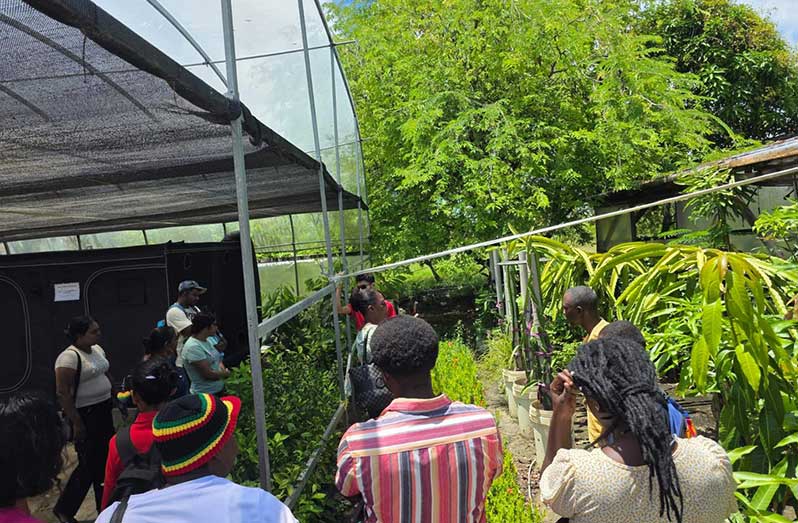
RESIDENTS in Region Five are receiving training in climate-smart agricultural techniques under a government-supported initiative aimed at strengthening food production, expanding employment opportunities and building more resilient farming communities.
The programme, being implemented through the WIIN Climate Smart Agriculture initiative, is a collaboration between the Ministry of Human Services and Social Security and the National Agricultural Research and Extension Institute (NAREI).
According to the ministry, participants are undergoing both practical and theoretical training in a range of modern agricultural practices, including hydroponics, grafting, budding and shade house management.
As part of the programme, trainees also visited the Fort Wellington Model Farm and NAREI facilities, where they observed climate-smart agriculture systems and technologies being implemented in real-world settings.
Officials say the initiative is intended to equip residents with skills that can support self-employment, entrepreneurship and long-term food security while promoting sustainable farming practices.
Climate-smart agriculture has become an increasing priority in Guyana as the country seeks to modernise its agricultural sector and improve resilience to climate change, flooding and changing weather patterns. The approach focuses on improving productivity while reducing environmental impact and strengthening farmers’ ability to adapt to climate-related challenges.
Hydroponics and shade house cultivation, in particular, have gained attention as methods capable of increasing crop yields while using less land and water. Such techniques are also seen as important tools for improving year-round agricultural production.
The WIIN programme forms part of broader efforts by the government to support vulnerable groups and create economic opportunities through skills training and community-based initiatives.
Agriculture remains one of Guyana’s traditional economic pillars despite rapid expansion in the country’s oil-and-gas sector.





