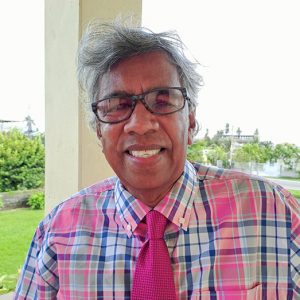
AFTER primary school, none of the Kissoon siblings went on to high school. For me, life had little meaning on D’Urban Street in Wortmanville. You get up in the morning and there is hardly food but plenty of time to do nothing. Before I go out onto the roadways, I would listen to Ron Robinson.
I was so sad when Ron died. I admired his radio voice when I was 14 years old and decades after, the great man and I became friends. A Portuguese salesman named Brian Sadler who worked as a commercial salesman for a company that was at the corner of Quamina and Carmichael Streets, sold my father a radio for a very cheap price.
Mr Sadler belonged to the Portuguese outfit named the Non-Pareil Club at the junction of Camp Road and Woolford Avenue, and my father was the chief groundsman at Non-Pareil. Mr Sadler did not know we didn’t have a radio at home, so he sold my father a transistor very cheaply and that little thing we would listen to.
All Georgetowners listened to Ron Robinson in the mornings. It was from Ron I learnt about the saxophone music of the Italian musician Fausto Papetti. Papetti was not a sophisticated saxophonist at all like Grover Washington Junior, but I found something special in his music. I became a UG graduate and went to Canada to study.
I lived in downtown Toronto where there was a huge record store named “Sam the Record Man.” I walked into Sam’s and saw Pappeti and bought every Papetti record. I still have dozens of Papetti. I gave some away. If you want some, please call me at 614-5927 or fredkissoon@yahoo.com. I am getting on in age and want to give away my record collection.
One morning, (I was about 16 years), I heard Ron played a song that I instantly liked. I mean instantly. It was a song about a girlfriend that had long gone, but the guy hopes she will return one day. He kept souvenirs of their days together and those souvenirs reminded him of her which he referred to as “traces of love.” He lives in hope that she will return, but will die in despair because she will never come back.
The song was titled “Traces” by Classics 1V with lead singer Dennis Yost. Of all the long-haired, soft-rock groups from the 1960s, Dennis Yost had an unusual voice. His voice stood out. “Traces” is one of the best love songs ever written. Its inherent rich texture is magnified by the inherent rich smoothness of Yost’s voice.
There is a company in the UK named Beat Goes On Records (BGO Record). It puts four albums on one CD and sells it for 10 American dollars, which can be bought from Amazon. I bought 32 Johnny Mathis albums on eight CDs. Imagine the pure magic of Mathis on eight CDs. So recently, BGO put four Classic 1V albums on one CD and I bought it for $12 US. At 16 years of age, through Ron Robinson, I came to love Dennis Yost and Classics 1V.
Yesterday morning (Sunday), I was driving to the National Park and the CD that was playing in my car stereo was from Classics 1V and of course “Traces” was on. I am excessively fond of Johnny Mathis. I think he can cover any song and do it better than the original singer.
He covered “Traces” on an album titled “Love Story.” But Johnny’s couldn’t outdo Dennis Yost. Many artistes have covered “Traces,” but the Dennis Yost original cannot be surpassed.
A tinge of sadness came over me as I drove into the National Park. Yost fell ill at age 65 and was in financial trouble and couldn’t pay his hospital bill. A benefit concert was held for him, but it did not raise the amount needed for the brain operation. Classics 1V was a huge act in the US in the 1960s and around the world. But at age 65, the man who serenaded the American population couldn’t pay his medical bill.
I will go to my grave and always wonder how people could vote for political parties in the US where a jet fighter costs a billion American dollars, but the government does not offer free medical treatment for their citizens who cannot afford it.
How can people vote for politicians who spend literally trillions on their armed forces but cannot spend money on free medical treatment? Dennis Yost would have lived if he were a Guyanese. It didn’t matter the cost of the brain operation. He would have walked into the Georgetown Public Hospital and got his operation free of cost.
DISCLAIMER: The views and opinions expressed in this column are solely those of the author and do not necessarily reflect the official policy or position of the Guyana National Newspapers Limited.