






THE Canadian-funded Justice Education Society (JES) Guyana Programme will officially conclude on September 30, bringing to a close four years of collaboration with the Office of the Director of Public Prosecutions (DPP) aimed at educating hinterland communities about domestic and sexual violence.
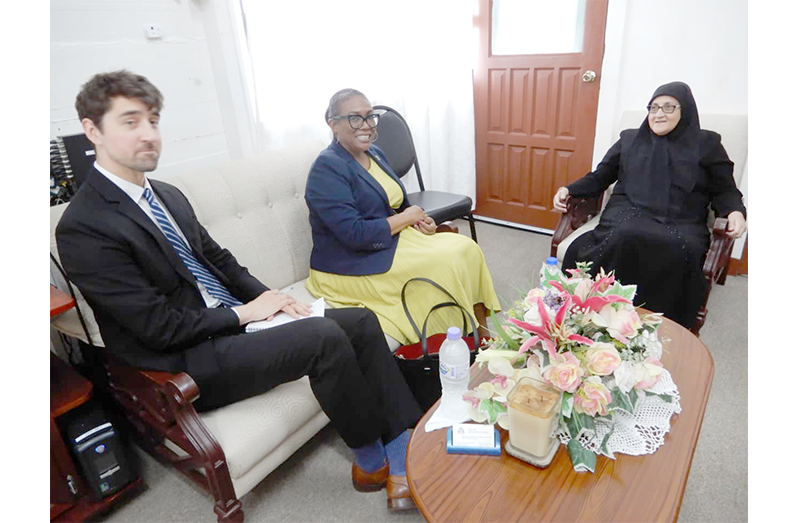
The impending conclusion of the programme was highlighted during a recent farewell courtesy call on Director of Public Prosecutions, Shalimar Ali-Hack, by Lisa Thompson, Country Director of the Justice Education Society, who was accompanied by International Programme Director, Gavin Martyn. During the meeting, Thompson thanked the DPP’s Chambers for its support through a series of joint outreach and community engagements, particularly in hinterland Regions One and Nine.
According to the DPP, the programme made significant strides in sensitising Amerindian communities, especially women and girls—on issues surrounding domestic and sexual violence.
Ali-Hack said the initiative also demonstrated the importance of targeting village leadership, noting that the training of Toshaos and senior village councillors remains critical to long-term change.
She stressed that education remains central to building stronger communities and fostering generational transformation.
During the engagement, the DPP reflected on the message she consistently shared during outreach visits: that young Amerindians should take their education seriously, from primary through tertiary level, and then return to their communities equipped to contribute to local development.
Ali-Hack also noted that many Amerindian communities are now benefitting from electricity, internet access and ICT hubs, opening new opportunities but also exposing residents to social challenges.
She pointed to the growing presence of loud music, intoxicants and illicit drugs in some communities, warning that these issues must also be taken into account during public education and outreach efforts.
Thanking the Canadian-funded initiative for its contribution, the DPP said Canada’s own experience with Indigenous communities places it in a strong position to offer guidance in matters relating to Guyana’s Amerindian populations, particularly in areas linked to technology, connectivity and community development.
Over the past four years, the DPP’s Chambers and JES conducted outreach programmes in several hinterland communities, including Moruca and Baramita in Region One, as well as the Deep South Rupununi villages of Potarinau, Shulinab, Meriwau and Quiko in Region Nine.
Beyond community outreach, the programme also partnered with the DPP’s Chambers to provide cultural sensitisation training for members of the Guyana Police Force, police prosecutors and legal staff attached to the DPP’s Office in those regions.
The conclusion of the JES Guyana Programme marks the end of a notable chapter in justice education and community engagement in the hinterland, where efforts to improve awareness of violence, rights and access to justice have increasingly been viewed as essential to strengthening vulnerable communities.



