






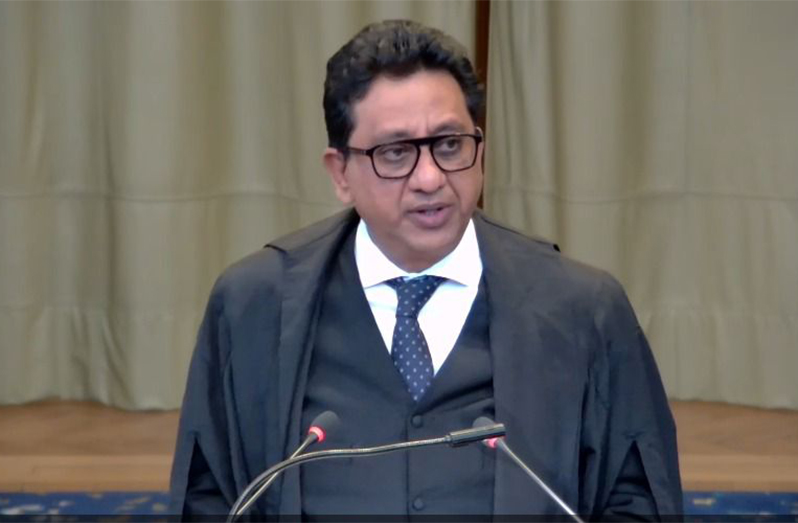
— says Venezuela has “no good answer” to Guyana’s case
–maintains Essequibo controversy threatens Guyana’s existence as sovereign state
Attorney General and Minister of Legal Affairs Anil Nandlall, SC, on Friday urged the International Court of Justice (ICJ) to deliver a “clear and complete” judgment affirming the validity of the 1899 Arbitral Award, warning that any ambiguity could allow Venezuela to continue laying claim to vast portions of Guyana’s territory.
Delivering Guyana’s closing rebuttal in the historic Essequibo border case, Nandlall described the proceedings as one of immense national importance, stressing that the controversy has overshadowed Guyana’s existence since independence in 1966.
“For more than 60 years, Venezuela has laid claim to more than 70% of Guyana’s sovereign territory,” Nandlall told the court. “Generations of Guyanese, mine being one of them, have grown up under the long and threatening shadow caused by Venezuela’s claim to nearly three quarters of our country.”
The Attorney General said the controversy has severely affected Guyana’s development, security and national wellbeing.
“The loss of the territory claimed by Venezuela would eviscerate Guyana. Indeed, the country as we know it would cease to exist,” he warned.
Nandlall said Guyana nevertheless placed its trust in international law and the judicial process when it approached the ICJ in 2018 seeking confirmation of the validity of the 1899 Arbitral Award, which legally established the boundary between Guyana and Venezuela.
He told the judges Guyana had full confidence in three things: the validity of the 1899 Arbitral Award, the United Nations Secretary-General’s decision to send the matter to the ICJ, and the court’s ability to fairly resolve the controversy.
“From Guyana’s perspective, there is no higher value or greater imperative than respect for international law,” Nandlall stated.
The Attorney General said the proceedings over the last eight years have vindicated Guyana’s confidence in the court, noting that the ICJ had already confirmed both its jurisdiction and the admissibility of Guyana’s application.
At the same time, he accused Venezuela of persistently attempting to avoid a determination on the merits of the case.
“Since the start of these proceedings, Venezuela has strained every sinew to avoid the court delivering a judgment on the merits of Guyana’s application,” Nandlall said.
According to him, Guyana’s legal team demonstrated that Venezuela’s arguments against the court’s jurisdiction and against the 1899 Arbitral Award were unsupported by either the text or history of the 1966 Geneva Agreement.
“Venezuela knows that it has no good answer to Guyana’s case,” he asserted.
Nandlall also defended the validity of both the 1897 Treaty of Washington and the 1899 Arbitral Award itself, rejecting Venezuela’s allegations of fraud, coercion or procedural impropriety.
“The arbitral tribunal faithfully fulfilled the mandate conferred by the 1897 Treaty,” he said. “Neither the terms of the award nor the way it was reached involved any excess of power or impropriety by the eminent members of the tribunal.”
He argued further that Venezuela accepted and respected the award for more than six decades before reversing its position in the 1960s.
“In short, the award was and remains valid and binding on the parties,” Nandlall declared, adding that the award constituted “the full, perfect and final settlement of the boundary between Venezuela and Guyana.”
The Attorney General also sharply criticised Venezuela’s actions toward Guyana’s Essequibo region since independence, accusing Caracas of repeatedly violating Guyana’s sovereignty.
He pointed to Venezuela’s occupation of Ankoko Island, military incursions, and more recent attempts to incorporate the Essequibo region into Venezuela through domestic legislation despite provisional measures issued by the ICJ.
“Venezuela’s attempts to annex its smaller neighbour’s territory, its attempts to erase and rewrite the history of Guyana’s Essequibo region, and its innumerable bellicose threats to Guyana’s sovereignty and territorial integrity are all redolent of colonialism,” Nandlall submitted.
In concluding his address, Nandlall stressed that the wording of the ICJ’s eventual ruling will be critically important for lasting peace and certainty.
“If the court accepts Guyana’s arguments, as we are confident that it will, then it is essential that the court’s judgment directly, explicitly and unambiguously affirms the validity of the 1899 award in its integrity and the boundary which it established,” he said.
“Any ambiguity or qualification in the court’s judgment will inevitably be seized upon by Venezuela as a basis for continuing to lay claim to vast swaths of Guyana’s sovereign territory,” the Attorney General warned.
A final ruling from the ICJ is not expected until later this year, according to Guyana’s Ministry of Foreign Affairs and International Cooperation.




