






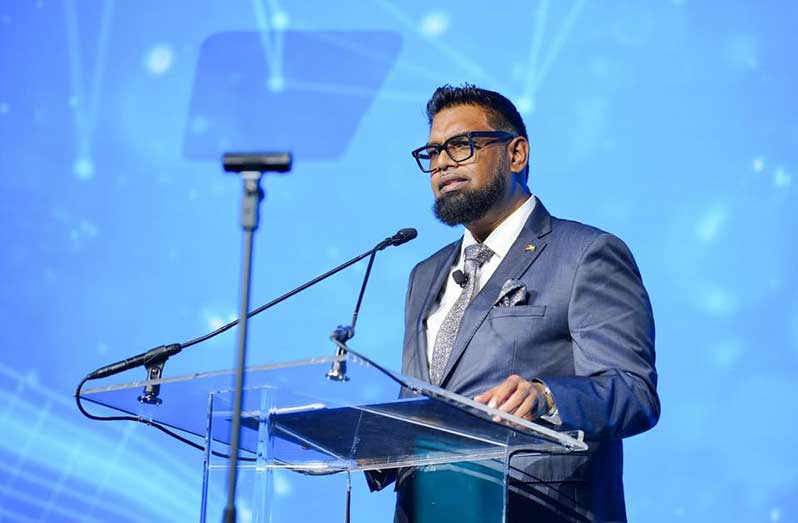
– tells OTC developing countries face widening investment gap
PRESIDENT Dr Irfaan Ali has called for a more equitable global financing framework to support the energy transition, noting that developing countries risk being left behind despite experiencing the fastest growth in energy demand.
The Head of State was at the time delivering remarks at the Offshore Technology Conference (OTC) in Houston, Texas, during which he underscored that while global investment in energy is increasing, it is still unevenly distributed, among other things.
Dr. Ali stated that total global energy investment reached approximately US$3.3 trillion in 2025, the highest level ever recorded, with a majority directed towards clean energy.
However, the distribution of this investment, he noted, reveals deep structural imbalances.
“Global clean energy investment is highly concentrated,” President Ali said. He added that the United States, China and the European Union continue to account for more than 80 per cent of total spending.
However, regions with rapidly growing energy demand, specifically in the global south, only receive a fraction of that financing.
Africa, he noted, accounts for less than three per cent of global clean energy investment, while Latin America, South Asia and the Middle East also lag significantly behind.
This disparity, the President said, presents a fundamental challenge to achieving a truly global and inclusive energy transition.
“The regions with the fastest-growing energy demand are not the regions receiving the largest share of investment,” he stated.
Dr Ali noted that this mismatch between demand and financing risks deepens inequality within the global energy system, potentially leaving developing economies reliant on outdated or less efficient energy infrastructure.
“This raises a fundamental question. Can the energy transition succeed if the regions with the greatest need have limited access to capital?” he asked.
According to the President, the financing gap facing developing countries is substantial.
He noted that estimates indicate that emerging markets and developing economies, excluding China, will require approximately US$2.5 trillion annually by 2030 for energy and climate-related investments, rising to about US$3.3 trillion annually by 2035.
“This is not a marginal gap. It is a structural financing deficit,” he emphasised.
Against this backdrop, he stated that public financing alone cannot bridge the divide as many developing nations depend on multilateral development institutions and concessional funding to support their energy transitions.
“The central and unavoidable question is from where, and on what terms, will the financing gap for the global energy transition be secured?” he said.
As such, Dr. Ali told the conference that without deliberate efforts to address these disparities, the global transition could become fragmented, meaning it would progress rapidly in developed economies while moving slowly in developing regions.
He warned that an outcome like this would undermine the broader objectives of climate action and sustainable development.
To this end, President Ali urged governments, financial institutions and private sector stakeholders to adopt a more inclusive approach, ensuring that capital flows align with global demand patterns and development needs.
He further championed the importance of co-operation over competition in addressing the energy challenge, noting that the transition must not be approached through narrow or exclusionary policies.
“We must find a balanced approach to the energy needs of the world and not be fighting as to which is better than the other,” he said.




