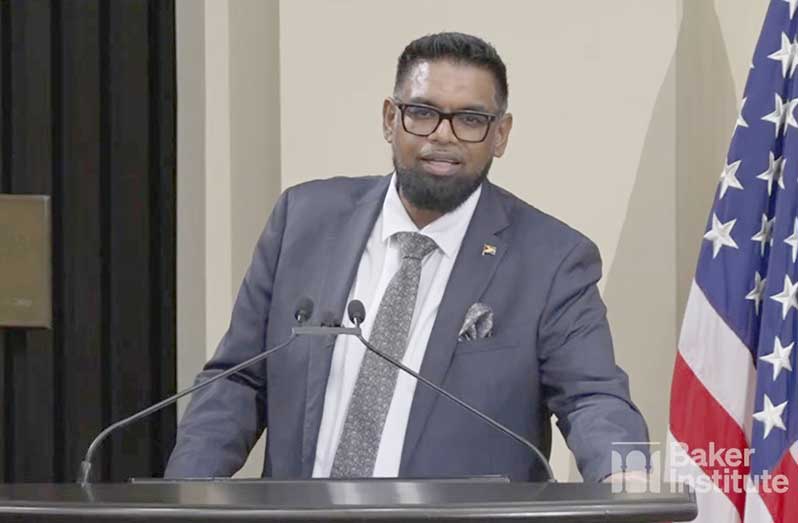
–President Ali shares country’s experience with Houston-based energy studies centre
PRESIDENT Dr Irfaan Ali has outlined Guyana’s approach to transforming the country’s vast natural assets into a model of inclusive and sustainable development.
The Head of State was, at the time, sharing Guyana’s experience and expertise at the Baker Institute’s Center for Energy Studies conversation series at Rice University in Houston, Texas.
During his remarks, President Ali told the gathering that Guyana is deliberately shaping an economic framework that maximises resources while addressing global challenges.
“We are positioning ourselves to live an economic reality that is based on optimising our natural asset to its fullest,” President Ali said.
He noted that Guyana’s strategy goes beyond oil production, focusing instead on building an economy that integrates energy, environmental stewardship and social advancement.
The Head of State said that the country is pursuing a balanced framework in which traditional energy and renewable investments coexist, while also being supported by technology and innovation to reduce environmental impact.
“We do not see Guyana as a petro-producing country that adds problems to the world,” he said, noting: “We see Guyana as utilising this advantage to demonstrate… that development powered by energy can coexist with environmental stability.”
A major component of this is the preservation and monetisation of Guyana’s environmental assets.
Dr Ali highlighted that even as oil production expands, the country maintains one of the world’s lowest deforestation rates, with more than 85 per cent forest cover intact.
It was against this backdrop that he pointed out that global systems have not adequately rewarded countries that preserve their forests, noting the imbalance in how environmental services are valued internationally.
“Here is a country that has decided… we are keeping it standing, but we are opening up the forest for international monitoring,” he said, while advocating for market-based mechanisms to ensure fair compensation for climate and biodiversity services.
Meanwhile, President Ali outlined a multi-pillar strategy for economic diversification, underpinned by revenues from the oil and gas sector.
He disclosed that these revenues are being channelled into manufacturing and industrial development, allowing Guyana to move beyond raw production into value-added industries such as petrochemicals, agro-processing and food production.
With investments in gas-to-energy projects expected to significantly reduce electricity costs, he told the energy studies centre that Guyana is positioning itself as a major supplier of processed food within the Caribbean and wider region.
To this end, he pointed to Guyana’s strategic location as a gateway to northern Brazil and a potential hub for regional integration.
Dr Ali said ongoing investments in roads, ports, bridges and energy infrastructure are aimed at unlocking cross-border economic opportunities and enhancing competitiveness.
Further, he highlighted that Guyana is investing heavily in digitisation, artificial intelligence and technology to accelerate development and improve efficiency.
President Ali noted that energy must not only be produced but also utilised domestically to create value and drive economic expansion.
“It is not only about the production of energy, it is how much of that energy you can consume yourself to add value and create multiplier effect within your countries,” he said.
Additionally, Dr Ali highlighted the government’s people-centred approach focused on human capital development, with investments in education, healthcare and skills training that are intended to ensure citizens benefit directly from economic growth.
“It is people-centred… understanding how these investments can uplift people,” he said.
To this end, he outlined that Guyana’s experience offers a practical example of how resource-rich countries can pursue growth responsibly, balancing economic expansion with environmental protection and social progress.