






–says allegations of U.S.–British collusion implausible & unsupported by historical record
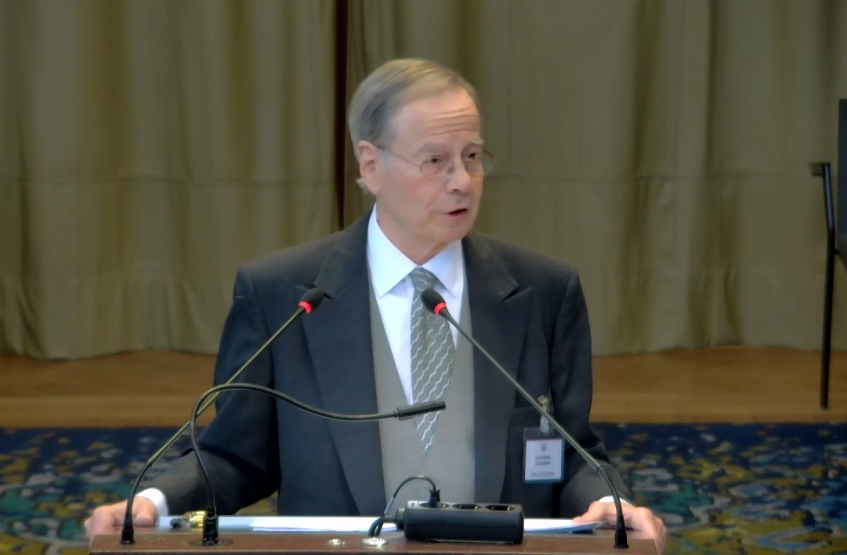
International lawyer Paul Reichler mounted a detailed defence of the 1897 Treaty of Washington, arguing that Venezuela’s attempt to invalidate the agreement underpinning the 1899 Arbitral Award is historically and legally unsustainable.
Presenting submissions in the ongoing border controversy case before the International Court of Justice (ICJ), Reichler told the Court that the treaty—agreed between Venezuela and Great Britain—was the legitimate basis for arbitration that ultimately settled the boundary.
“I will address you on the 1897 Treaty of Washington, the treaty between Venezuela and Great Britain by which they agreed to arbitrate their territorial dispute, and pursuant to which the dispute was arbitrated two years later, resulting in the award of 3 October 1899,” he stated.
He explained that Venezuela’s case rests heavily on attacking that treaty’s validity.
“In these proceedings, of course, Venezuela challenges the validity of that award. The first reason it gives for the alleged invalidity of the award is the purported invalidity of the 1897 treaty,” Reichler said.
Reichler underscored that Venezuela had long accepted the arbitral outcome, only reversing its position decades later.
“As the court is well aware, Venezuela accepted, respected, and complied with the 1899 arbitral award for more than 60 years,” he noted.
He added that the first formal challenge came in 1962, and even then, Venezuela continued to recognise the treaty as valid.
“It was not until 1963, 66 years after it ratified the treaty, that Venezuela first began to find fault with it,” he told the Court.
Reichler laid out the historical background to the treaty, pointing to decades of failed negotiations and rising tensions over the disputed territory between the Essequibo and Orinoco rivers.
He emphasised that Venezuela itself had repeatedly sought arbitration and enlisted the support of the United States of America to pressure Britain into agreeing.
“Recognising that it was unable to stop the British diplomatically or militarily, Venezuela implored them to settle the dispute by arbitration. But the British refused,” he said.
According to Reichler, it was only sustained U.S. intervention that broke the deadlock.
“It was clear that the possibility of submitting the dispute to arbitration could have materialised only with the support of the United States,” he stated.
Turning to Venezuela’s legal arguments, Reichler rejected claims that the treaty was the product of collusion between the United States and Great Britain.
“Mr. President, neither Venezuela’s contention of fraud nor its contention of error withstands scrutiny or is even plausible,” he argued.
He described the allegations as illogical and unsupported by evidence.
“They strain credulity, requiring you to conclude that the United States… made a complete volte-face… by switching sides and supporting Britain’s interest in the disputed territory to the prejudice of Venezuela’s,” Reichler said.
Reichler further contended that documentary evidence shows Venezuela was actively involved in the negotiations and trusted U.S. representatives to advance its interests.
“To the contrary, the evidence shows that Venezuela trusted [then U.S. Secretary of State] Mr. Richard Olney, as well as his boss, President Grover Cleveland, to protect its interests,” he told the Court.
He pointed to records demonstrating that Venezuelan representatives were consulted and that their proposals were incorporated into the treaty text.
“This is entirely fallacious. It is completely refuted by the documentary evidence, as you will now see,” Reichler said in response to claims that Venezuela had been excluded.
The validity of the 1897 Treaty remains a central pillar in the broader case concerning the legitimacy of the 1899 Arbitral Award, which legally established the boundary between Guyana and Venezuela.
Reichler’s submissions sought to reinforce Guyana’s position that the treaty—and by extension the award—was lawfully concluded and remains binding under international law.
As hearings continue, the ICJ is expected to weigh these historical and legal arguments in determining the merits of Guyana’s case.
Guyana has called on the ICJ to uphold the validity of the 1899 Arbitral Award.
Rulings of the ICJ are binding on parties.




