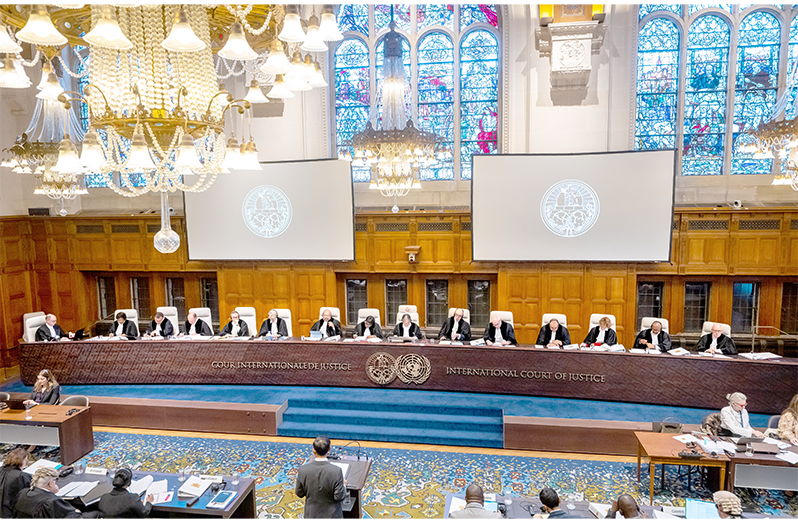
THE International Court of Justice (ICJ) will commence public hearings on the merits of the long-running border controversy between Guyana and Venezuela from Monday, May 4 to Monday, May 11, 2026, at the Peace Palace in The Hague, Netherlands.
The hearings mark a critical stage in the case concerning the validity of the October 3, 1899 Arbitral Award, which determined the boundary between the Colony of British Guiana and Venezuela, and continues to define the present-day border between Guyana and Venezuela.
In a statement issued by the Ministry of Foreign Affairs and International Co-operation on Friday, the government said it is approaching the hearings with “full confidence in the strength of its case,” grounded in historical evidence and established principles of international law.
The case was formally filed by Guyana on March 29, 2018, seeking a final and binding ruling affirming the legal validity of the 1899 Award and the boundary determined thereafter.
According to the government, that boundary was further confirmed through a 1905 agreement between the then British Guiana and Venezuela, which adhered to the unanimous decision of the Arbitral Tribunal.
The ICJ has already ruled twice on its jurisdiction in the matter, first on December 18, 2020, and again on April 6, 2023, both times affirming that it has the authority to hear and determine the case.
The ICJ also rejected Venezuela’s objections to its jurisdiction, and confirmed that it could proceed to consider the substantive issues raised by Guyana.
In addition to jurisdiction rulings, the ICJ has issued multiple provisional measures aimed at preserving the status quo while the case is pending.
In its December 2023 Order, the court directed Venezuela to refrain from any action that would alter the current situation in the disputed territory, where Guyana exercises administration and control.
More recently, in May 2025, the court strengthened those measures, ordering that Venezuela must not conduct or prepare to conduct elections in the territory in dispute.
Guyana had sought these measures amid concerns over actions by Venezuela that could interfere with its sovereignty over the Essequibo region.
The upcoming hearings will focus on the merits of the case, where both countries will present their full legal arguments.
According to the court’s schedule, Guyana will open the proceedings on Monday, May 4, with its first round of oral arguments from 10:00 a.m. to 1:00 p.m. and again from 3:00 p.m. to 6:00 p.m.
Venezuela will then present its first round of arguments on Wednesday, May 6, during the same time slots of 10:00 a.m. to 1:00 p.m. and 3:00 p.m. to 6:00 p.m.
The second round of oral arguments will follow on Friday, May 8, when Guyana will present from 3:00 p.m. to 6:00 p.m., while Venezuela will conclude the hearings on Monday, May 11, also from 3:00 p.m. to 6:00 p.m.
The proceedings will be conducted in the court’s official languages, English and French, and will be streamed live and made available on demand via the ICJ’s website and UN Web TV.
The ICJ, the principal judicial organ of the United Nations, is tasked with resolving legal disputes between states in accordance with international law.
Guyana maintains that the 1899 Arbitral Award is legally binding and settled the land boundary definitively, while Venezuela has challenged its validity.
Guyana has consistently argued that the award definitively settled the border over a century ago.
In accordance with the Geneva Agreement, Guyana and Venezuela engaged in more than two decades of Good Offices efforts under the auspices of the United Nations Secretary-General in an attempt to reach a peaceful resolution.
However, on January 30, 2018, after the process failed to yield meaningful progress, the Secretary-General determined that the Good Offices process had run its course and selected judicial settlement by the ICJ as the next means of resolving the controversy.
Guyana has since received widespread international backing for its position, with support from the Caribbean Community, the Commonwealth, the European Union, the Organisation of American States and other global partners. They have also expressed concern over actions by Venezuela that could heighten tensions and threaten regional stability.