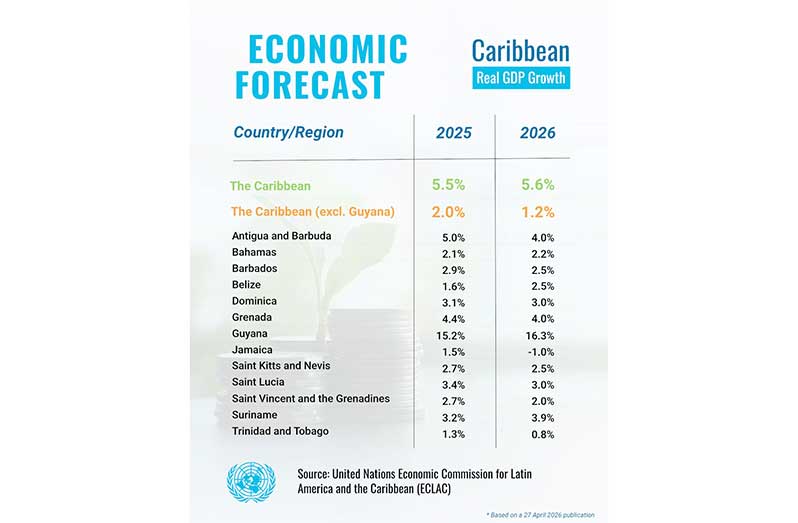
GUYANA is expected to remain the principal engine of economic expansion in the English- and Dutch-speaking Caribbean in 2026, with growth projected at 16.3 percent, according to updated regional forecasts released by the United Nations’ Economic Commission for Latin America and the Caribbean (ECLAC).
The latest Economic Forecast shows that the subregion is expected to grow by 5.6 percent in 2026, slightly higher than the 5.5 per cent recorded in 2025.
However, ECLAC noted that this headline performance is heavily influenced by Guyana’s exceptional expansion, driven primarily by the continued development of its oil and gas sector.
When Guyana is excluded from the calculation, regional growth falls sharply to 1.2 percent in 2026, down from 2.0 percent the previous year, underscoring the uneven nature of economic performance across the Caribbean.
Across Latin America and the Caribbean (LAC) as a whole, average growth is projected at 2.2 percent in 2026, a slight downgrade from the 2.3 percent forecast in December 2025. ECLAC attributed the weaker outlook to a more challenging global environment marked by heightened geopolitical tensions, tighter financial conditions, and renewed inflationary pressures.
REGIONAL SLOWDOWN AND GLOBAL PRESSURES
The report indicates that 24 of the region’s 33 economies are expected to experience slower growth in 2026, while only seven are projected to accelerate. This pattern, ECLAC warned, reflects a broader trend of subdued regional expansion, with growth hovering around 2.3 percent annually for four consecutive years.
External conditions remain a key constraint. Rising geopolitical instability, particularly conflicts in the Middle East, has contributed to volatility in global commodity and financial markets. Oil prices in early 2026 were reported to be 74 percent higher than December 2025 levels, increasing production and transportation costs worldwide.
At the same time, food prices remain elevated, while key global trading partners—including the euro area, China, and India—are experiencing slower growth. The World Trade Organization (WTO) has projected global trade growth of 2.7 percent in 2026, down from 4.7 percent in 2025.
DOMESTIC DEMAND AND INFLATION PRESSURES
ECLAC noted that regional growth is also being constrained by weaker private consumption and only moderate investment recovery in most economies. Employment growth is expected to slow to 1.1 percent in 2026, compared with 1.5 percent in 2025.
Inflationary pressures are also expected to persist, with median inflation in the region projected to exceed 3 percent in 2026, up from 2.4 percent the previous year. South America is particularly affected, with exchange rate volatility and higher import costs adding to domestic price pressures.
Uneven performance across subregions
The forecast highlights significant disparities within the region: South America is projected to grow by 2.4 percent in 2026, down from 2.9 percent in 2025; Central America is expected to slow to 2.2 percent, compared with 2.3 percent in 2025; and Caribbean economies (excluding Guyana) are projected to expand by just 1.2 percent.
Within the Caribbean, performance varies widely. Several economies are expected to grow above 4 per cent, while others remain below 3 percent, and a few are projected to contract. Guyana remains a clear outlier, with double-digit expansion continuing to lift the regional average.
Risks and structural constraints
ECLAC cautioned that risks to the outlook remain tilted to the downside. These include sustained high global interest rates, continued volatility in commodity markets, inflationary pressures from energy and food costs, and weak domestic demand across several economies.
The commission also pointed to long-standing structural challenges in the region, including limited fiscal space, external vulnerabilities, and institutional constraints that continue to weigh on growth potential.
In response, ECLAC stressed the need for stronger domestic resource mobilisation, improved governance, and policies aimed at boosting productivity and investment to strengthen long-term economic resilience across Latin America and the Caribbean.