






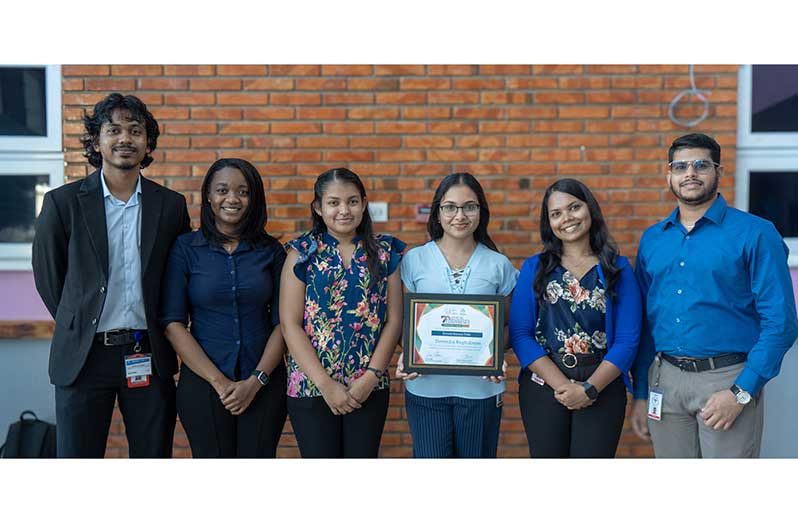
A team of young medical interns from the Georgetown Public Hospital Corporation (GPHC) has earned regional acclaim after winning the prestigious Donald Simeon Prize at the Caribbean Public Health Agency (CARPHA) Annual Health Research Conference, marking a major achievement for Guyana’s medical research community.
The group also secured the award for Best Guyanese Paper with their study, “From Bite to Insight: Clinical, Demographic and Laboratory Predictors of Severe Outcomes in Adult Dengue Fever Patients,” highlighting their contribution to tackling one of the region’s most persistent public health challenges.
Conducted in collaboration with the University of Guyana School of Medicine, the research was led by interns A. Amichand, O. Arjun, A. Muthu, A. Parsaud, A. Pasha, D. Raghubansi, and T. Walrond, under the supervision of R. Dubraj and R. Gobin.
Focusing on dengue fever, which remains endemic across Guyana and the wider Caribbean, the study analysed 289 adult patients with laboratory-confirmed infections who sought care at GPHC’s Accident and Emergency Department between July 2023 and January 2025. Using a retrospective and analytical approach, the researchers aimed to address a critical question faced daily by frontline clinicians: how to quickly identify patients at risk of developing severe illness.
Their findings point to platelet count as the most significant predictor of severe dengue, with lower levels strongly linked to worse outcomes. Additional risk factors included older age, delayed medical attention—particularly in cases where symptoms persisted beyond eight days—and the presence of warning signs identified by the World Health Organization. Conversely, a normal white blood cell count was found to have a protective effect.
Notably, other commonly considered factors such as gender, vital signs, liver enzyme levels, haematocrit, and pre-existing conditions like hypertension and diabetes showed no significant impact on patient outcomes within the study’s model.
The implications of the research are substantial. The findings suggest that simple, widely available laboratory tests can play a crucial role in early risk assessment, enabling better triage and faster clinical decision-making in busy emergency departments. This is particularly important in resource-limited settings, where timely intervention can significantly improve patient outcomes.
The study also reinforces the importance of early laboratory testing and supports the strengthening of existing dengue management protocols across the healthcare system.
For the interns, presenting at the CARPHA conference marked their first opportunity to showcase their work on a regional platform. The experience provided exposure to leading public health experts and fostered meaningful dialogue on shared challenges within Caribbean healthcare systems.
Their success underscores the growing impact of young healthcare professionals in advancing evidence-based medicine. By bridging the gap between research and clinical practice, the team has demonstrated that effective solutions to complex health issues can often be found through the strategic use of accessible data.
The achievement represents a significant milestone not only for the interns but also for GPHC, the University of Guyana, and the country as a whole.




