
I SPENT the last few days travelling, and while I have travelled to a few countries in the past, I was not fully aware of how much one’s passport—and even nationality—influences one’s ability to travel and move around freely. I stood in certain queues and observed how some travellers could move past freely simply because they had a certain type of passport. I watched as some people were stopped, asked questions, and sidelined, compared to others who were not required to utter a word to pass through.
For some people like myself, travelling means taking extra documentation, remembering dates and itineraries, or preparing an online folder with backup soft copies of documents. As I reflect on this reality of travelling with a passport from a “developing” country, I can’t help but ponder how contradictory the concept of globalisation can be in times like these. In one instance, globalisation is meant to connect us all through equal access and means, but at the same time, it seems as if borders are drawn more tightly and explicitly for some. Unfortunately, certain nationalities and backgrounds are marginalised and discriminated against at airports, border control, and immigration.
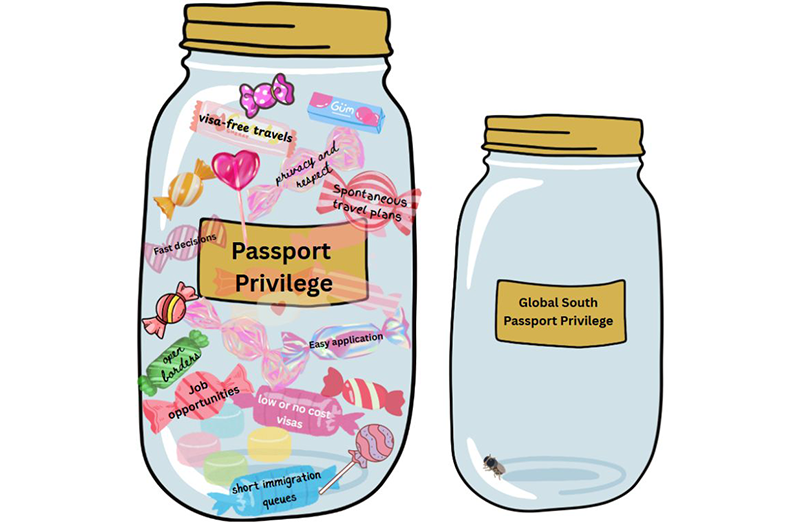
We are meant to use our passports as proof of residency and access to certain places whenever we travel. It is meant to be nothing more than a document used during local or international travel, whether for vacation, business, or personal reasons. However, the function and purpose of a passport have expanded beyond their simplistic origins. Instead, I now view passports as a marker of power, politics, and stratification. While our passports are not descriptors of who we are as individuals, they can sometimes lead to assumptions about our identities that people make without even knowing who we truly are. The freedom of mobility is often emphasised—until the topic of “the type of passport you have” comes up. I sometimes feel a degree of mistrust from people when they look at my passport because of the layers of scrutiny that often follow whenever I decide to travel.
As minuscule as it sounds, I decided to write on this topic because I believe the Global South, including Guyana, has been subjected to these perceptions for far too long. Have you ever scrolled through the list of countries the Global South can travel to versus the list of countries that allow entry without extra restrictions? I can assure you that the list of countries we can travel to is usually shorter than the list of countries that can visit us in return. Unfortunately, the cost is high for most Global South passport holders—from hefty visa fees and insurance to additional documentation. Apart from the financial cost, there are also emotional and mental effects.
I can recall wanting to apply to certain international conferences or forums in the past, but after seeing the cost or the process required to obtain a visa, I was deterred, sad, and disappointed. In certain cases, some Global North passport holders can freely choose to live or take up residency in countries they see fit without scrutiny or a hefty cost. Can we say the same?
There is a silence on this topic, and I hope it can be discussed further in this column as I continue to research it more thoroughly. While globalisation connects us, that does not necessarily imply equality. As I converse with people from the Global North, I realise that not everyone understands their privileges and disadvantages equally.
I am currently studying abroad, and even as a temporary resident in another country, my international friends could not fathom how difficult it is to move from one country to the next—especially if a visa is required. I realised our passports create a silent system of stratification among us. It is “silent” because it is not discussed or debated until the topic of freedom of mobility arises. Only then did I become aware of how “stuck” I am, even while studying abroad.
I intend to break that silence.
It’s a shame that these challenges still exist in a world that “celebrates” the strength of global communities, freedom to explore and travel, and the ability to seek refuge when necessary.