
– President Ali notes
– global shocks, disease threats underscore urgency at COSALFA 52
PRESIDENT, Dr Irfaan Ali has noted that the Caribbean and wider Latin American region must urgently strengthen animal-health systems as global instability and disease threats continue to expose vulnerabilities in food production and supply chains.
The Head of State made this known while delivering remarks at the opening of the 52nd Meeting of the South American Commission for the Fight against Foot-and-Mouth Disease (COSALFA), during which he stated that the region can no longer treat food security and animal health as aspirational goals but as matters of survival.
He stated that resilience has become even more vital in an era when external shocks can disrupt access to food and markets beyond shores here, as he pointed to the ongoing geopolitical tensions in parts of the world that have already affected global supply chains.
President Ali added that international shipping networks are facing disruptions, fertiliser supplies are tightening and grain shipments are being delayed, while livestock-trade logistics are becoming increasingly uncertain.
“For our region, which still imports far too much of what we consume, this is not a distant crisis. It is a present reality,” he said.
“Higher costs, delayed deliveries, and mounting food-insecurity risks are now daily challenges,” the president added.
Against this backdrop, Dr Ali stressed that strengthening animal-health systems is critical to building resilience, warning that a single outbreak of Foot-and-Mouth Disease (FMD) could have devastating consequences.
“We are acutely aware that a single outbreak of foot-and-mouth disease would devastate food security, rural livelihoods, and trade across Latin America and the Caribbean,” he said.
To this end, he stated that vigilance is not optional; it is survival.
However, he cautioned that vigilance alone is not enough and further urged countries to build systems that are “proactive, interconnected, and resilient to shocks, both biological and geopolitical.”
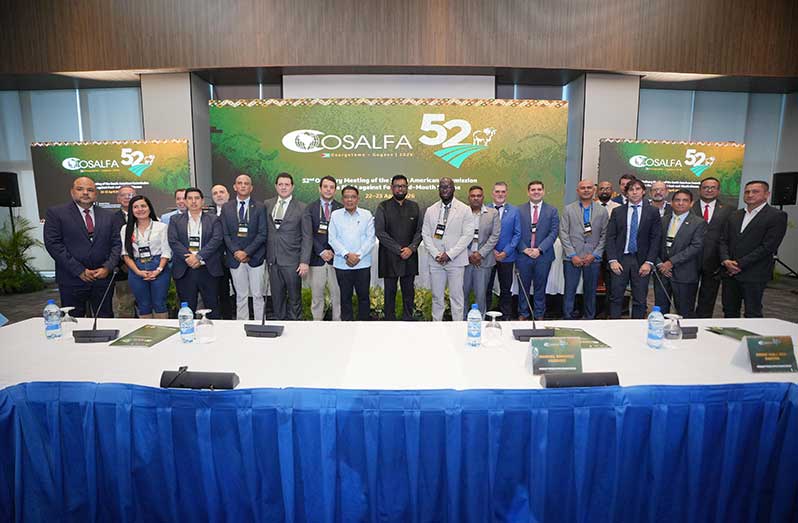
He went on to highlight Guyana’s position as one of the countries in the region designated free of FMD without vaccination, noting that it is a strategic advantage that strengthens food security, protects livestock industries, and opens export opportunities.
Additionally, Dr Ali said Guyana is pursuing an ambitious agenda to become a net exporter of safe, high-quality agricultural products, while contributing to CARICOM’s broader goal of reducing food imports among other things.
Meanwhile, Minister of Agriculture Zulfikar Mustapha too emphasised that while the region has made significant progress in controlling FMD, the risks remain high and require constant vigilance and stronger systems.
“The reality is this: the closer we get to full eradication, the higher the stakes become,” Mustapha said. “One breach, one lapse in cross-border coordination, one weakness in early detection can undo years of effort.”
He noted that COSALFA 52 comes at a critical juncture as countries prepare to transition from the 2021–2025 action plan to a new strategic framework for 2026–2030.
“This is not a routine meeting. It is a moment to sharpen our collective resolve,” the Agriculture Minister said.
He went on to add that the region must guard against complacency after decades of investment and progress.
Mustapha outlined Guyana’s ongoing efforts to strengthen its veterinary and surveillance systems, including expanding diagnostic capacity and improving national monitoring frameworks.
He said the meeting provides an opportunity for countries to deepen collaboration, accelerate the adoption of new technologies, and ensure that all states have the systems necessary to protect their livestock sub-sectors.
Adding to this, Director of the Pan African Foot-and-Mouth Disease and Veterinary Public Health Centre (PANAFTOSA), Manuel Sánchez, warned that while the Americas have maintained strong sanitary stability, the global risk environment is becoming more complex.
He stated that FMD continues to circulate in parts of Africa, the Middle East, and Asia, with outbreaks occurring in countries previously recognised as disease-free, further highlighting the persistent global threat.
While the Americas have not recorded intra-regional introductions since 2018, the director cautioned that the region’s risk profile is shifting, stressing that COSALFA remains critical for coordinated action, preparedness, and sustained vigilance.