







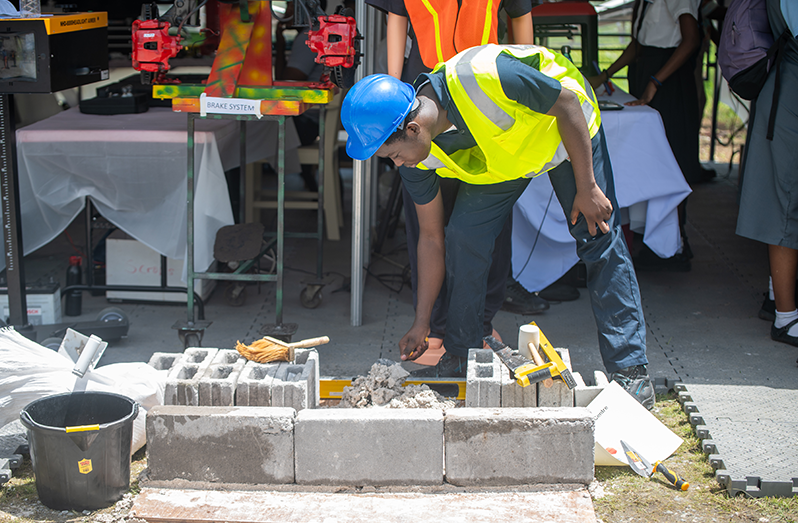
–CVQ, business training initiatives boosting skills, entrepreneurship
SINCE 2020, Guyana’s education system has expanded opportunities for students to earn the Caribbean Vocational Qualification (CVQ), as part of a broader push to strengthen Technical and Vocational Education and Training (TVET).
Digital Media Coordinator at the Ministry of Education Shane Marks said TVET is not just another subject, but a key pillar in the government’s investment in people, skills and the country’s future.
“These are not just random programmes; they are skills connected to real industries, real jobs, and real opportunities,” Marks said in a recent update on TVET.
He explained that programmes are tailored to reflect the economic realities of each region, ensuring that training aligns with local demand rather than offering a one-size-fits-all approach.
“So, when we talk about TVET, we are really talking about a national investment in relevance, equity and opportunity; education that prepares people to work, create, earn, and contribute to national development,” he said.
Students can access training in a wide range of fields, including furniture making, electrical installation, commercial food preparation, crop production, masonry, plumbing, small engine repairs, and motor vehicle systems.
At the Guyana Industrial Training Centre (GITC), welding student Akeelah Vancooten said TVET is opening doors for young people who may be uncertain about their career paths.
She noted that acquiring technical skills allows individuals to become financially independent, whether through employment or entrepreneurship.
Meanwhile, efforts are being made to bridge the gap between skills training and business development.
Last week, 30 learners at the GITC began a specialised course aimed at transforming technical skills into viable business ventures.
The initiative, a joint effort between the Ministry of Education and the Small Business Bureau (SBB), is designed to equip students with the tools needed to transition from skilled tradespeople to business owners.
Upon completion, participants will receive SBB certification, and may qualify for grants of up to $400,000 to support the establishment or expansion of their businesses.
The programme is expected to extend beyond the GITC to other institutions, including the University of Guyana, the Board of Industrial Training, and technical institutes in Essequibo, New Amsterdam, Linden, and Leonora.
Under the National TVET Policy 2025–2035, Guyana is aligning vocational training with high-growth sectors such as oil and gas, climate-resilient agriculture, hospitality, and digital technology.
The expanded framework aims to move students beyond skills acquisition and into entrepreneurship and job creation, strengthening the country’s workforce and economic resilience.



