–chat group created to update stakeholders on progress of the project
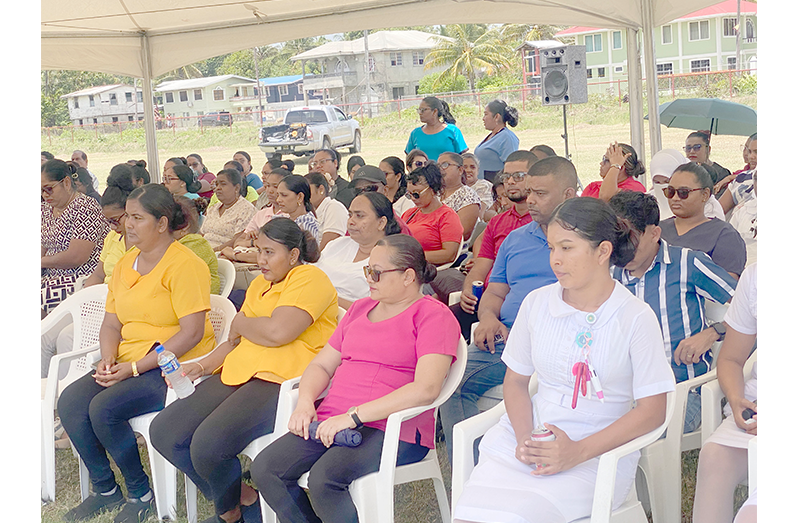
CONSULTATIONS have officially commenced for the construction of a new Suddie Primary School in Region Two (Pomeroon-Supenaam), with educators, parents and community leaders welcoming the long-awaited project and its special modern features.
The consultation was held on Friday, April 17, and marks the first phase of the project before it advances to the design stage. The consultation was spearheaded by the Ministry of Education and the Regional Democratic Council Region Two.
The engagement shared details of the project, gathered community feedback and addressed social and environmental concerns.
The proposed Suddie Primary School will be located at Onderneeming, close to the New Opportunity Corps, and will feature smart classrooms, modern recreational spaces, upgraded sanitation facilities, and improved environmental safeguards.
One of the major highlights of the proposed school is that it will be equipped with smart classrooms and built in accordance with the Ministry of Education’s new non-academic standards.
These standards focus on ensuring adequate space for recreation, storage, security, teaching areas and other facilities needed to create a modern learning environment.
Coordinator within the Ministry of Education managing the IDB-funded Support to Education Recovery Project, Patrick John, said the new school will be significantly different from the current facility.
“The school will look different. The ministry’s non-academic standards document outlines what is required for recreation, storage, security and teaching spaces,” John said.
He related that the new institution will also include proper garbage disposal, improved washrooms, adequate storage areas, modern electrical systems and wider open spaces for physical education and other activities.
The project will be funded through a US$90 million loan from the Inter-American Development Bank and forms part of a wider programme aimed at improving human capital through better educational facilities.
John said there are plans to construct six new schools in Regions One, Two, Four, Five and Six, while 19 schools will also be rehabilitated across Guyana.
Education officials said the location was selected because of overcrowding at the current school and the need to better serve surrounding communities. Although a 13-acre plot was identified, only five acres will be used for the construction.
Headteacher Denis Ombrella expressed strong support for the project, while senior educator Venetia Obermuller highlighted the many challenges currently facing the existing school.
Obermuller said the existing building is overcrowded, outdated and no longer able to properly accommodate students and staff.
“The building is cramped and outdated. There is too much noise and limited space,” the senior educator.
She related that the school currently has 12 classes, forcing the library to be used as an additional classroom.
The sick bay has been converted into a storage area, while the auditorium is too small to meet the school’s needs. The washroom facilities are faulty, there is no proper garbage disposal system, and the electrical system is overloaded.
The school also lacks adequate space for physical education.
“The physical space does not cater for physical education. The new location will ease these challenges,” she added.
John assured those present that these shortcomings are being addressed in the design of the new school.
Regional Education Officer Shondelle Hercules described the project as a long-awaited step towards providing a modern learning institution for the area. She noted that Suddie Primary School currently has an enrolment of 245 students, comprising 127 boys and 118 girls, along with 35 teachers, 26 of whom are trained.
She said the project will not only benefit Suddie but the wider Region Two community.
Region Two Vice Chairman Humace Oodit stressed the importance of consultation and stakeholder involvement in the process.
“It is important that teachers, parents and all stakeholders are involved so they can take ownership and be proud of having a brand-new school coming to Suddie,” Oodit said.
He noted that the current school site has become too limited for the growing population and that additional space and facilities are urgently needed.
Environmental considerations also formed a major part of the discussion. Project Director Khalid Alladin said that the project will follow the environmental and social standards of the Inter-American Development Bank (IDB). These include measures for pollution control, biodiversity protection, waste management and continued stakeholder engagement.
A WhatsApp group has also been created to keep residents updated on the progress of the project.
Parents and teachers attending the meeting warmly welcomed the plans and thanked the Ministry of Education for considering Region Two.
“We are so grateful for this project,” said Chairperson of the Suddie PTA, Amanda Jeffrey.
The consultation was attended by Regional Executive Officer Susan Saywack and Regional Engineer.